
Beyond Charge: How Band Symmetry Dictates Doping in PbTe and SnTe
Bi, Cr and Ag dopants in PbTe and SnTe: impact of the host band symmetry on doping properties by ab initio calculations
This study investigates the electronic properties of Bi, Ag, and Cr dopants and cation vacancies in PbTe and SnTe using ab initio DFT calculations with a large supercell approach. The research reveals that while Bi acts as a donor and Ag as an acceptor in both hosts, Cr behaves as a resonant donor in PbTe but a resonant acceptor in SnTe, achieving SOTA-level theoretical consistency with experimental observations.
TL;DR
In the world of IV-VI semiconductors, not all hosts are created equal. This paper demonstrates that the electrical activity of impurities like Chromium (Cr) and Bismuth (Bi) in PbTe and SnTe isn't just about electron counting—it's about "symmetry matching." By using large-scale DFT calculations, the authors show that host band parity (the mathematical symmetry of the wavefunctions) is the hidden hand determining whether a dopant becomes a donor, an acceptor, or a resonant state.
Background: The Mirror World of IV-VI Semiconductors
PbTe and SnTe are the "rock stars" of thermoelectrics and topological physics. While they share the same crystal structure, they sit on opposite sides of a topological divide. In PbTe, the conduction band is "odd" (L-6) and the valence band is "even" (L+6). In SnTe, they swap—a phenomenon known as band inversion.
The core question the authors tackle is: How does this swap affect the way the host "feels" a dopant?
The Symmetry Insight: Why Parity Matters
Most textbooks teach doping using the Effective Mass Approximation (EMA), treating the dopant as a hydrogen-like atom. The authors argue this is insufficient for IV-VI materials. Instead, they propose a Hybridization Model based on Group Theory:
- Bismuth (Bi): Its 6p orbitals are odd. In PbTe, they hybridize with the odd-parity conduction band, pushing Bi states into the gap as a donor. In SnTe, they interact with the valence band.
- Chromium & Silver (Cr/Ag): Their s and d orbitals are even. They selectively "talk" to the even-parity host bands (L+6).
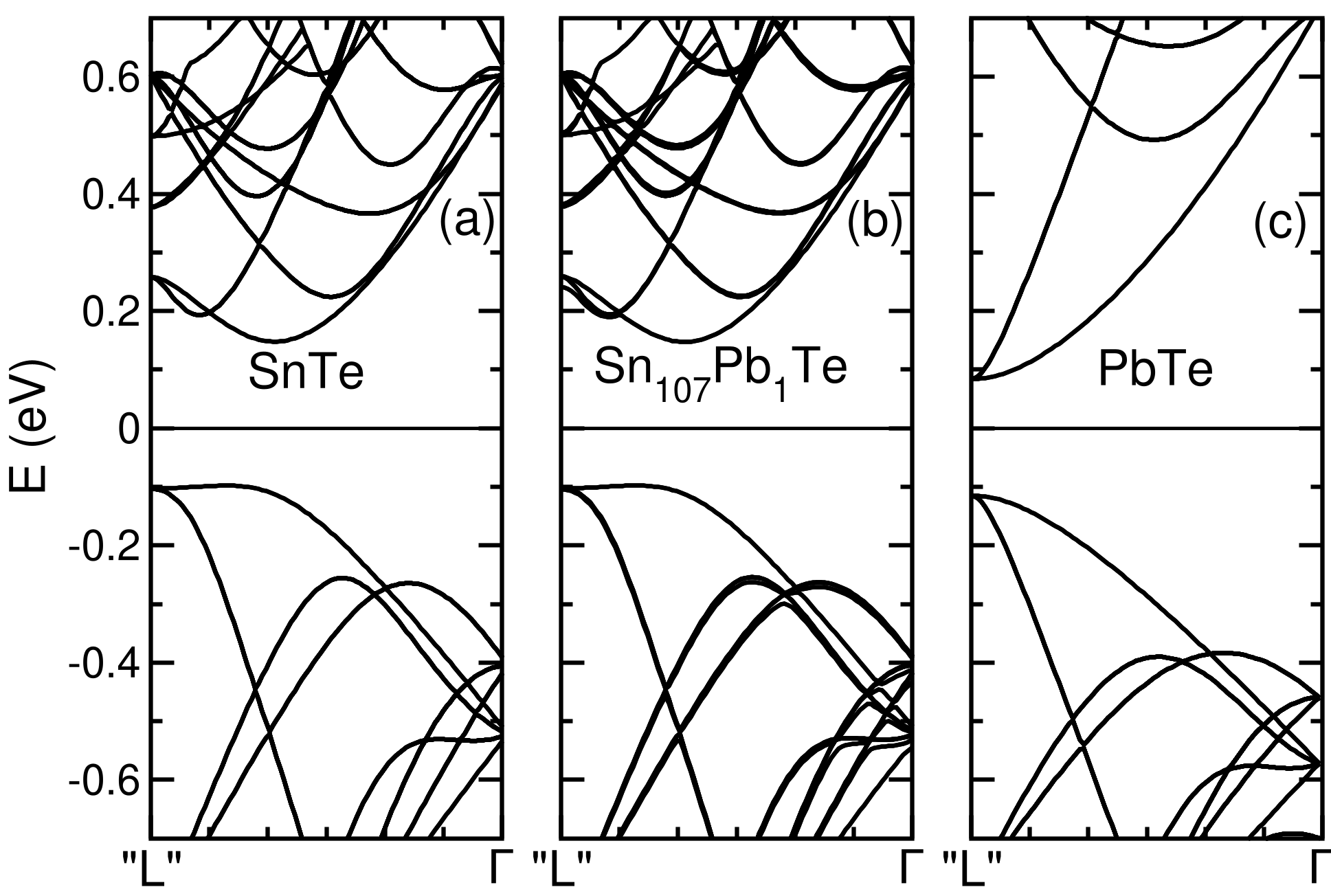 Figure 1: Comparison of unperturbed band structures. Note the subtle shifts in SnTe's VBM compared to PbTe.
Methodology: High-Fidelity Simulations
To capture these effects, the researchers used:
- Large Supercells (216 atoms): This prevents artificial interaction between dopants across periodic boundaries, better simulating isolated impurities.
- Fully Relativistic DFT: Essential for Lead (Pb) and Bismuth (Bi), where spin-orbit coupling is so strong it practically defines the band gap.
- Local Density Approximation (LDA): Tuned to match experimental band gaps, providing a reliable baseline for defect energy levels.
Key Findings: The Cr Conundrum
One of the most striking results is the behavior of Chromium.
- In PbTe: Cr acts as a resonant donor. Its e2-derived spin-up band sits right at the bottom of the conduction band.
- In SnTe: Cr flips to a resonant acceptor.
This shift is directly linked to the band inversion. Because the symmetry of the band edges swaps, the "energy anchor" for the Cr d-orbitals moves relative to the Fermi level.
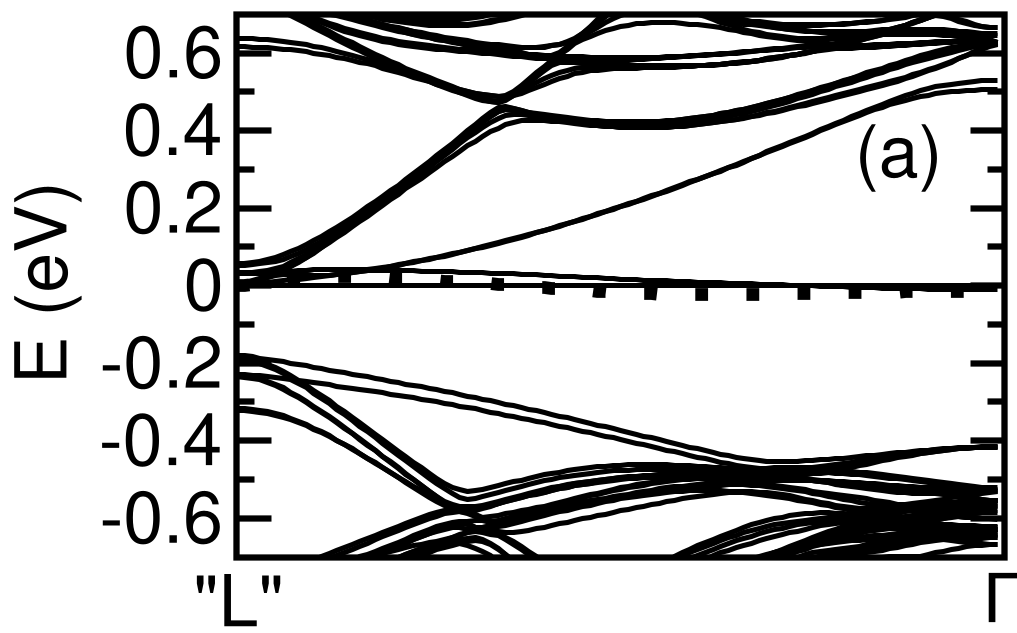 Figure 2: The Calculated DOS and band structures for Transition Metal dopants, highlighting the spin-splitting and resonant levels.
Deep Insight: The Native Defect Struggle
The paper also addresses the "elephant in the room" for SnTe: Cation Vacancies. SnTe is virtually impossible to make n-type because it is "born" with massive amounts of Sn vacancies that act as double acceptors. The authors' calculations show that these vacancies create resonant acceptor states deep in the valence band, explaining why hole concentrations in SnTe are so stubbornly high ().
Critical Analysis & Conclusion
This work moves the field beyond empirical "trial and error" doping. By focusing on wavefunction parity, it provides a predictive framework for selecting dopants in topological crystalline insulators.
Takeaway: If you want to engineer the next peak-performance thermoelectric material, don't just look at the energy levels of the dopant; look at the symmetry of its orbitals relative to the host's band edges.
Limitations: While the LDA+SO approach is robust, the authors acknowledge that exchange-correlation functionals can slightly shift absolute energy values. Future work involving GW approximations or hybrid functionals might refine the exact energy positions of resonant levels even further.