
The Ghost in the Machine: Decoding Biases in Generative Art through Art History
Biases in Generative Art -- A Causal Look from the Lens of Art History
This paper presents a critical investigation into ethical and socio-cultural biases within AI generative art pipelines, specifically focusing on style transfer and portrait generation. By integrating art history with Structural Causal Models (SCMs), the authors identify systematic failures in current SOTA models (like CycleGAN and ArtGAN) to capture the true intent, historical context, and diverse identities inherent in art.
TL;DR
Generative AI is currently acting like a "tourist with a phrasebook"—it can repeat the brushstrokes of Van Gogh but doesn't understand the sunlight. This paper argues that the biases we see in AI art (like skin lightening or historical inaccuracy) aren't just data errors; they are fundamental failures in how we mathematically define "artistic style." By using Structural Causal Models (SCMs), the authors prove that current AI lacks the "causal lens" of art history, leading to cultural stereotyping.
Problem & Motivation: The Poverty of Correlation
In the world of Computer Vision, "style" is often reduced to a Gram matrix—a statistical fingerprint of texture and color. However, art history teaches us that style is a causal outcome of intent, emotion, and socio-political context.
The authors highlight a jarring example: an AI-generated "Van Gogh" rendition of a photo (via CycleGAN) replaced vibrant red flowers with dry, muted tones. To a human art historian, this is a "hallucination" of the worst kind—it contradicts Van Gogh’s documented letters where he described using bright contrasting colors to "infuse life" into his work. This is Confounding Bias: the AI misses the unobserved variable (the artist’s emotion) and produces a biased, stereotypical output.
Methodology: High-Level Causal Mapping
The paper introduces Structural Causal Models (SCMs) to map out why AI fails. Instead of treating an image as a flat vector, they represent the creation process as a Directed Acyclic Graph (DAG).
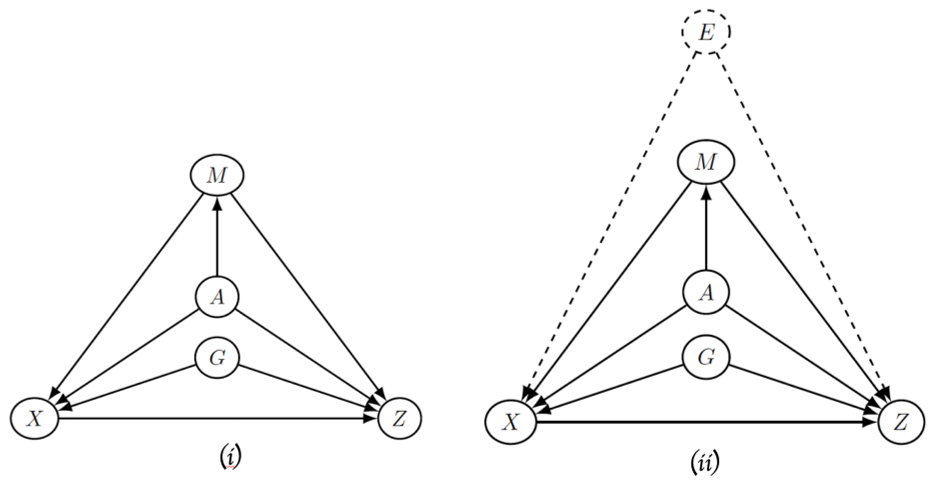
In this model:
- X (Artist) and Z (Artwork) are influenced by A (Art Movement), G (Genre), and M (Material).
- If a model (like ArtGAN) only learns from a subset (e.g., only looking at Gustave Doré's engravings and ignoring his colorful paintings), it suffers from Selection Bias.
- The causal link from X to Z is "blocked" by these unobserved factors, making it impossible for a standard GAN to truly capture an artist's essence.
Case Studies: Beyond the Surface
The paper provides a series of "post-mortems" on popular AI apps:
1. Transportability Bias (The Gender/Era Mismatch)
In Case Study 8, the authors tested a gender-swap tool on Renaissance portraits. The AI failed to recognize that men in the Renaissance often wore long hair. Consequently, it mistook male portraits for females, revealing that the model's understanding of "gender" was limited to modern western grooming standards—a classic Transportability Bias.
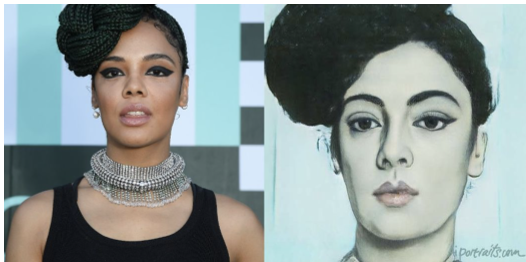
2. Selection Bias (The AIportraits Controversy)
The "AIportraits" app, trained primarily on 45,000 Renaissance portraits, essentially "whitewashed" people of color. Because the training data was not representative of global skin tones, the model's latent space was structurally biased toward Eurocentric features.
3. Kinetic vs. Static (Cubism vs. Futurism)
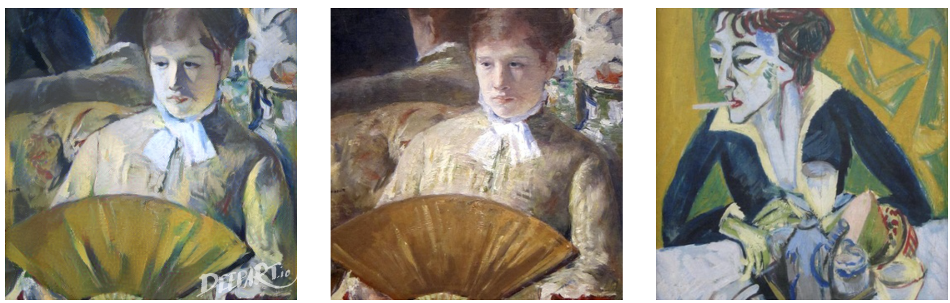
When transferring a Cubist image into a "Futurist" style, the AI managed to change colors but failed to introduce movement (kinetics), which is the defining causal feature of Futurism. This proves that AI doesn't understand the philosophy of the movement, only its palette.
Critical Insight & Conclusion
The fundamental takeaway is that Generative Art is an ethical act. When we use AI to "color" history or "transfer" styles, we risk creating a distorted version of our cultural heritage.
Limitations & Future Work
- Data Scarcity: The authors admit that Ukiyo-e was the only non-Western style studied due to the lack of available AI applications for other global art forms.
- Quantifying the Intangible: While SCMs provide a framework, quantifying "emotion" or "intent" for a loss function remains an open, massive challenge.
The paper concludes with a call for Interdisciplinary Accountability. We must stop evaluating AI art solely through "user studies" (which often suffer from automation bias) and start involving art historians and social scientists in the loop of model design.