
Mapping the Evolution of Agrarian Expertise: A Graph-Based Deep Dive into Farmer Cultivation
Bibliometric and Graph Analysis in Document Data Mining Based on the Cultivation of New Type Professional Farmers
This paper presents a multi-dimensional bibliometric and social network analysis of research concerning the cultivation of "new-type professional farmers" in China. Using a combination of CiteSpace, Gephi, and UCINET, the study maps the evolution of the field from 2006 to 2019, identifying key research hotspots and emerging trends.
TL;DR
This study moves beyond standard qualitative reviews by utilizing a powerful "analysis trio" (CiteSpace + Gephi + UCINET) to map the intellectual landscape of China's "New-type Professional Farmer" cultivation. It identifies a transition from basic training to complex "Internet+" models while pinpointing a strategic neglect of information security literacy.
Problem & Motivation: Beyond the Qualitative Surface
Since the 2012 "No. 1 Central Document," the professionalization of farmers has been at the heart of China’s agricultural modernization. However, scholarly reviews of this field have historically been descriptive and fragmented. The authors argue that simply listing "what" is being researched is insufficient. To understand the "how" and "where to next," we need to visualize the underlying social network of academic discourse.
The motivation was to solve the "Tool Silo" problem—where researchers use CiteSpace for simple mapping but miss the quantitative structural metrics (like Betweenness Centrality and CONCOR clustering) that social network analysis (SNA) software provides.
Methodology: The "Analysis Trio" Pipeline
The authors implemented a sophisticated technical workflow to process data from the CNKI database (2006–2019):
- CiteSpace: Used for initial co-word matrix extraction and time-series mapping.
- Excel/VBA: A custom script was used to reverse-calculate the CiteSpace cosine-normalized matrix back into an original frequency matrix, a critical step for accurate SNA.
- Gephi: Employed for its high-performance layout algorithms to visualize the "Co-word Network Map."
- UCINET: The heavy lifter for quantitative structural metrics, including density measurement and Core-Edge analysis.
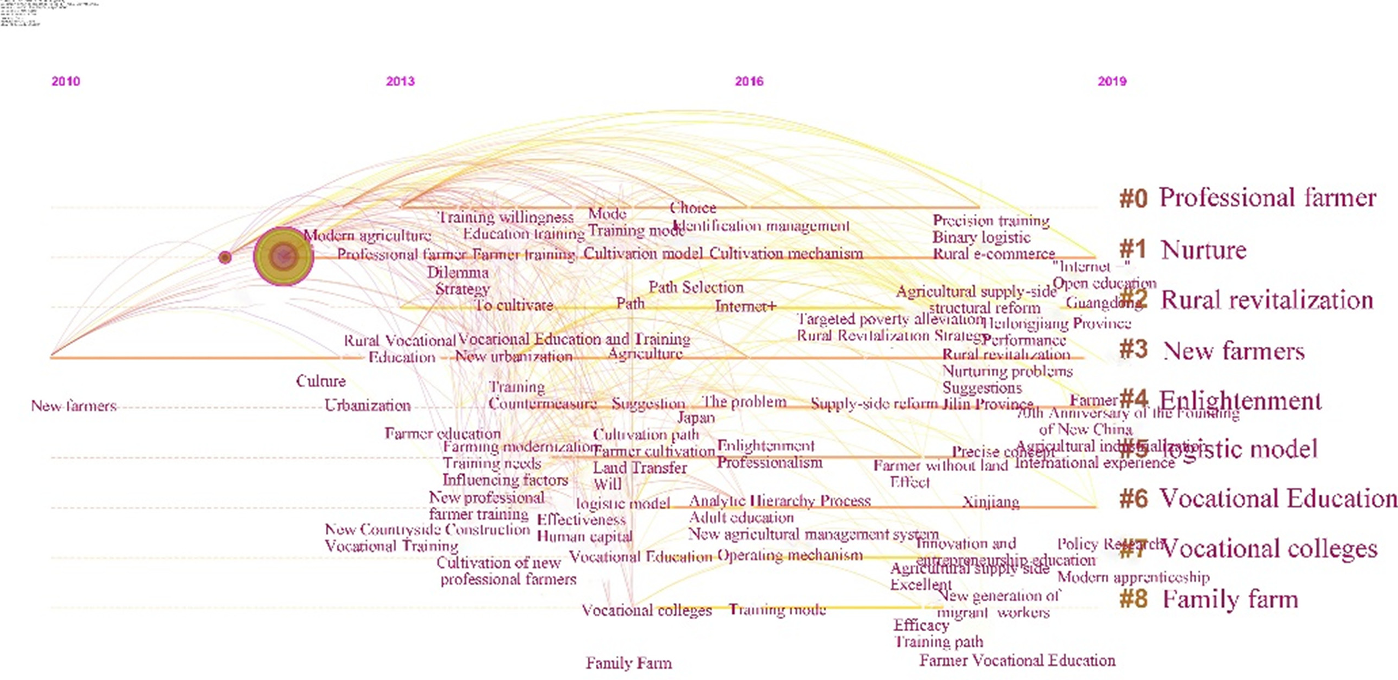 Figure 1: The temporal evolution of keywords shows the shift from basic cultivation (pre-2012) to diversified topics like Rural Revitalization (post-2012).
Experiments & Results: The Scattered Frontier
The study found a network density of 0.2691, which—in the world of academic discourse—indicates a relatively scattered research field. While the "core" is occupied by staples like "Modern Agriculture" and "Vocational Education," the "periphery" contains the true growth signals.
The Core-Periphery Insights
By applying Betweenness Centrality, the authors identified keywords that act as "bridges" between different research sub-fields.
| Keywords | Betweenness Centrality | Eigenvector Centrality |
|---|---|---|
| Professional Farmer | 17.951 | 42.293 |
| Modernization | 7.246 | 29.053 |
| Rural Revitalization | 5.571 | 24.362 |
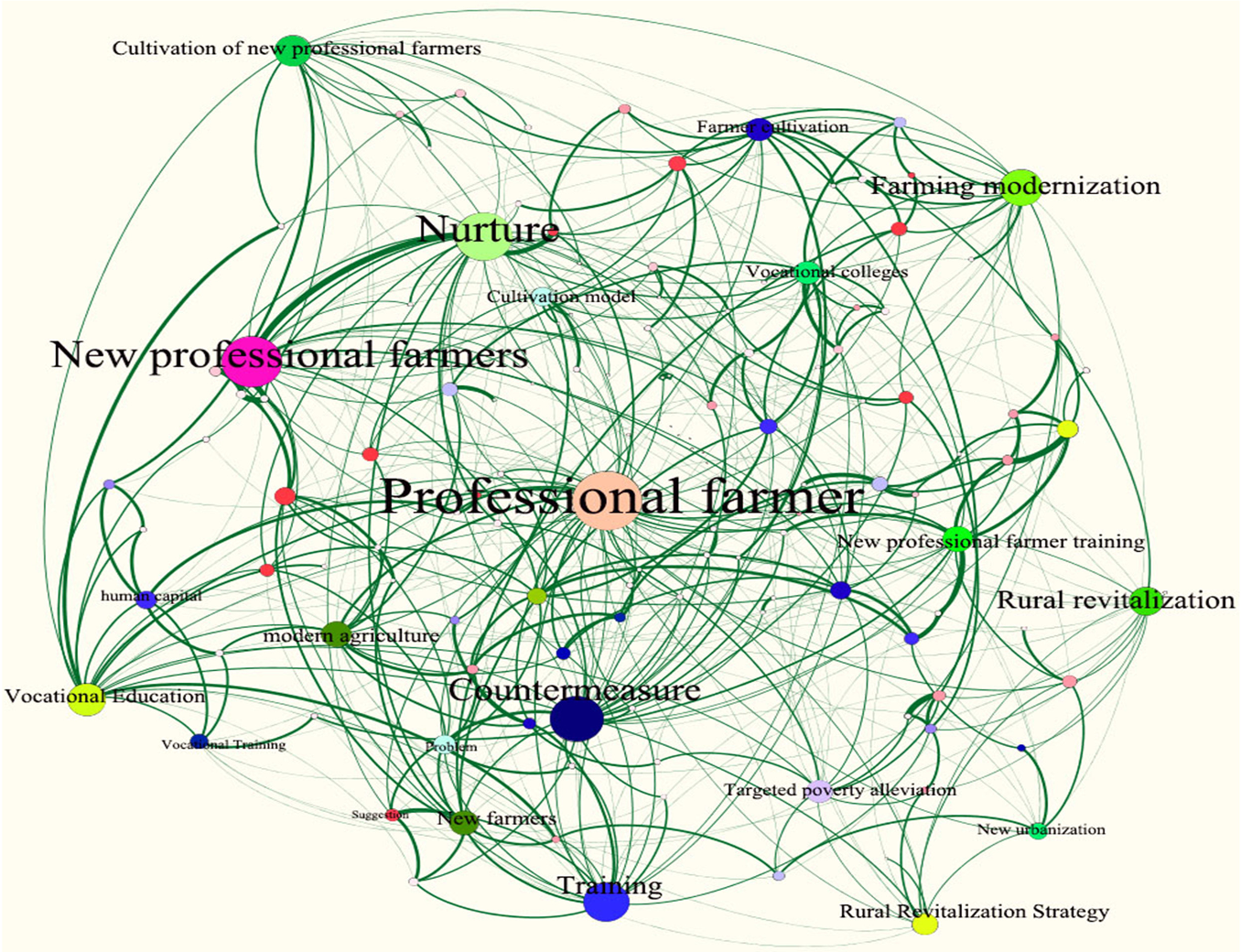 Figure 2: The Gephi-generated network illustrates the high centrality of "Professional Farmers" while revealing a sparse, decentralized periphery.
Clustering and Trend Detection
Using CONCOR (Convergence of Iterated Correlations), the study grouped 19 marginal words into four emerging themes:
- Cultivation Model Exploration
- Mechanism Reform
- Policy Support
- Demand Change
Strategic Insight: The Missing Link (Information Security)
The most striking discovery from this data-mining exercise is the Information Literacy Gap. While "Internet+" and "Micro-classes" are appearing in the literature, there is almost zero mention of Information Security Literacy for farmers. As agricultural transactions move online, the lack of security training creates a vulnerability in the modernization chain.
Conclusion & Future Outlook
This work demonstrates that bibliometrics is not just about counting citations; it's about identifying the "white space" in a field.
- Takeaway: Future research must shift from "case-by-case" descriptive analysis to predictive, quantitative modeling (like the Logistic models identified in the periphery).
- Limitation: The dataset ends in 2019, missing the massive digital acceleration of the 2020-2022 period.
- The Future: We expect a surge in "Modern Apprenticeship" and "Information Security" keywords in the next generation of agricultural literature.