
B-CSE: Revolutionizing Customer Satisfaction through Big Data and Hadoop
Design of Customer Satisfaction Evaluation System Based on Big Data
This paper presents a Customer Satisfaction Evaluation (CSE) system leveraged by big data technology and the Hadoop ecosystem. By integrating traditional questionnaires with call center business data, web crawlers, and IoT hardware metrics, the system provides a multi-dimensional, objective framework for measuring customer loyalty across various industries.
TL;DR
Customer satisfaction measurement is evolving from biased, small-scale surveys to objective, massive-scale data analytics. This paper introduces a Big Data Customer Satisfaction Evaluation (B-CSE) system that integrates call center logs, web crawlers, and IoT data into a unified Hadoop-based framework. It bridges the gap between what customers say in surveys and what they actually feel as expressed through their behaviors and social sentiment.
Background & Positioning
In the competitive landscape of the 2020s, customers are an enterprise's most scarce resource. While models like the American Customer Satisfaction Index (ACSI) have existed since 1996, they traditionally lack the technical infrastructure to handle the velocity and variety of modern data. This paper positions itself as a structural bridge, moving traditional satisfaction theories into the Big Data Era.
The Core Motivation: Moving Beyond Subjectivity
The authors identify a critical "distortion" in existing survey-based models:
- Small Sample Size: Questionnaires capture a fraction of the user base.
- Subjective Bias: Respondents often fill out surveys out of habit or extreme (negative or positive) bias, missing the "silent majority."
- Static Nature: Traditional surveys are snapshots in time; they cannot reflect the dynamic shifts in real-time service quality.
Methodology: The 6-Layer Architecture
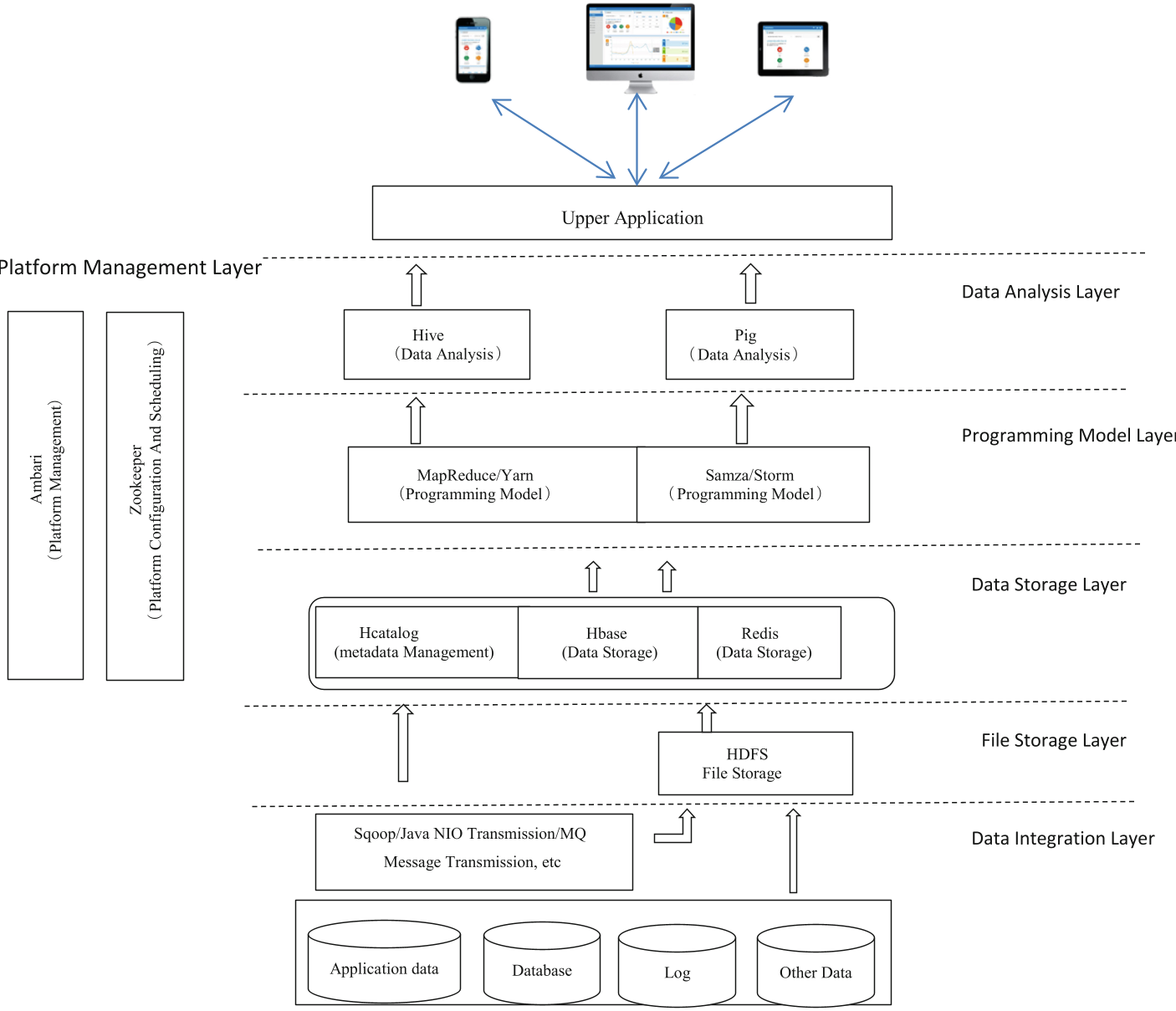
The proposed B-CSE system is not just a model but a complete technical stack. It is built on a Cloud Computing + Hadoop platform to handle the storage and processing of heterogeneous data.
Technical Framework
The architecture is partitioned into six distinct layers:
- Data Integration Layer: Ingests data from call centers, crawlers, and hardware.
- Data Analysis & Programming Model Layers: Utilizes Hadoop and J2EE/PHP environments for processing.
- Application Layer: Serves front-end clients (App, Mini-programs, H5).
Big Data Mining Logic
The "secret sauce" of this system is how it converts raw data into a "Satisfaction Score":
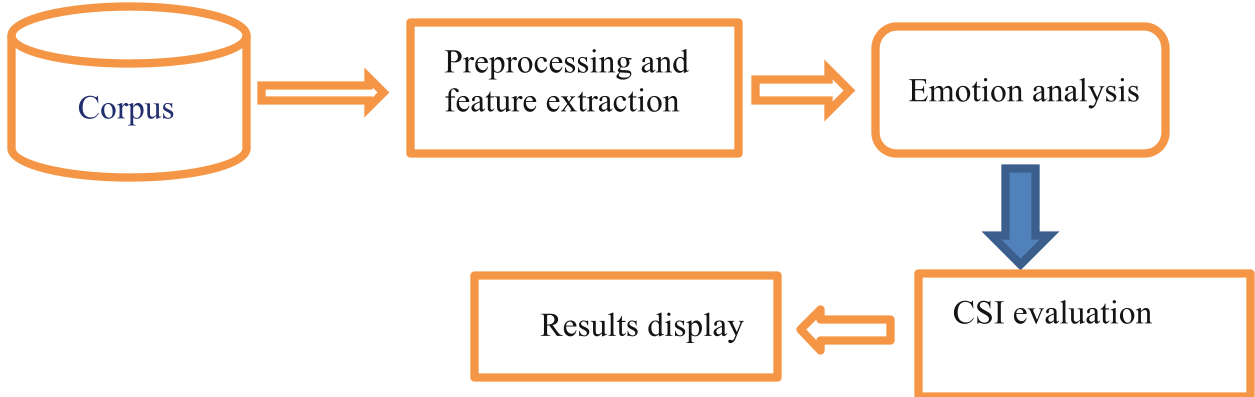
- Sentiment Analysis: Using web crawlers to scrape external product comments, the system performs text mining to categorize emotions.
- Mapping Matrix: Call center business data (e.g., call duration, resolution rate) is mapped through a conversion matrix to objectively rank satisfaction.
- Biometric Feedback: Indirectly capturing satisfaction through IoT hardware (e.g., heart rate or usage logs from wearables).
Experiments & Functional Map
The system's functional map ensures that evaluation leads to action. Beyond just "Data Collection" and "Evaluation," it includes a Satisfaction Promotion module—a feedback loop designed to track the implementation of improvement schemes.
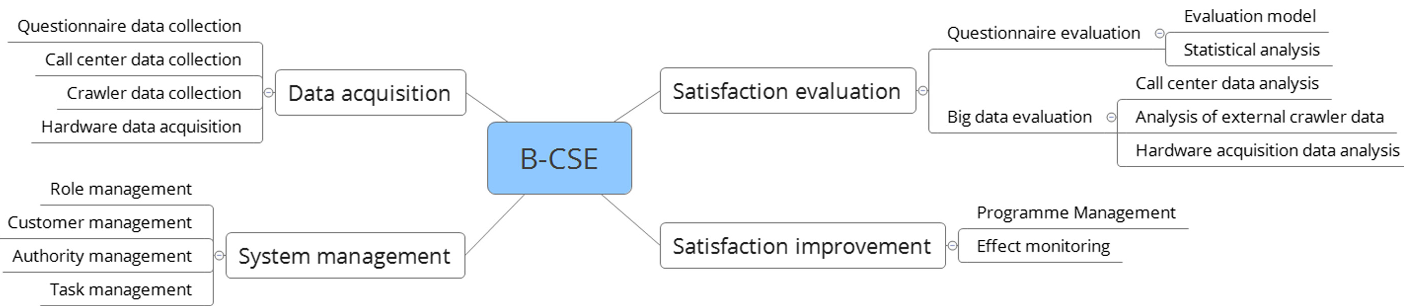
By utilizing the American ACSI and Swedish SCSB models as theoretical foundations, the B-CSE system ensures that its quantitative outputs are grounded in established marketing science, while its data ingestion remains modern and scalable.
Critical Insight & Conclusion
Takeaway
The shift from qualitative literature reviews to quantitative big data architectures allows enterprises to reduce measurement costs while increasing the "freshness" of their customer insights. The integration of "Intelligent Hardware" is particularly forward-thinking, suggesting a future where satisfaction is measured via physiological or environmental sensors rather than just text.
Limitations
While the paper outlines a robust architecture, it lacks a detailed statistical breakdown of the Sentiment Analysis accuracy or a comparison of the Hadoop cluster's performance versus traditional SQL databases in this specific context.
Future Outlook
As AI and Large Language Models (LLMs) evolve, the "Text Mining" portion of this system could be vastly improved, allowing the B-CSE system to understand nuance and sarcasm in customer reviews with clinical precision.