
Big Data for Active Situation Awareness: Bridging the Gap Between Perception and Cognition
Big Data Infrastructure for Active Situation Awareness on Social Network Services
This paper proposes a big data infrastructure for Active Situation Awareness (ASA) targeting Social Network Services (SNS). By integrating a three-layered awareness architecture with a Hadoop-based distributed computing engine, the authors achieve efficient feature extraction and pattern recognition on large-scale social data.
TL;DR
This research addresses the challenge of making sense of the massive, chaotic data streams produced by Social Network Services (SNS). The authors propose an Active Situation Awareness (ASA) framework that utilizes a Hadoop-based Big Data infrastructure to power the perception of social relations. By implementing a three-stage MapReduce TF-IDF algorithm, the system can efficiently turn raw social data into meaningful feature vectors for high-level reasoning.
The Motivation: Moving from Passive to Active Awareness
Situation Awareness (SA) is traditionally defined as a three-tier pyramid: Perception (noticing data), Comprehension (understanding the current state), and Projection (predicting future states).
Previous works focused heavily on the top of the pyramid—using ontologies (like SAW Core) and reasoning rules (like SWRL). However, these systems often failed when faced with "Big Data." They were too slow at the "Perception" stage. The authors argue that for a system to be "Active," it must ingest and process massive datasets (e.g., Facebook events, interest changes) in real-time to provide immediate insights.
Methodology: The Big Data Backbone
The core innovation lies in the integration of a distributed manipulation engine directly into the SA architecture. Instead of treating data mining as a separate pre-processing step, it is embedded as a "Web Service" layer that feeds the perception engine.
The 3-Stage MapReduce TF-IDF
To identify what a social media user is interested in (their "feature vector"), the authors optimized the TF-IDF (Term Frequency-Inverse Document Frequency) calculation for a distributed environment:
- Stage 1: Counts word occurrences within specific documents.
- Stage 2: Calculates the relative frequency of words within those documents.
- Stage 3: Computes the global importance of words across the entire dataset to determine the final TF-IDF value.
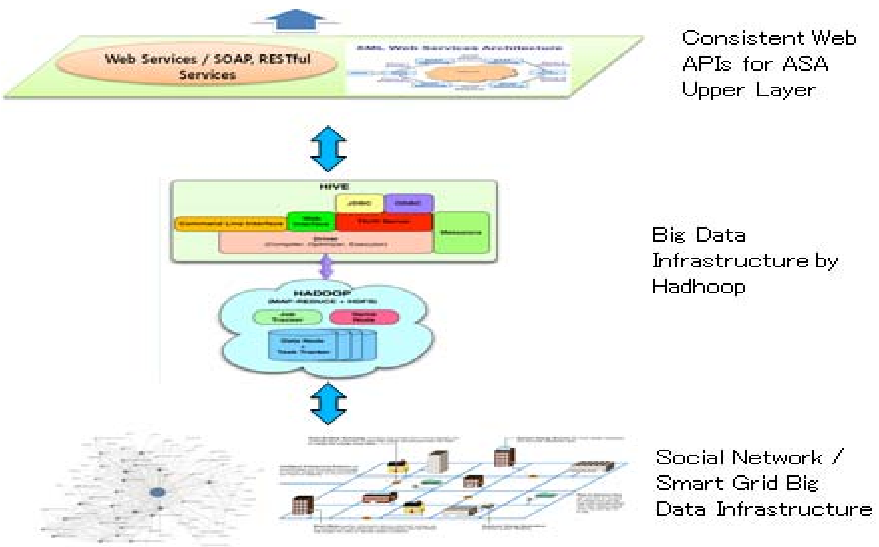
The architecture above illustrates how the Hadoop infrastructure sits beneath the Service layer, providing the raw computational power needed for situational perception.
Experiments & Results
To validate their approach, the researchers simulated 5GB of SNS data. They compared the performance of TF-IDF calculations across different node configurations.
The experimental results confirmed a linear scaling property: as nodes were added to the cluster, the time cost fell sharply. This proves that the bottleneck of "Perception" in situation awareness can be overcome by leveraging distributed horizontal scaling.
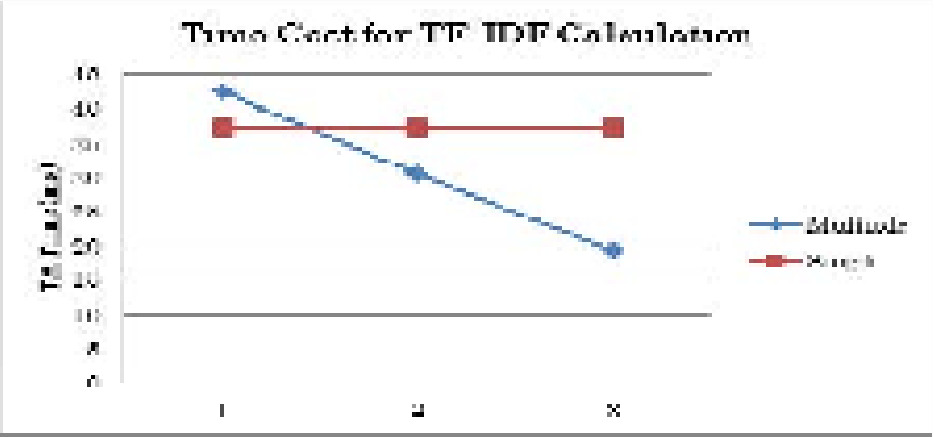
The graph highlights the dramatic reduction in processing time when moving from a single environment to a distributed Hadoop cluster.
Critical Analysis & Conclusion
This paper serves as a bridge between the "Semantic Web" era of Situation Awareness and the "Big Data" era. While the use of TF-IDF and Hadoop might seem foundational by modern standards, the architectural insight—positioning a distributed engine as a first-class citizen in the SA pyramid—is critical for modern AI applications.
Limitations: The paper focuses primarily on text-based perception via TF-IDF. Modern situational awareness also requires handling multi-modal data (images, video) and complex graph relations which might necessitate moving beyond Hadoop to frameworks like Apache Spark or Flink for lower latency.
Future Outlook: We expect future "Active Situation Awareness" systems to replace manual ontologies with Large Language Models (LLMs) while maintaining this paper's core philosophy: robust, distributed infrastructure is the only way to support real-time human-like cognition at scale.