
Beyond Traditional Econometrics: Forecasting Thailand’s Economic Cycle with Machine Learning
Big Data and Machine Learning for Economic Cycle Prediction: Application of Thailand’s Economy
This paper presents a machine learning-based framework for predicting Thailand's economic cycles by integrating "Big Data" from diverse sources like Google Trends and the World Bank. The authors evaluate three algorithms—k-Nearest Neighbors (kNN), Support Vector Machines (SVM), and Random Forest (RF)—to forecast GDP growth trajectories, with Random Forest emerging as the SOTA approach for this specific macroeconomic context.
TL;DR
This study challenges the dominance of traditional parametric econometrics by applying Machine Learning (ML) to "Big Data" for predicting Thailand's economic cycles. By processing 29 diverse indicators—ranging from GDP growth to YouTube search trends—the researchers found that Random Forest provides the most accurate "sensibility" for forecasting transitions between economic peaks and recessions, accurately predicting a high-growth period for Thailand in late 2018.
Contextual Positioning
In the world of central banking and fiscal policy, accuracy is paramount. However, traditional models often rely on the ceteris paribus (all else being equal) assumption, which fails during periods of high volatility. This paper shifts the paradigm from "assumption-heavy" models to "data-driven" AI, positioning itself as a practical bridge between computer science and social science.
Problem & Motivation: The Failure of Parametric Assumptions
Traditional econometrics often struggles with "Big Data" because it isn't just about volume; it's about variety and velocity. The authors argue that fixed-variable estimations used by central banks are inherently limited.
The core insight here is that economic movements are now deeply intertwined with social movements and digital behaviors. To capture this, we need models that don't just look at historical GDP numbers but also at what people are searching for on Google or discussing on social media.
Methodology: The Machine Learning Trio
The researchers compared three robust non-parametric algorithms:
- k-Nearest Neighbors (kNN): Using Euclidean distance to classify economic states based on historical proximity.
- Support Vector Machines (SVM): Finding the optimal hyperplane (maximal margin) to segregate economic "Peak" from "Recession."
- Random Forest (RF): Utilizing an ensemble of decision trees to minimize entropy and maximize information gain.
Newton's Method for Data Linearization
Before running the ML models, the authors employed Newton’s Method to find the "optimal value" of GDP growth (3.55%), which served as the baseline to categorize the economic cycle into four stages: Peak, Expansion, Recession, and Fall.
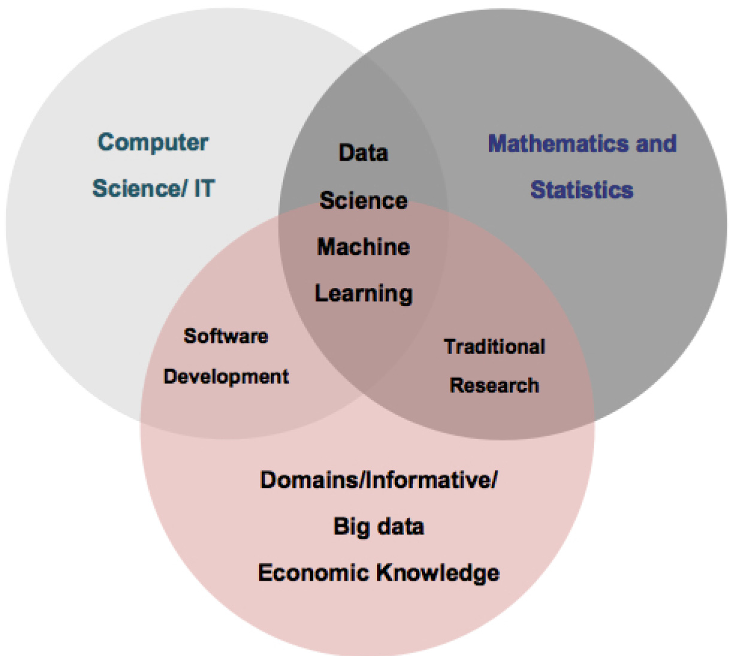 Figure 1: The intersection of Mathematics, Statistics, and Computer Science in Big Data analysis.
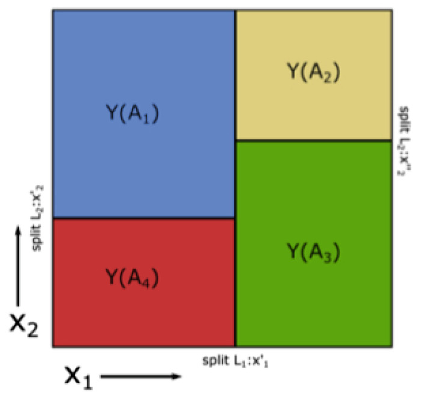 Figure 2: Schematic representation of the Tree model logic used to segregate the target data space.
Experiments & Results: Random Forest Reigns Supreme
The models were validated using Cohen’s Kappa coefficient, a more robust metric than simple accuracy as it accounts for the possibility of agreement occurring by chance.
| Method | Accuracy | Kappa Coefficient | Recommended Model |
|---|---|---|---|
| Random Forest | 0.70 | 0.4167 | Yes |
| k-NN | 0.60 | 0.00 | No |
| SVM | 0.54 | 0.00 | No |
The Random Forest model effectively identified the "Peak" economic status of 2018, outperforming its peers. This suggests that the ensemble nature of Random Forests is particularly well-suited for the noisy, multi-modal data found in macroeconomics.
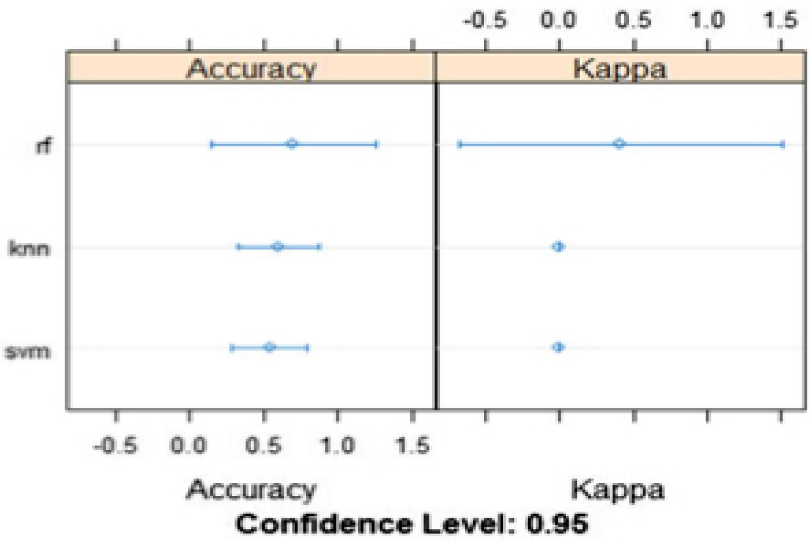 Figure 3: Model selection visualization highlighting the superiority of Random Forest via Kappa scores.
Critical Insight & Conclusion
Takeaway
The study proves that Big Data—specifically "digital footprints" from search engines—contains predictive signals that traditional financial indicators miss. Political stability and social sentiment are no longer "externalities"; they are core data points.
Limitations & Future Work
While Random Forest performed best, a Kappa of 0.4167 indicates there is still significant room for improvement (it represents "moderate" agreement). Future research could explore Deep Learning (LSTMs or Transformers) which are specifically designed for sequence modeling, potentially offering even higher precision in time-series forecasting for central banks like the Bank of Thailand.
In conclusion, the marriage of AI and Economics is no longer a luxury—it is a necessity for navigating the complexities of the modern global market.