
Big-Five Personality Profiling: Beyond the Questionnaire
Big-Five Personality Traits Based on Four Main Methods
2019-01-01
Summary
Problem
Method
Results
Takeaways
Abstract
This paper investigates the assessment of the Big-Five Personality Traits (OCEAN model) by integrating data from four distinct sources: mobile application usage, handwriting analysis, facial expressions (FACS), and social media activity. It synthesizes various machine learning and graphological techniques to categorize individuals into Agreeableness, Extraversion, Conscientiousness, Openness, and Neuroticism profiles.
## TL;DR
This research shifts personality assessment from subjective self-reporting to objective behavioral analysis. By synthesizing data from **mobile app usage, handwriting, facial expressions, and social media**, the paper provides a framework to map human behavior to the "Big-Five" personality traits (OCEAN) with high efficiency, targeting applications in recruitment and targeted marketing.
## The Motivation: Why traditional tests fail in the Digital Age
For decades, the "Gold Standard" for personality assessment has been the questionnaire. However, these are plagued by "Survey Fatigue" and social desirability bias. The authors argue that our **digital persona** and **physical nuances** (like how we cross a 't' or how many social apps we open) provide a more honest and quantifiable reflection of our psychological makeup.
## Methodology: The Four Pillars of Behavioral Sensing
The paper breaks down the personality detection into four key modules:
### 1. Mobile App Fingerprinting
The methodology utilizes an API to collect package names, launch times, and categories.
- **Extraverts** gravitate towards messaging and social networking.
- **Neuroticism** is characterized by a tendency to avoid isolation, leading to frequent use of social apps for information gathering.
- **Conscientious** users avoid time-consuming "distraction" apps, preferring productivity tools.
### 2. Graphology (Handwriting Analysis)
The authors apply image processing to analyze strokes. Key metrics include:
- **Baseline Slope**: Ascending lines indicate optimism.
- **Pen Pressure**: Heavy pressure correlates with long-lasting emotional intensity.
- **T-bar height**: Higher T-bars on the stem correlate with high self-esteem and "Conscientiousness."
### 3. Facial Expression Recognition (FACS)
Using the **Viola-Jones Face Detection (VJFD) algorithm**, the system divides the face into eyes, cheeks, brows, lips, and wrinkles. It maps **Action Units (AU)** to emotions via neural networks.

*Figure 1: Conceptual overview of multi-modal personality trait categorization.*
### 4. Social Media Analytics
Using a **Naive Bayes Classifier**, the system processes metadata from Facebook, Twitter, and LinkedIn.
- **Openness**: Correlates with knowledge of the latest features and diverse communication components.
- **Agreeableness**: High correlation with the sheer number of online friends.
## Experimental Insights & Results
The paper highlights that while "Openness to Experience" is difficult to track due to the ubiquity of social media (everyone uses it now), traits like **Neuroticism** and **Extraversion** show distinct, measurable patterns in digital metadata.
| Trait | Digital/Physical Indicator | Behavioral Interpretation |
| :--- | :--- | :--- |
| **Extraversion** | High friend count, Right slant in writing | Socially active, communicative |
| **Neuroticism** | High wall usage, Low private messaging | Anxious, seeking external validation |
| **Conscientiousness** | Low count of gaming apps, Vertical slant | Organized, self-disciplined |
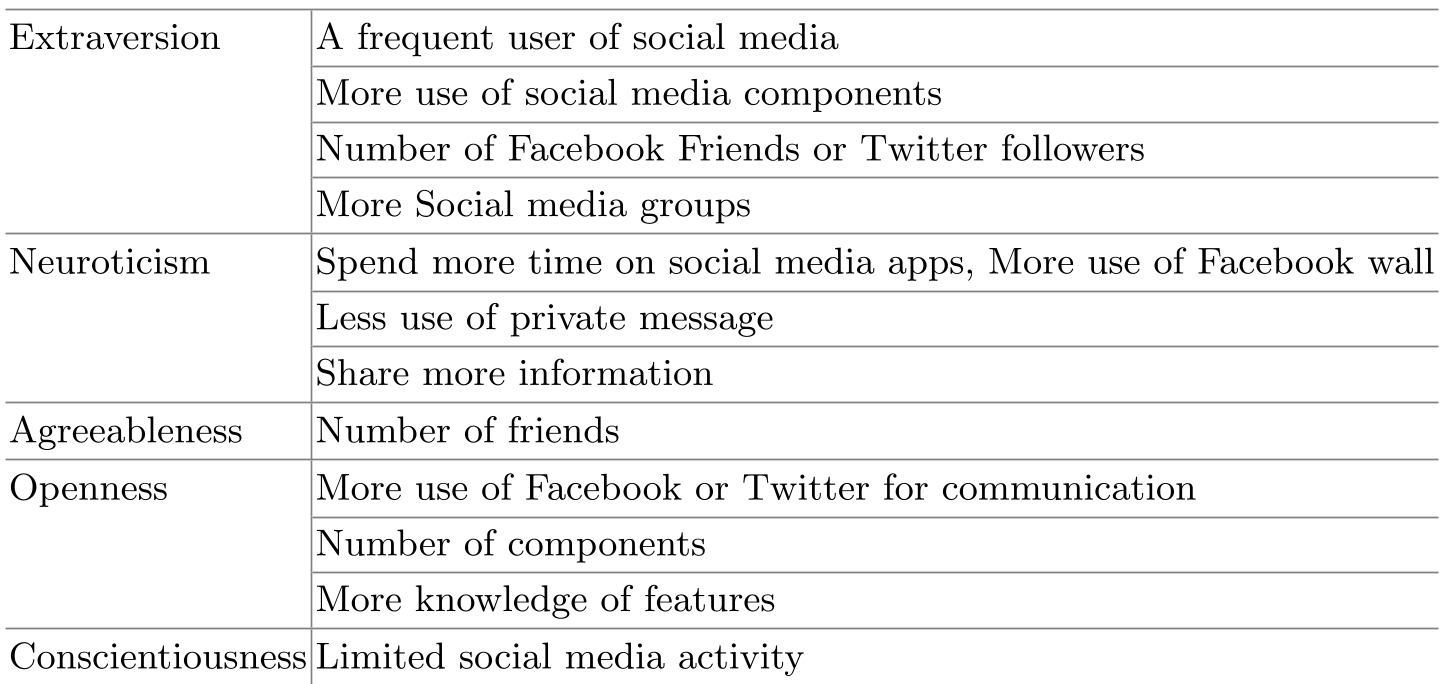
*Figure 2: Trait-specific behaviors on social media platforms.*
## Critical Analysis & Conclusion
### Deep Insight
The true value of this work lies in its **passive sensing** capability. By moving the "model into the user's brain" (as the authors suggest), electronic devices act as a continuous observer. This is particularly useful for HR departments to filter candidates without the overhead of proctored psychological exams.
### Limitations
- **Language Dependency**: Much of the referenced social media analysis is English-centric.
- **Privacy Concerns**: The paper focuses on technical feasibility but leaves out the ethical implications of "scraping" personality without explicit active participation.
- **Dynamic Behavior**: The study assumes personality is fixed (quantifiable features), whereas digital behavior can be highly context-dependent.
### The Takeaway
The future of AI-driven recruitment and marketing lies in **multi-modal fusion**. By combining the "what" (mobile apps), the "how" (handwriting), and the "reaction" (facial expressions), we can achieve a 360-degree psychological profile that far exceeds the accuracy of a 50-question survey.