
Big Tech and the Crisis of Societal Sustainability: An Ethical Reckoning
Big tech and societal sustainability: an ethical framework
This paper proposes an ethical framework to evaluate the impact of "Big Tech" (ICT giants) on societal sustainability, focusing on the survival of democratic institutions and individual rights. It critiques the rapid, profit-driven innovation cycles of firms like Google, Amazon, and Facebook, advocating for a multi-dimensional ethical approach—combining utilitarianism with rights and justice—to mitigate the systemic risks posed by AI, automation, and surveillance capitalism.
TL;DR
Is our obsession with "innovation" killing democracy? This paper explores the concept of Societal Sustainability, arguing according to a strict ethical audit that Big Tech’s current path—driven by surveillance and automation—is fundamentally incompatible with a free society. To survive, we must move beyond mere regulation toward proactive ethical standards and aggressive user activism.
The "Invisible" Dimension of Sustainability
When we talk about sustainability, we usually think of carbon footprints or social equity. However, Bernard Arogyaswamy introduces a terrifying third pillar: Societal Sustainability. This refers to the survival of the very institutions that make a society free—an independent judiciary, a free press, and the right to individual autonomy.
The author argues that Big Tech (Google, Facebook, Amazon, etc.) has created a "Technopoly," where technology dictates values rather than values guiding technology. We are currently making a "Faustian bargain," trading our cognitive capabilities and privacy for the convenience of "free" search engines and instant gratification.
Methodology: The Ethical Screen
The paper doesn't just complain; it applies a rigorous ethical lens. By using Act Utilitarianism (maximizing the good while minimizing harm), the author maps out the trajectory of ICT (Information and Communication Technology) impact.
The Matrix of Impact
The author categorizes the effects of Big Tech into a 2x2 matrix of Direct vs. Indirect and Present vs. Future consequences.
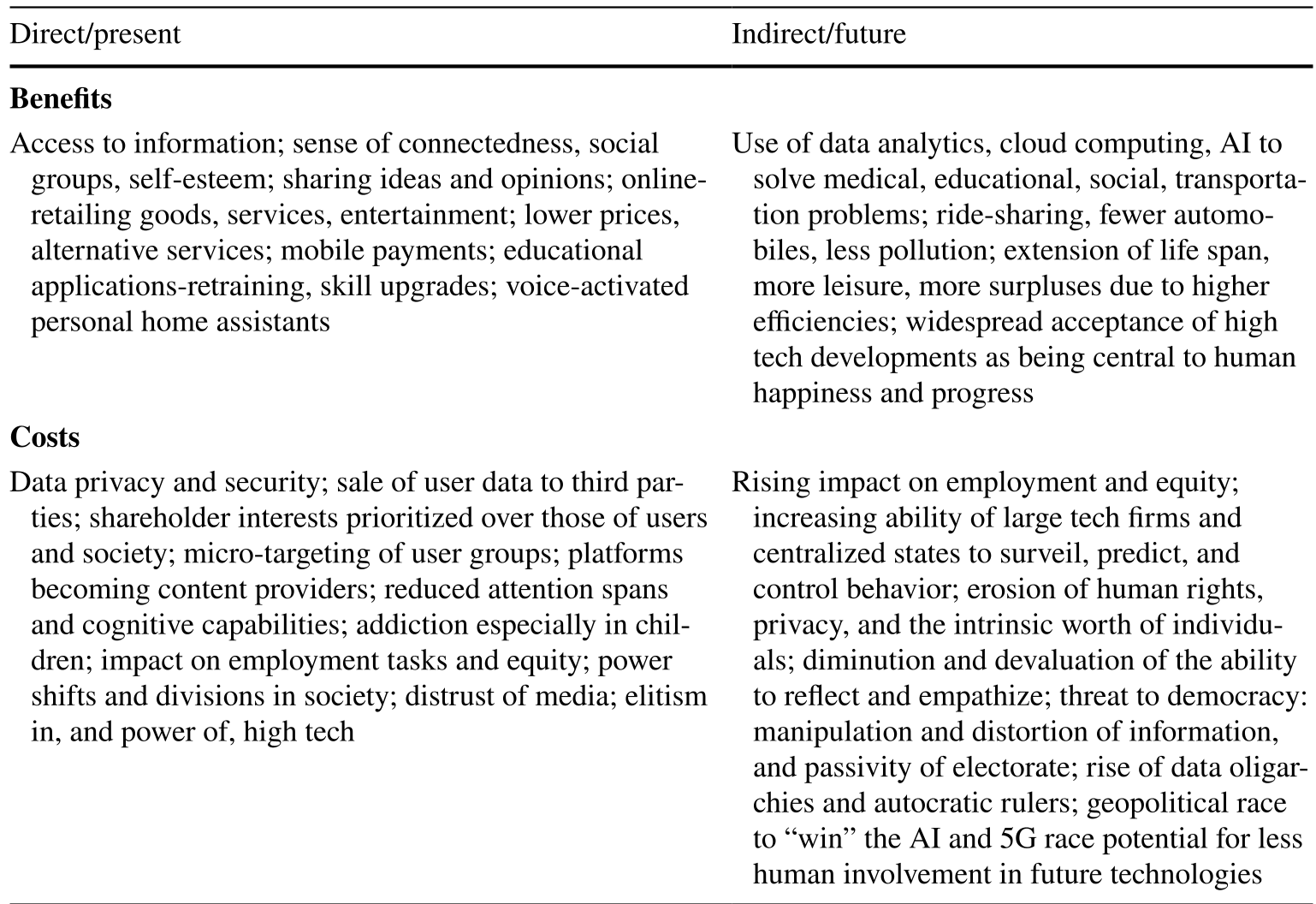
- Direct/Present Costs: Data privacy breaches, addiction (especially in children), and reduced attention spans.
- Indirect/Future Costs: The rise of "Data Oligarchies," the erosion of the "intrinsic worth of individuals," and a geopolitical AI arms race.
Deep Dive: Surveillance Capitalism and the "Behavioral Surplus"
One of the most potent insights in the paper is the shift from a service economy to Surveillance Capitalism. In this model, firms don't just provide a service; they extract "behavioral surplus."
- DA (Required Data): The data needed to improve a service.
- DB (Behavioral Surplus): The extra data used to predict, modify, and control user behavior for the benefit of advertisers and political actors.
This extraction has led to what the author calls a "New Feudalism," where tech giants act as lords and users are essentially "peasant farmers" of data.
The Automation Trap
The paper takes a hard look at the AI and Robotics revolution. While Big Tech claims technology creates as many jobs as it destroys, the author presents a grimmer reality:
- Job Displacement: Up to 40% of low-and-medium skill jobs could vanish by 2030.
- The Shadow Workforce: Even within tech giants, a "two-tier" system has emerged. Half of Google’s workforce consists of contractors and temps (CVTs) with few rights, mimicking pre-union "sweatshop" conditions.
Is Regulation Enough?
The author is skeptical of top-down regulation alone.
- Breaking up Big Tech: While appealing, it might not work due to the deep integration of services (e.g., Search, Android, and YouTube).
- The China Factor: A "national interest" argument is often used by US firms to avoid regulation, fearing that hobbling domestic giants would cede the AI leadership to China.
The Proposed Solution: A Three-Pronged Approach
- Corporate Self-Regulation: Beyond PR, companies need Chief Ethics Officers with the power to veto products.
- User Activism: Bottom-up pressure, boycotts, and digital literacy education starting from the toddler stage.
- International Frameworks: Negotiating "moral limits" on AI usage, similar to nuclear non-proliferation treaties.
Critical Insight: The Pre-Singularity Tipping Point
We are nearing what the author calls "Pre-Singularity"—the point where the complexity of machine learning becomes so opaque that human actors can no longer exercise rational or moral discretion.
If we don't act now to embed rights, justice, and the common good into our technological DNA, we may find ourselves in a world where the "messiness" of democracy is replaced by the "efficiency" of an authoritarian algorithm.
Conclusion
The paper is a clarion call. The "Age of Accelerations" is moving faster than our ethical frameworks can adapt. Societal sustainability isn't just a tech problem—it’s a survival problem. We must decide the direction of technology before technology decides the direction of humanity.