
Bimodal Emotion Recognition: Why More Data Doesn't Always Mean Better Performance
Bimodal person-dependent emotion recognition comparison of feature level and decision level information fusion
The paper investigates person-dependent bimodal emotion recognition by integrating speech and facial expressions. It compares two architectures—Feature Level Fusion and Decision Level Fusion—using SVM classifiers and an expert system, ultimately establishing that Decision Level Fusion achieves superior performance in identifying the six basic emotions.
TL;DR
Recognizing human emotion is a complex task that transcends any single sense. This paper explores the synergy between what we say (speech) and how we look (facial expression). By comparing early-stage feature merging with late-stage decision merging, the researchers found that treating each modality as an independent expert—and then combining their opinions via a rule-based system—is the most effective way to help computers "feel" human emotion.
The Core Challenge: The Asynchrony of Expression
In the realm of Affective Computing, the assumption that speech and facial movements are perfectly synchronized is a common pitfall. In reality, a sudden gasp or a subtle frown may precede or follow a spoken word. Furthermore, some emotions are naturally "louder" in one channel; for instance, sadness is often more distinct in the prosody of speech (lower pitch and intensity), while surprise is more visible on the face.
Existing systems often fail when they try to fuse raw data too early, essentially "watering down" the strong signals from one modality with the noise or missing data from another (such as a subject wearing glasses or having facial hair).
Methodology: Feature Level vs. Decision Level Fusion
The researchers tested two distinct architectural philosophies:
- Feature Level Fusion (Early Fusion): Concatenating the high-dimensional vectors of facial tracking data and speech MFCCs/pitch into one giant vector before classification.
- Decision Level Fusion (Late Fusion): Training separate SVM classifiers for the face and speech. Each produces a "likelihood" (probability). These probabilities are then fed into an Expert System.
The Expert System logic:
- Noise Filtering: If a probability is too low, ignore it.
- Additive Belief: If both the face and voice suggest "Anger," the total confidence increases.
- Conflict Resolution: If the face says "Happy" but the voice says "Sad," the system selects the one with the higher probability based on predefined logic.
 Figure 1: Comparison of Feature-level (mixed features) vs. Rule-based Decision Fusion.
Experimental Insights
Using the eNTERFACE 2005 database, the study yielded surprising results regarding the reliability of modalities:
- Speech Outperformed Face: Contrary to some previous studies, speech proved more reliable (53% vs 36% accuracy). The authors attribute this to the "real-world" complexities of the database, where facial hair and glasses interfered with tracking algorithms.
- Fusion Superiority: Decision Level Fusion reached a mean accuracy of 57%, consistently beating single modalities and the 52% achieved by Feature Level Fusion.
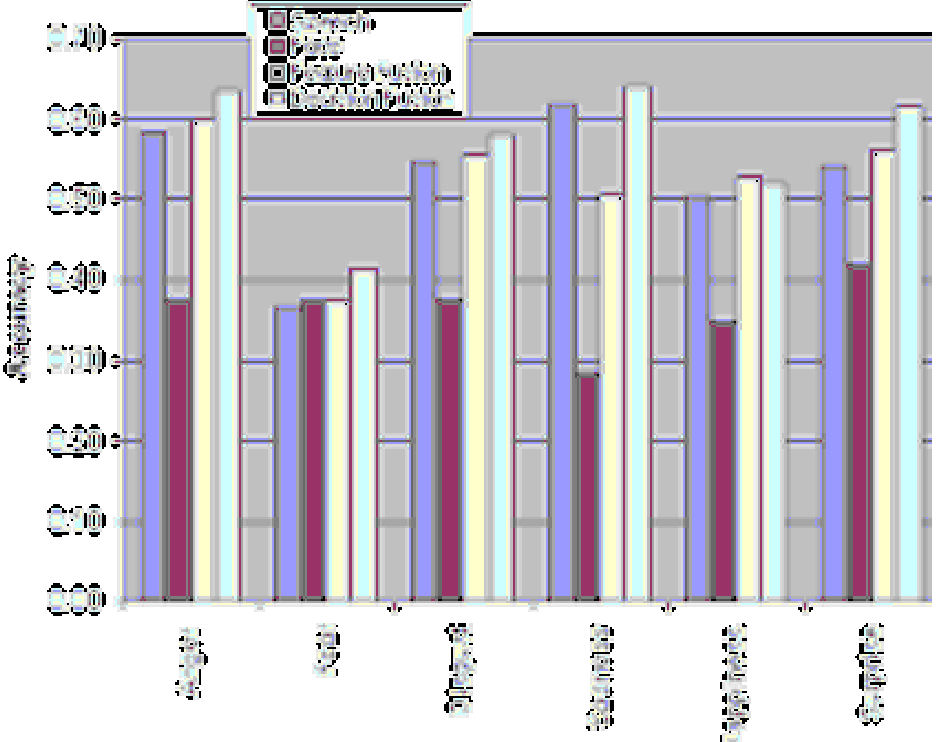 Figure 2: Accuracy of single-modality vs. combined systems across six basic emotions.
| Emotion | Speech | Face | Feature Fusion | Decision Fusion |
|---|---|---|---|---|
| Anger | 0.59 | 0.38 | 0.60 | 0.64 |
| Sadness | 0.62 | 0.29 | 0.51 | 0.64 |
| Mean | 0.53 | 0.36 | 0.52 | 0.57 |
Critical Analysis & Conclusion
The primary takeaway is that Decision Level Fusion acts as a robust filter. By allowing each modality to be processed independently, the system prevents the "pollution" of a strong signal (like clear audio) by a weak signal (like an occluded face).
Limitations
- Person-Dependent: The system was tested in a person-dependent context, meaning it might struggle with the sheer variety of emotional expression across a broader, unseen population.
- Rule Complexity: As the number of emotions or modalities increases, the "Expert System" rules can become unwieldy and difficult to maintain.
Future Directions
The shift toward Dynamic Information Fusion (using models like LSTMs or Transformers, which were less prevalent in 2008) is the logical next step to handle the temporal flow of emotion even more gracefully. This work remains a foundational reminder that in multimodal AI, the strategy of integration is just as important as the data itself.