
Bio-Inspired Influence: A New Frontier for Social Media Summarization
Summarizing social media content via bio-inspired influence maximization algorithms
This paper presents a multimedia summarization framework for Online Social Networks (OSNs) that utilizes a bio-inspired influence maximization algorithm. By modeling OSNs as hypergraphs and applying a modified Artificial Bee Colony (ABC) algorithm, the system identifies "influential" multimedia objects to generate summaries that balance priority, continuity, variety, and non-repetitiveness.
TL;DR
The paper introduces a framework that treats social media summarization as an Influence Maximization (IM) problem. By modeling Online Social Networks (OSNs) as hypergraphs and employing an Artificial Bee Colony (ABC) algorithm, the authors distill massive multimedia streams into concise summaries that emphasize variety and relevance while minimizing redundancy.
Background: Beyond Simple Text Summaries
In the era of Instagram, YouTube, and Flickr, information isn't just text; it’s a web of interactions. Current SOTA methods often struggle to balance the "social" aspect (who posted it, who liked it) with the "content" aspect (is this image similar to that one?). The authors argue that the most "important" objects in a network are those that "influence" or "recommend" others—essentially finding the "hubs" of information.
Methodology: The "Hive Mind" Approach
1. The Hypergraph Foundation
Unlike standard graphs where an edge connects two nodes, the authors use Hypergraphs. This allows a single "hyperedge" to connect multiple entities (e.g., a user, a set of tags, and an image), capturing the n-ary relationships typical of OSNs.
2. Bio-Inspired Influence Maximization
The core innovation is the use of the Artificial Bee Colony (ABC) algorithm.
- Employer Bees: Locate top-ranked objects based on centrality.
- Scout Bees: Search for better candidates in the "neighborhood" of current solutions.
- Waggle Dance: Recommending paths represent the dance, signaling the "profitability" (relevance) of a piece of content to others.

3. The PCVR Optimization Model
Once influential candidates are found, they are filtered through the PCVR model (Priority, Continuity, Variety, and non-Repetitiveness):
- Priority (): Matches user keywords via WordNet semantic similarity.
- Continuity (): Prefers objects shared in similar timeframes.
- Variety (): Ensures content comes from different users.
- Non-Repetitiveness (): Penalizes excessive semantic similarity.
Experimental Insights
The system was tested on the YFCC100M dataset (Yahoo Flickr Creative Commons). The authors focused on topics like "landscapes" and "sea/ocean/beach."
Key Results:
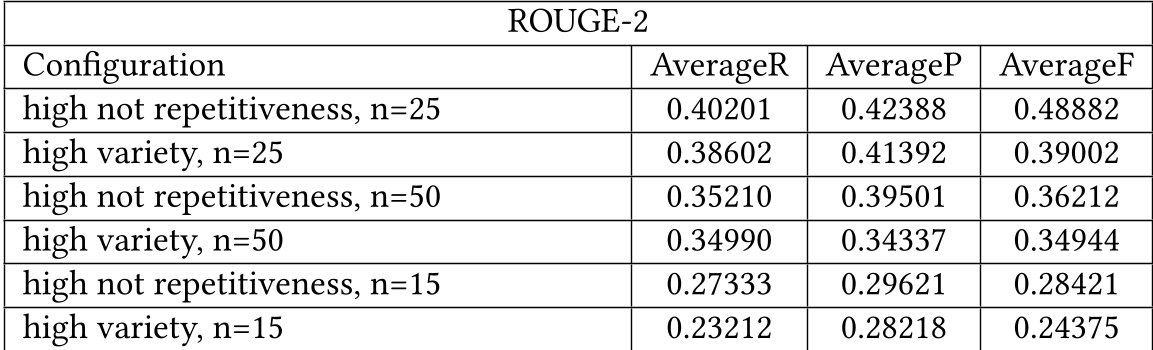
- Optimal Length: Summaries of length performed significantly better than or , suggesting a "sweet spot" for human consumption.
- Metric Advantage: The "High Not Repetitiveness" configuration consistently outperformed "High Variety," reaching an Average F-measure of ~0.49.
Critical Analysis & Conclusion
This work successfully bridges Graph Theory and Evolutionary Computing. By treating a summary as a set of influential "seeds," the authors bypass the computational explosion of traditional optimization.
Limitations: The current model relies heavily on WordNet for semantic similarity, which may not capture modern slang or evolving social media hashtags as effectively as modern LLM-based embeddings (e.g., CLIP or BERT).
Future Outlook: The authors suggest moving toward Game Theory (Pareto fronts) to resolve the conflict between variety and non-repetitiveness more elegantly. For industry practitioners, this approach offers a robust blueprint for building "Discovery" feeds that prioritize diverse, high-influence content over repetitive viral loops.
Takeaway: Effective summarization isn't just about what is being said, but who is saying it and how it ripples through the social fabric.