
Bio Sketchbook: Empowering Young Observers through AI-Assisted Nature Sketching
Bio Sketchbook: an AI-assisted Sketching Partner for Children's Biodiversity Observational Learning
Bio Sketchbook is an AI-assisted sketching partner designed to facilitate biodiversity observational learning for children. It leverages ResNet-50 for plant classification and the Photo-Sketching model to transform photos into contour drawings, guiding young novices through the process of drawing from nature.
TL;DR
Bio Sketchbook is an innovative AI partner that bridges the gap between digital interaction and nature. By converting plant photographs into interactive contour drawings, it helps children overcome the technical hurdles of sketching, turning a smartphone or tablet into a sophisticated tool for biodiversity observation and science education.
Background: The Gap in Nature Literacy
In an era of increasing biodiversity loss, public awareness is more critical than ever. However, most science curricula still confine children to classrooms and textbooks. While ecological researchers advocate for "observational learning," the entry barrier is high: drawing what you see (morphological sketching) is significantly harder for children than drawing from imagination. Bio Sketchbook addresses this by acting as a "scaffolding" partner in the child-AI collaboration loop.
Motivation & Design Goals
The authors identified that children often lack the "patience" or "eye" for biological details like leaf texture or stamen structure. Through design probes with professional science and art teachers, they established four core pillars for the system:
- Free Exploration: Removing the stress of formal "learning tasks."
- Tool Independence: Eliminating the need for physical painting kits in the field.
- Feature-Guided Observation: Explicitly prompting children to look at morphology, color, and environment.
- Gamified Motivation: Using a "collection" mechanic (similar to Pokémon Go) to encourage repeated use.
Methodology: The "Brain" Behind the Sketch
Bio Sketchbook is more than a simple filter app; it is a multi-stage educational pipeline.
The Technical Stack
- Vision Engine: A ResNet50-V2 model trained on the iNaturalist2017 dataset allows the system to identify thousands of species in real-time.
- Sketch Synthesis: It employs Photo-Sketching algorithms to infer visual boundaries, providing a "skeleton" for the child to build upon.
- Knowledge Graph: Integration with Google’s Knowledge Graph ensures that the information provided is scientifically accurate and contextually relevant.
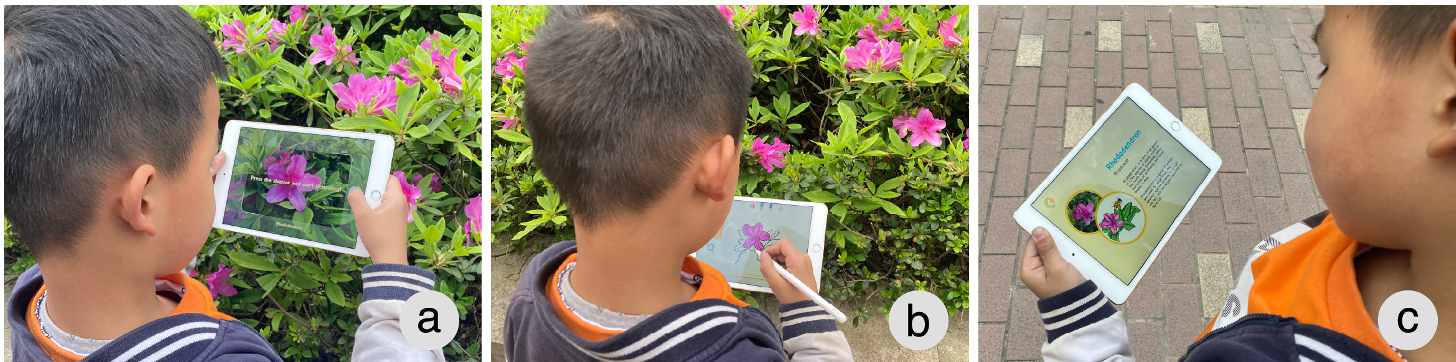 Figure 1: The Bio Sketchbook interaction flow: (a) Capture, (b) Draw, (c) Learn.
The Interaction Loop
The "Observe and Draw" phase is the methodology's heart. After taking a photo, the AI generates a faint contour. The child isn't just "coloring in"; they are guided to:
- Refine the lines: Forcing them to look at the plant's shape.
- Match the colors: Encouraging them to discern subtle differences in hues (e.g., different shades of green in different light).
- Contextualize: Adding the surrounding environment to the canvas.
Experimental Insights
The preliminary study conducted in a botanical park yielded fascinating qualitative results. Children generally viewed the AI in two distinct ways:
- The Tool View: "It told me what the plant is."
- The Teacher View: "It taught me how to draw and corrected my mistakes."
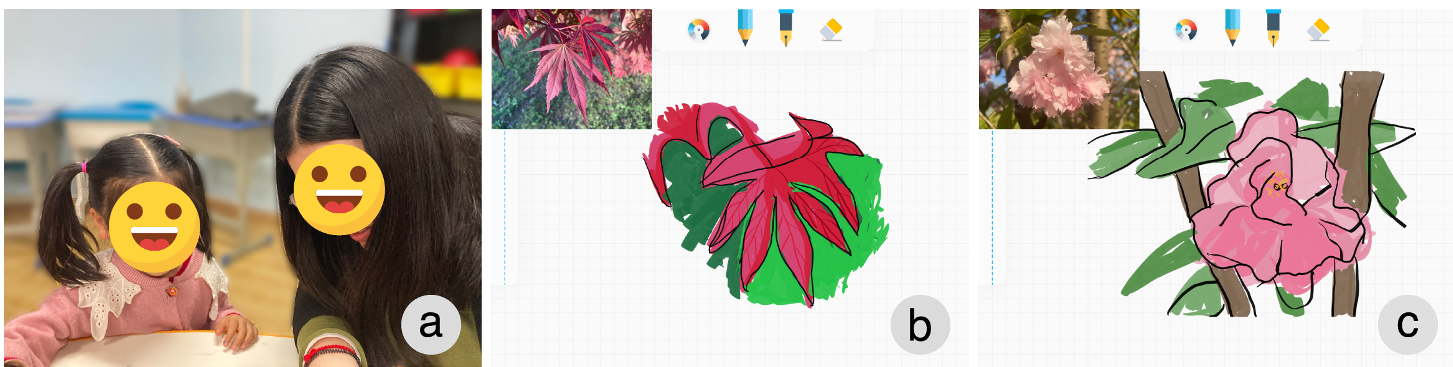 Figure 2: (a) Field study interview, (b-c) Examples of drawings produced by 5-8 year olds.
Crucially, children began to notice micro-features that the AI didn't explicitly point out, such as specific red spots on purple azaleas. This indicates that the AI-assisted process successfully triggered "Active Observation," where the tool serves as a catalyst for human curiosity rather than just an automated replacement.
Critical Analysis & Conclusion
Bio Sketchbook is a prime example of how AI can be used to augment rather than replace human effort. By handling the "frustrating" parts of drawing (perspective and initial form), it frees the child’s cognitive load to focus on scientific observation.
Limitations:
- The system currently struggles with identifying plants at different growth stages (e.g., a bud vs. a full bloom).
- The "one-size-fits-all" hardware (iPad) can be physically taxing for very small children to hold while sketching.
Future Outlook: The authors plan to dive deeper into the "long-term relationship" between children and AI partners. The real test of such systems will be whether they can sustain a child's interest in nature long after the novelty of the AI wears off.
Final Takeaway
Bio Sketchbook proves that the marriage of Computer Vision and Interactive Design can turn "screen time" into "nature time," providing a scalable way to foster the next generation of biodiversity advocates.