
Stance Classification: The New Frontier in Biomedical Engineering for the Fake News Era
Biomedical Engineering Research in the Social Network Analysis Era: Stance Classification for Analysis of Hoax Medical News in Social Media
This paper explores the application of stance classification to detect medical hoaxes in social media, framing it as an extension of biomedical engineering research. By utilizing the Emergent dataset methodology and a custom Snopes-based medical corpus, the authors demonstrate how linguistic alignment and word embedding can categorize news headlines into "for," "against," or "observing" stances.
TL;DR
In an era where "alternative facts" can be as lethal as any virus, this paper argues that Biomedical Engineering must expand its borders. Researchers from Institut Teknologi Sepuluh Nopember present a study on Stance Classification—categorizing whether social media content supports, refutes, or merely discusses a medical claim—to combat the spread of medical hoaxes. By leveraging linguistic alignment and word embeddings, they achieve up to 95% accuracy in identifying refutations of fake medical news.
Contextual Positioning
Traditionally, biomedical engineering is synonymous with MRIs, nanoparticles, and prosthetics. However, the authors pivot toward Social Network Analysis (SNA). In the Indonesian context, where medical misinformation often undermines public health policies, this paper serves as a bridge, treating information hygiene as a critical component of healthcare systems.
The Problem: Beyond the "Bag-of-Words"
Detecting medical hoaxes is uniquely challenging compared to general fake news. A medical hoax often uses sophisticated, convincing language rather than obvious sensationalism.
- Prior Work Limits: Most Indonesian hoax classifiers rely on simple keyword filtering or basic supervised learning.
- The Nuance Gap: These methods fail to distinguish between a headline that repeats a hoax and one that debunks it. This is where Stance Detection becomes essential—it doesn't just ask "is this true?" but "what is this article's attitude toward the claim?"
Methodology: Aligning Claims and Headlines
The research utilizes a two-pronged feature extraction strategy to feed into their classifiers:
- Headline Features: Traditional NLP processing including BoW representations and grammatical structure analysis.
- Claim-Headline Features (The Insight): Because news articles often use "hedging" (vague language like "Scientists are looking at..."), the authors use the Paraphrase Database (PPDB). This aligns the words of a verified claim with the words in a suspect headline to measure semantic distance using word embeddings.
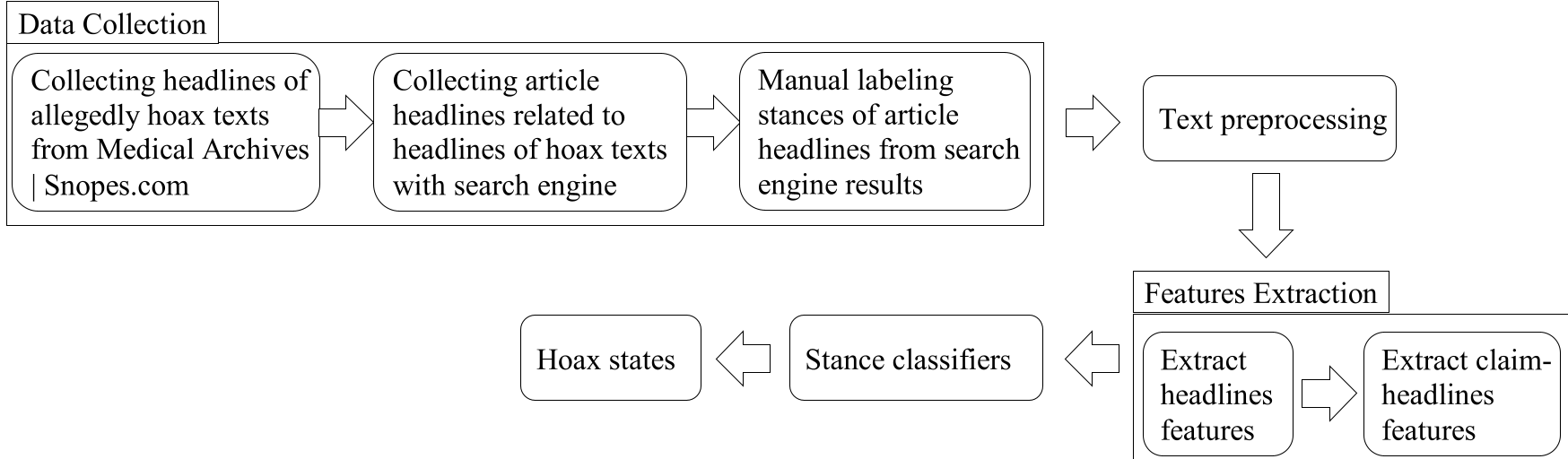 Figure 1: The overarching workflow for medical hoax stance classification.
Experimental Analysis & Results
The study utilized a specialized dataset derived from snopes.com, containing 19 true, 42 false, and 17 unverified medical claims.
Performance Breakdown
The researchers compared standard headline features against the alignment-based features.
- Refutation Success: Both methods were highly effective at identifying the "Against" stance (refuting a hoax), reaching an accuracy of 95.95%. This is vital for automatically surfacing debunking articles.
- The Hedging Challenge: The "Observing" class (vague reporting) showed significant weakness in recall (41.67%), indicating that models still struggle with subtle journalistic hedging.
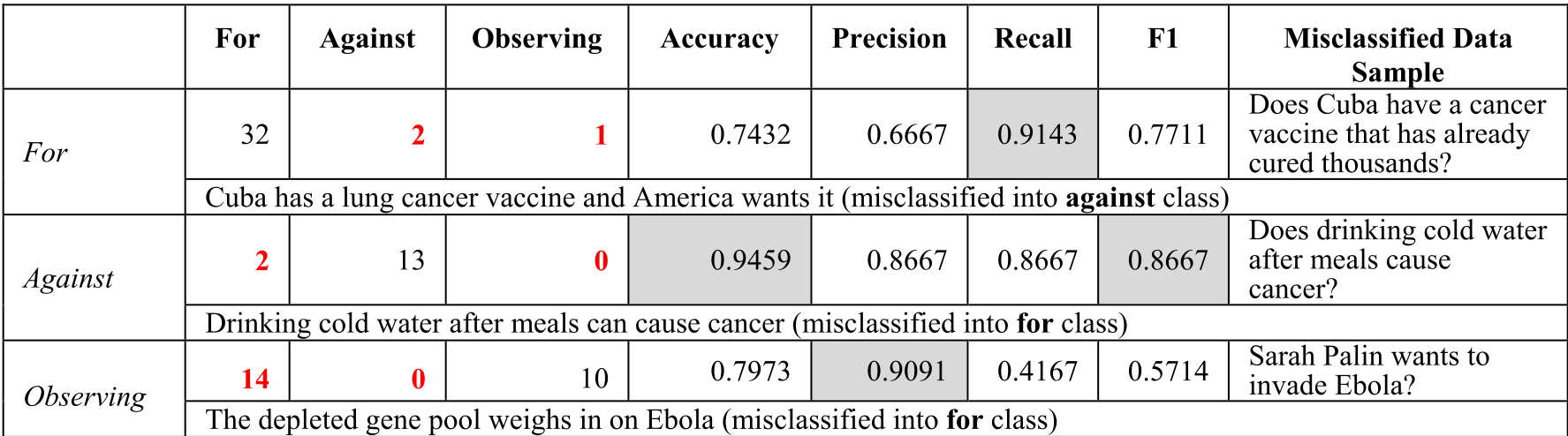 Table 1: Performance metrics for headline-based stance classification.
Deep Insight: Why it Matters
This work highlights a critical Inductive Bias in information retrieval: social media analysis is a linguistic game as much as a network game (topology). While the "Against" class (refutations) is linguistically distinct, the "For" and "Observing" classes share too much semantic overlap for simple models.
Limitations & Future Work
- Language Barrier: The study primarily uses English-based tools (PPDB, Snopes). Adapting this to Indonesian requires navigating different grammatical structures and a lack of formalized hoax datasets.
- Semantic Depth: Current BoW and basic embeddings lack the context-heavy understanding provided by modern architectures (like Transformers), which would likely solve the "vague language" problem identified in the "Observing" class.
Conclusion
The fight against pandemics like MERS or COVID-19 isn't just fought in the lab; it's fought in the latent space of social media. By framing Stance Classification as a biomedical necessity, Purnomo et al. provide a blueprint for a multidisciplinary approach to modern public health.