
BioShare: Quantifying the Social Pulse of Biometric Data Sharing
BioShare: A research tool for analyzing social networks effects when sharing biometric data
BioShare is an open-source research tool designed to analyze the psychological and social effects of sharing real-time biometric data (e.g., heart rate) across social networks. It provides a comprehensive framework for capturing, visualizing, and logging interactions between data-sharing users and their online audiences, specifically optimized for longitudinal research in human-computer interaction (HCI).
TL;DR
Imagine broadcasted heart rate data not as a medical record, but as a form of social storytelling. BioShare is an open-source research platform designed to study exactly that. It bridges the gap between biometric sensors and social networks, allowing researchers to experiment with how sharing heart rate and location data affects both the broadcaster and the audience.
Contextual Positioning
In the landscape of Quantified Self (QS), most research focuses on individual self-improvement. BioShare shifts the focus toward Social Biometrics. It moves beyond the proprietary silos of Nike+ or Runkeeper to offer an extensible toolkit for HCI (Human-Computer Interaction) researchers to run controlled social experiments.
The Problem: The "Closed Loop" of Commercial Apps
Commercial fitness apps are designed for user retention, not scientific discovery. For researchers, they present three major roadblocks:
- Lack of Transparency: Proprietary algorithms and closed data access.
- Rigid Interfaces: No way to test how different visualizations (e.g., a simple number vs. a live waveform) change viewer empathy or engagement.
- No Interaction Logs: Inability to track the exact moment a viewer interacted with a specific biometric spike.
Methodology: Engineering the Social Pulse
BioShare’s architecture is built on three functional pillars: Capture, Visualize, and Analyze.
1. The Broadcaster (Mobile App)
Running on Android, the app pulls data from heart rate sensors (via Bluetooth) and GPS. It doesn't just upload data; it acts as a receiver for social support. When a friend "cheers" online, the runner feels a vibration or hears a narration, closing the feedback loop between the crowd and the athlete.
2. The Spectator (Web Interface)
This is where the experimental magic happens. Researchers can assign spectators to different "conditions"—one group might see a live heart rate line chart, while another sees only a numeric average. This allows for the study of Affective Connection.
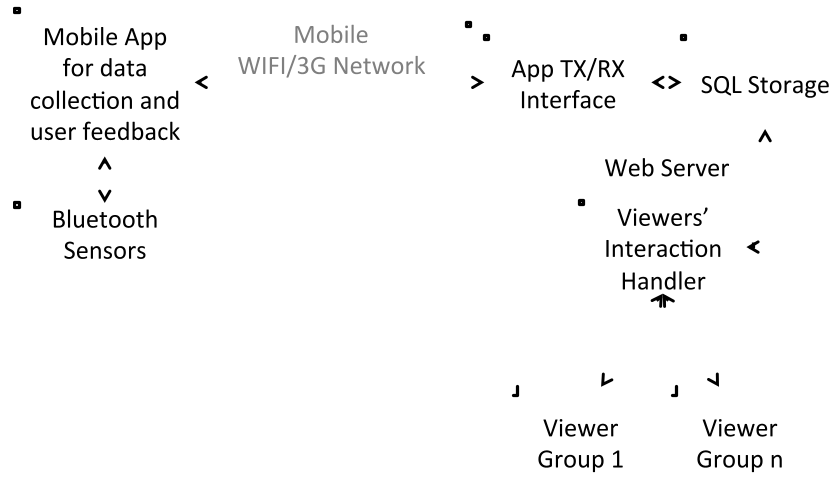 Figure 1: The BioShare Architecture, showing the flow from biometric sensors to the social network and back to the user.
3. The Researcher (Logging Engine)
Every click, zoom, and comment is timestamped against the biometric data. Researchers can ask: "Did the audience cheer more when the heart rate exceeded 170 BPM?" or "Does a map view increase the number of comments compared to a chart view?"
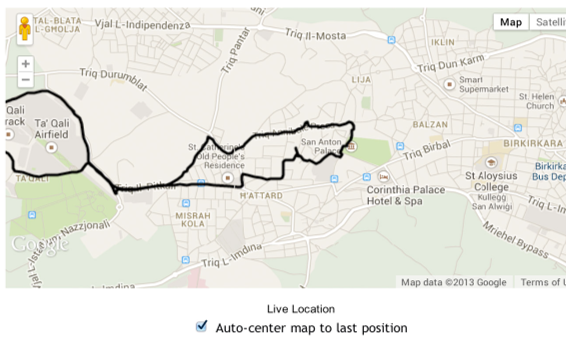 Figure 2: The default BioShare visualization, combining live heart rate graphs with orientation-corrected street views.
Experimental Potential: Automated Storytelling
The paper demonstrates BioShare in the context of long-distance running. The authors frame biometric sharing as Automated Storytelling. Instead of a runner posting "I'm tired," their rising heart rate and slowing pace tell the story of their struggle and perseverance in real-time.
The system measures:
- User Engagement: Quantitative counts of cheers and posts.
- Psychological Impact: Qualitative data via triggered in-app surveys.
- Community Formation: How data-driven interactions foster a sense of "being there" for the remote athlete.
Critical Insight & Future Outlook
The true value of BioShare lies in its ability to probe the Ethical Frontier. As the authors suggest, if biometric sharing becomes the norm, does not sharing data make someone appear "unhealthy by default" to insurance companies?
Limitations
- Connectivity: The system relies heavily on stable mobile data, which is often a challenge during major sporting events.
- Privacy: While intended for research, the "open-broadcast" nature of the tool requires rigorous ethical safeguards when deployed in the wild.
Conclusion: BioShare is a vital contribution to the HCI community. It transforms biometric data from a private vanity metric into a shared social currency, providing the raw tools needed to understand how our bodies will communicate in the social networks of the future.