
Birds of a Feather Check Together: Enhancing Rumour Detection via Sequential Context and Homophily
Birds of a feather check together: Leveraging homophily for sequential rumour detection
The paper introduces a novel sequential rumour detection framework based on Linear-Chain Conditional Random Fields (CRF) and the socio-psychological principle of homophily. Evaluated on five Twitter breaking news datasets, it achieves state-of-the-art performance, notably outperforming enquiry-based baselines with a 40% improvement in F1 score.
TL;DR
To combat the spread of unverified information during breaking news, researchers have developed a novel system that doesn't just look at what is said, but when it is said and who the speaker follows. By using Linear-Chain Conditional Random Fields (CRF) and the principle of homophily, this approach achieves a massive 40% improvement in F1 score over traditional baselines, effectively identifying rumours even before the public starts questioning them.
Contextual Intelligence: Moving Beyond Keywords
During fast-paced events like the Ferguson unrest or the Sydney Siege, social media becomes a chaotic stream of updates. Traditional rumour detection has a major "Recall" problem: it often waits for "enquiry tweets" (e.g., "Is this true?") to flag a rumour. But what if a rumour is so "credible-looking" that no one questions it initially?
The authors argue that a rumour is defined by its unverified status, not its eventual truth value. To detect this "unverified" nature, we must look at the Sequential Dynamics—how the story has unfolded up to that point—and the Social Context of the user.
Methodology: The Core Innovations
1. Sequential Modeling with CRF
Instead of treating each tweet as an isolated data point (the "bag-of-tweets" approach), the authors use Linear-Chain CRFs. This allows the model to learn the transition probabilities between labels (Rumour vs. Non-Rumour) across a timeline.
- The Intuition: A report about a "gunman on the loose" is more likely to be a rumour if previous reports in the sequence also lacked authoritative sources or shifted frequently.
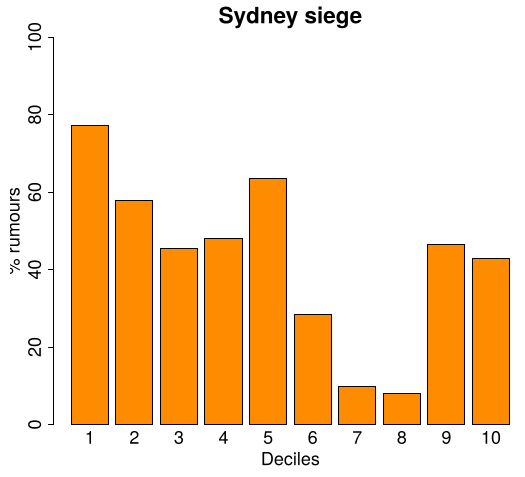 Fig 1: Rumour distribution across event deciles shows that rumours don't just happen at the start; they evolve throughout the event.
2. Leveraging Homophily (Birds of a Feather)
The most striking contribution is the use of Homophily. The social science principle suggests that people associate with others similar to themselves. The authors translate this into a technical feature: RumourRatio.
- Direct RR: Has this user posted rumours before?
- Following RR (Homophily): If we don't know the user, look at who they follow. If their followings frequently share unverified content, the user is statistically more likely to do the same.
Experimental Results & Performance
The researchers tested their approach against the state-of-the-art enquiry-based method (Zhao et al.) and standard classifiers like SVM and Naive Bayes.
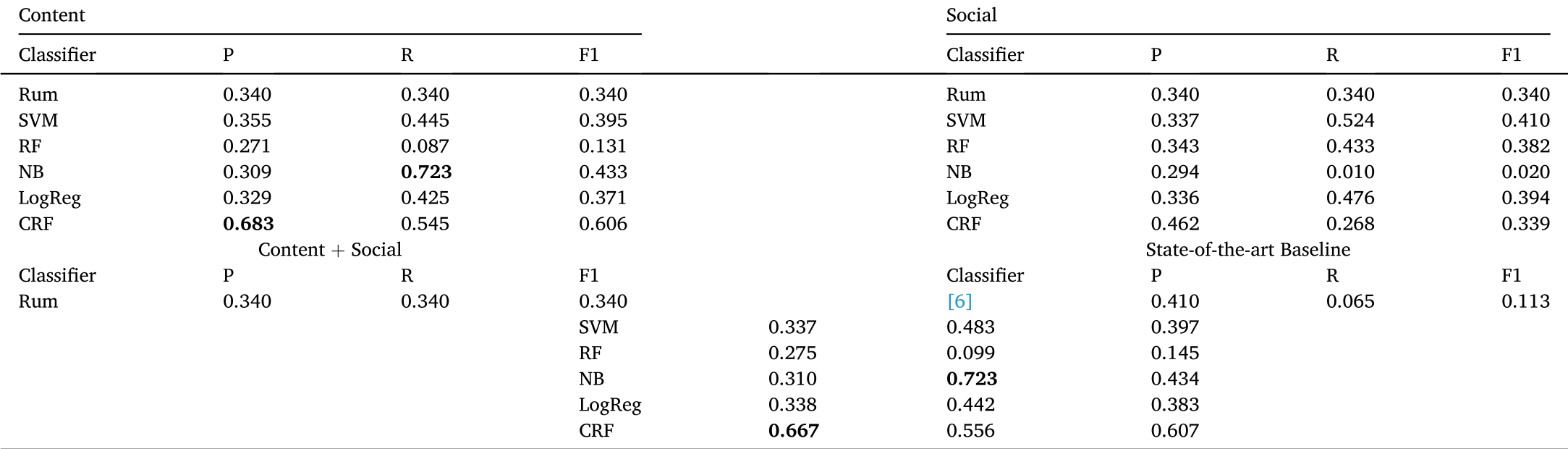 Table 1: CRF significantly outperforms non-sequential baselines in Precision and F1 score.
Key Findings:
- Sequential Advantage: CRF outperformed the best non-sequential baseline (Naive Bayes) by 39.9% in F1 score.
- The Homophily Boost: Adding the Homophily feature (HP) increased the availability of user data from ~17% to over 80%, providing a much denser signal for the classifier.
- Consistency: While CRF suffers from a "cold start" (less context in the first 10% of an event), it quickly gains superior accuracy as the sequence grows.
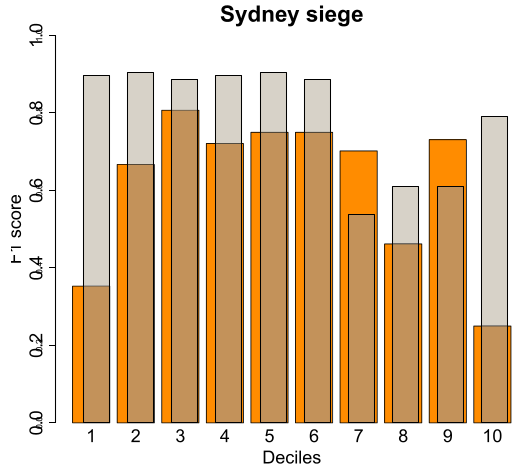 Fig 2: CRF+HP performance vs. best non-sequential classifiers across the event lifecycle.
Critical Insight: The "Journalistic" Dataset
Unlike previous "top-down" datasets that started with known lies, this study used a bottom-up approach. Journalists annotated 5,802 tweets as the news unfolded. This reflects the real-world challenge: detecting a rumour before we know if it's a lie.
Conclusion & Future Outlook
This work proves that context is king. By combining the temporal "flow" of news with the social "network" of the speaker, we can build tools that warn users about unverified information in real-time.
Future Work: The authors suggest that integrating user location and more granular pairwise similarity between tweets could further push the boundaries of automated social newsgathering.