
Bittella: Harmonizing Social Intelligence with P2P Efficiency
Bittella: A Novel Content Distribution Overlay Based on Bittorrent and Social Groups
This paper introduces Bittella, a social-aware content distribution overlay that integrates the efficient downloading mechanisms of Bittorrent with the search capabilities of unstructured Peer-to-Peer (P2P) networks. It leverages a novel Ranking Algorithm to autonomously form social groups based on semantic interests, resulting in a "Small-World" topology that enhances content discovery and download speeds.
TL;DR
Bittella is a hybrid P2P architecture that merges the search flexibility of unstructured networks (Gnutella) with the high-throughput performance of Bittorrent. By introducing an automated Ranking Algorithm, it organizes peers into social groups based on shared interests, drastically reducing search traffic and improving download speeds by up to 400% through high local hit rates.
The Structural Paradox of P2P
For years, the P2P landscape has been divided. On one hand, unstructured networks (like Gnutella) are resilient and support complex semantic searches but drown in the "noise" of flooding-based queries. On the other hand, structured networks (DHTs) are efficient but brittle under the pressure of "churn"—the constant joining and leaving of nodes.
The authors of Bittella identify a missed opportunity: Systematic Serendipity. Users who download the same content likely share broader interests. By capturing these social relationships, a network can transition from "blind searching" to "informed asking."
Methodology: The Three-Layer Social Engine
Bittella's architecture is a sophisticated stack designed to decouple discovery from delivery:
- Underlay Layer: The foundation (unstructured P2P) used for initial bootstrapping and routing "unexpected" queries.
- Swarm Layer: The "engine room" where Bittorrent-style chunked downloading occurs.
- Social Layer: The "brain" where peers are ranked. This results in a Small-World topology—dense clusters of like-minded experts loosely connected to the rest of the world.
The Ranking Algorithm: Quantifying Interest
The secret sauce is the Ranking Algorithm, which calculates a PeerRank without adding protocol overhead. It uses two passive metrics:
- Swarm Matching: Did I meet this peer while downloading the same file? (Indicates shared outcome).
- Query Matching: Does the content this peer is searching for align semantically with my past 20 queries? (Indicates shared intent).

The formula balances swarm participation and semantic query similarity using an factor to prioritize different behaviors.
A Novel Trackerless Scheme
Unlike traditional Bittorrent, which relies on a central tracker, Bittella peers function as their own distributed directories. When a "Seed" creates a file, it generates a .bittella metadata file. New nodes find this via the underlay and immediately begin a "Peer Exchange" (gossiping) to expand their swarm knowledge.
Experimental Results: Speed and Sanity
The researchers benchmarked Bittella against Gnutella in a 1,000-node simulation.
1. Download Efficiency
By utilizing BitTorrent's chunk-based parallelism, Bittella obliterates the performance of standard unstructured downloads.
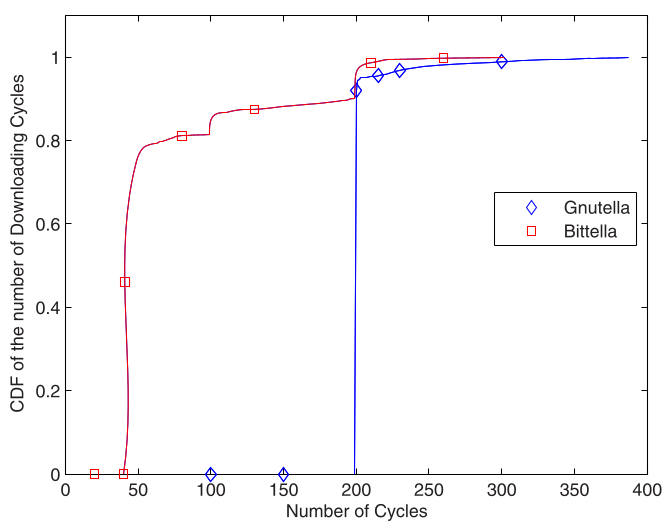 Figure 2: The CDF shows 80% of Bittella users finishing in 50 cycles, while Gnutella users are still struggling past 200 cycles.
2. Bandwidth Conservation
The most striking result is the relationship between the Local Hit Rate and bandwidth. As nodes "learn" who their social partners are, they query them directly. By the end of the simulation, the Local Hit Rate approached 80%, causing a 1.5x reduction in total network traffic compared to Gnutella's constant flooding.
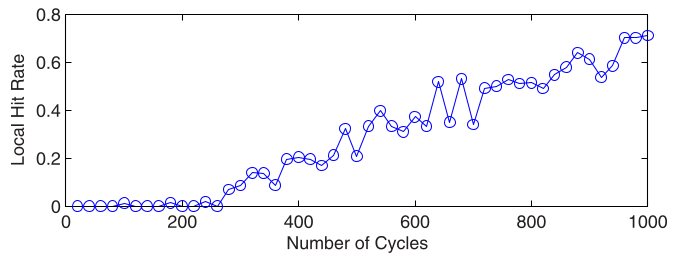 Figure 4: As the network matures, the "Learning Procedure" takes over, and the need for expensive flooding queries plummets.
Critical Analysis & Conclusion
Takeaway: Bittella proves that content distribution shouldn't be "socially blind." By leveraging the fact that humans form interest-based clusters, we can build tech that is both faster and lighter on network resources.
Limitations: While the Secure Permanent Peer ID (using Public/Private keys) addresses the "churn" and IP-change problem, the current simulation is static. Real-world performance in a highly adversarial environment with massive churn remains a future challenge.
Future Outlook: The researchers suggest extending this to Live Streaming and VoD, where social clustering could be even more effective (e.g., users in the same region watching the same live sports event). Bittella is a precursor to a more "human-centric" internet architecture.