
Blended Behavioral Analysis: Solving Identity Theft via Multi-Dimensional Synergy in MSNs
On Complementary Effect of Blended Behavioral Analysis for Identity Theft Detection in Mobile Social Networks
The paper proposes a multi-dimensional identity theft detection framework for Mobile Social Networks (MSNs) using "Blended Behavioral Analysis." By integrating spatial distributions (check-ins), post interests (tips), and social preferences (friendships), the method achieves an Intercept Rate (IR) of over 93.6% on the Foursquare dataset by leveraging the complementary effects of sparse data.
Executive Summary
TL;DR: This paper tackles the "Data Sparsity" problem in identity theft detection by shifting focus from deep single-dimensional modeling to multi-dimensional fusion. By combining how you move (spatial), what you say (interests), and who you follow (social), the authors achieve a staggering 93.6% detection rate, proving that even sparse and "unreliable" data points can create a robust digital fingerprint when blended.
Background: Positioned in the intersection of Cybersecurity and Social Computing, this work moves beyond population-level outlier detection (detecting weird behavior) to individual-level verification (detecting behavior that is not "you").
Problem & Motivation: The Sparsity Trap
Current identity theft detection in Mobile Social Networks (MSNs) faces a paradox: human behavior is highly unique, but our digital footprints are incredibly fragmented. If a system only looks at your check-ins, it might miss an attacker who only posts text updates.
The authors identify that Data Sparsity is the "silent killer" of effective ID theft detection. Most users simply don't check in or post enough to create a statistically significant baseline in one single dimension. The insight here is Complementarity: an attacker might mimic your location (low spatial entropy) but will likely fail to match your specific social preferences or linguistic interests.
Methodology: The Core Triad
The authors break down the "Blended Space" into three distinct models:
1. User Spatial Distribution Model (USDM)
To handle the "Cold Start" problem (where a user has few check-ins), they use Mixed Kernel Density Estimation (MKDE).
- Physical Intuition: Your location probability is a mix of your own history and your friends' footprints.
- Formula Logic: This accounts for the fact that we often visit places similar to our social circle.
2. User Post Interest Model (UPIM)
Using Latent Dirichlet Allocation (LDA), they treat a user's history of "tips" or comments as a document. The model generates a topic probability distribution (). When a new post appears, they calculate the Jensen-Shannon (JS) Divergence between the old and new distributions. A high divergence suggests an identity anomaly.
3. User Social Preference Model (USPM)
Instead of looking at the topology of the social graph (which is often incomplete), they look at the content generated by your friends. If you suddenly follow new people whose interests deviate significantly from your existing circle's "social preference," the system flags an anomaly.
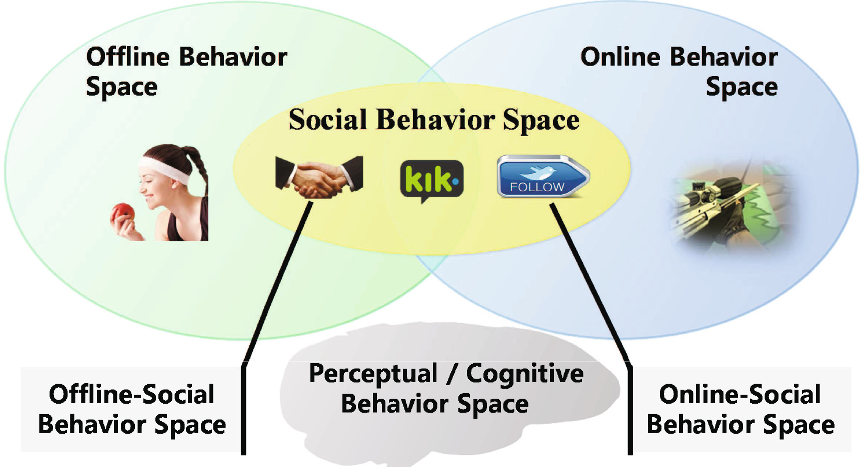
Experiments & Results: The Power of Fusion
The researchers tested their methods on large-scale Foursquare (23k users) and Yelp (43k users) datasets.
The "Multi-Dimension" Boost
The most striking finding is the Complementary Effect.
- Single Dimension: Models focusing only on check-ins or tips were relatively weak (IR ~0.43).
- Dual Fusion: Combining Check-ins and Social (DoCF) jumped the Intercept Rate to 0.91.
- Triple Fusion (DoCTF): Reached a peak performance of 0.936 IR.
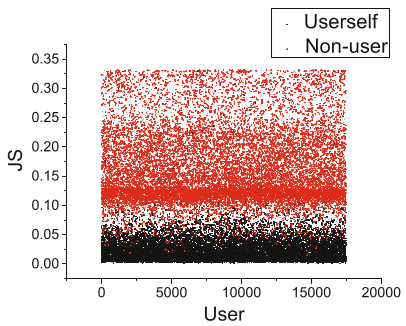 Fig: Detection performance across Check-in, Tips, and Friendship dimensions.
The ROC curves across both datasets show that Social Preferences (DoF) were surprisingly the most stable single indicator of identity, likely because friendship communities change more slowly than location or vocabulary.
Critical Analysis & Conclusion
Takeaway
Identity is not a single point; it is a manifold. This paper successfully proves that multi-dimensional fusion is the only viable path to overcoming data sparsity in MSNs. By shifting the metric from "absolute outliers" to "divergence from personal history," the authors provide a practical framework for real-time account security.
Limitations
- Latency vs. Accuracy: The model requires at least 30-60 words to reach stable accuracy in the text/friendship dimensions. This might delay detection during the first few minutes of a hijack.
- Computational Cost: Running LDA and MKDE for millions of users in real-time requires significant backend optimization not fully detailed in the paper.
Future Outlook
As mobile apps move towards "Super-Apps" (integrated chat, pay, and transit), this Blended Behavioral Analysis will become the gold standard for silent, background authentication.