
DBM-CNN: Navigating the Complexity of Blended Emotions in the Wild
Blended Emotion in-the-Wild: Multi-label Facial Expression Recognition Using Crowdsourced Annotations and Deep Locality Feature Learning
This paper introduces RAF-ML, the first large-scale in-the-wild facial expression database specifically designed for multi-label (blended) emotions. It proposes the Deep Bi-Manifold CNN (DBM-CNN) and a domain adaptation extension (DBM-DACNN) to achieve state-of-the-art results in recognizing complex, co-occurring emotional states.
TL;DR
While most AI models try to force human emotions into six or seven neat "boxes," the reality is far messier. We often feel multiple emotions at once—a phenomenon called blended emotions. This paper introduces RAF-ML, a massive real-world dataset for multi-label expression recognition, and DBM-CNN, a deep learning framework that uses Bi-Manifold Learning to capture the nuance of human affect better than any single-label model.
The Problem: The Myth of "Pure" Emotions
In the academic world of Facial Expression Recognition (FER), we have dominated the "Basic Emotion" task, reaching near 100% accuracy on lab-controlled datasets. However, these models often fail in the "wild" (real-world social media, candid photos) because:
- Ambiguity: A face is rarely just "angry"; it might be a mix of disgust and anger.
- Lack of Data: Most datasets only provide one label per image, ignoring the inherent continuity of expressions.
- Annotation Noise: Crowdsourced labels are subjective; one person's "sad" is another's "neutral."
Methodology: High-Quality Data Meets Bi-Manifold Learning
1. Constructing RAF-ML
The authors collected 30,000 images from the web and used 315 annotators to generate 1.2 million labels. To solve the "noise" problem, they applied an Expectation-Maximization (EM) algorithm to estimate annotator reliability and image difficulty, eventually filtering out 4,908 high-quality images with distinct multi-peak emotion distributions.
2. The DBM-CNN Architecture
The core innovation is the Bi-Manifold Loss. Standard CNNs use Softmax cross-entropy, which only cares about separating classes. DBM-CNN adds a layer that ensures:
- Feature Manifold (): Visually similar faces stay together in the feature space.
- Label Manifold (): Faces with similar emotion distributions stay together.
By aligning these two manifolds, the model learns the "physics" of how emotions blend.
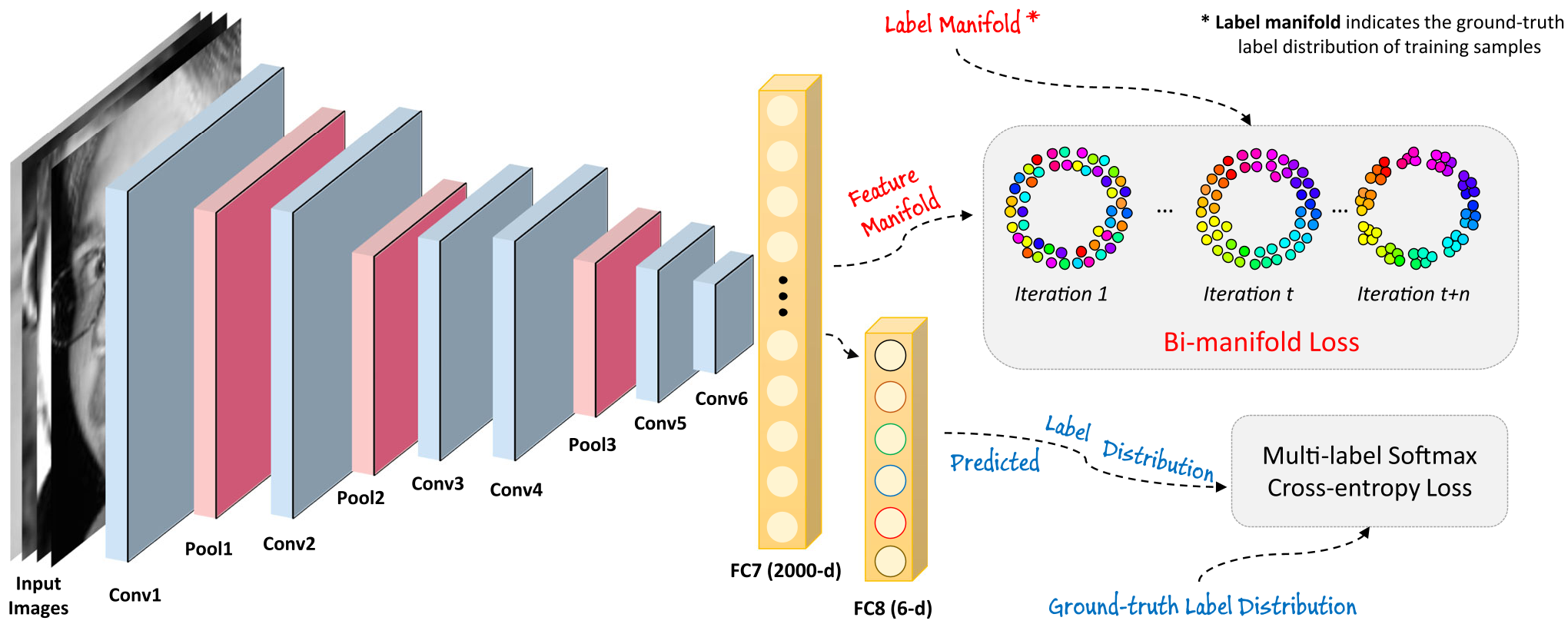 Figure 1: The DBM-CNN framework incorporating the Bi-Manifold Loss.
Experiments: Superior Generalization
The researchers didn't just stop at RAF-ML. They extended their model to the DBM-DACNN, using Domain Adaptation (specifically MK-MMD loss) to transfer knowledge from their multi-label data to traditional single-label datasets like CK+, SFEW, and MMI.
Key Findings:
- Multi-Label Power: DBM-CNN crushed standard AlexNet and VGG features across all metrics (Hamming Loss, Average Precision, F1-Score).
- Transfer Success: Even on single-label tasks, training on the "richer" multi-label RAF-ML data resulted in higher accuracy than training on the target datasets alone. For example, it hit 96.46% on the CK+ dataset.
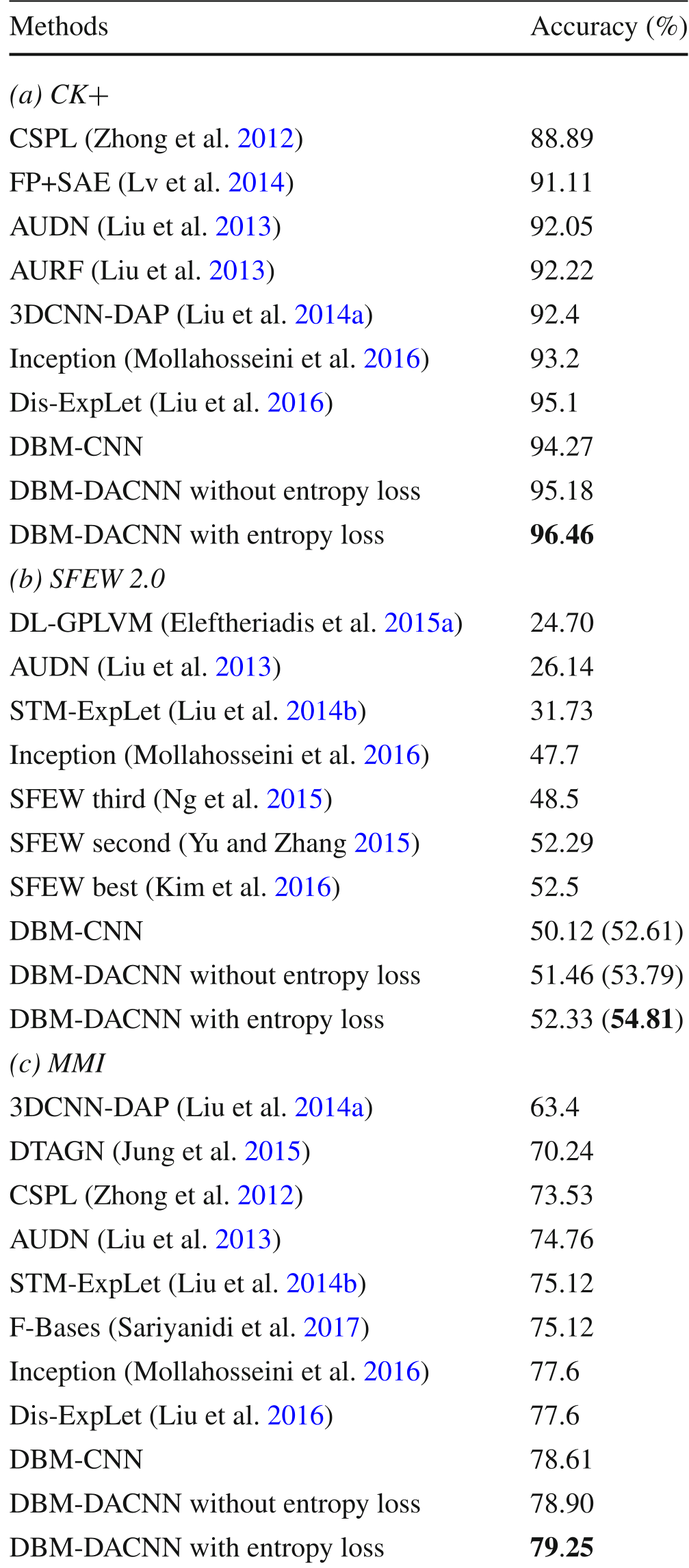 Table 1: Performance comparison across different datasets showing the robustness of DBM-DACNN.
Critical Insight: Why This Matters
The breakthrough here isn't just the dataset size—it's the architectural acknowledgment of emotional continuity. By treating facial features as residing on a manifold that mirrors the complexity of human labeling, the authors have provided a roadmap for more empathetic and accurate Human-Computer Interaction (HCI).
Limitations & Future Work
While the Bi-Manifold approach is powerful, it is computationally intensive due to the K-Nearest Neighbor (KNN) search within the manifolds during training. Future iterations might look into more efficient graph-based approximations to scale this to video-level real-time analysis.
Conclusion
The RAF-ML database and DBM-CNN framework represent a significant pivot in affective computing. By moving away from "winner-take-all" classification toward a nuanced, manifold-based understanding of emotion, we are one step closer to AI that truly understands the "blended" nature of human feeling.