
Toward Blockchain-Assisted Gamified Crowdsourcing: Bringing Transparency to Knowledge Refinement
Toward Blockchain-Assisted Gamified Crowdsourcing for Knowledge Refinement
This paper proposes a blockchain-assisted gamified crowdsourcing framework designed for knowledge graph refinement. By converting triple-based knowledge into yes/no quizzes within a chatbot interface, the system leverages "the wisdom of the crowd" to validate data while using blockchain to ensure transparency in reward distribution.
TL;DR
Building a high-quality Knowledge Base (KB) usually requires expert curation, but what if we could use casual smartphone users instead? This paper introduces a system that turns knowledge validation into a game. By using Blockchain to record player actions, the authors ensure that rewards are calculated fairly and transparently, solving the core challenge of trust and quality in Gamified Crowdsourcing.
Background: The Wisdom and the Noise
Knowledge Graphs, represented as triples like (Apple, Color, Red), are the backbone of intelligent systems—such as the word-retrieval assistant for people with aphasia discussed in this study. However, data scraped from the web or input by casual users is often "noisy" or incorrect.
The authors argue that while crowdsourcing can fix this, workers need two things:
- Motivation: Provided through Gamification (earning points).
- Trust: Provided through Blockchain (ensuring their points aren't tampered with and rewards are based on objective history).
The Core Mechanism: From Quiz to Chain
The refinement process follows a clear logic:
- Triple Extraction: Raw data enters a temporary knowledge base.
- Gamified Validation: Users interact with a LINE chatbot, answering simple "Yes/No/Don't Know" quizzes based on the triples.
- Consensus Logic: If a triple receives a threshold of votes () and a high enough agreement ratio (), it is promoted to the main knowledge base.
- Blockchain Integration: Every session log is pushed to a blockchain. This acts as the "Source of Truth" for calculating bonus rewards.
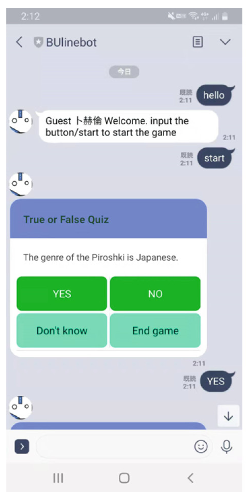 Figure: The prototype configuration shows the interaction between the Chatbot, the Knowledge Base, and the Blockchain ledger.
Methodology: Strategies for Selection
A key contribution of the paper is the analysis of Triple Selection Methods. How should the system choose which quiz to show the user?
- Narrow: Focuses on triples that already have some votes to "close them out" quickly.
- Wide: Spreads votes across as many triples as possible.
- Random: The baseline control.
Furthermore, the authors introduced User Reliability. Instead of every vote counting as "1", a user with a high history of correct answers (calculated from the blockchain) can have their vote weighted up to "3", significantly speeding up the consensus process.
Experimental Insights
Through simulations involving 1,000 virtual users, the study found that:
- The Wide method is slower to validate initially but ensures broader coverage.
- The Narrow method provides a steady stream of validated triples early on.
- Reliability Weighting is a "game-changer"—it reduces the total number of game sessions required to clean the knowledge base without sacrificing accuracy.
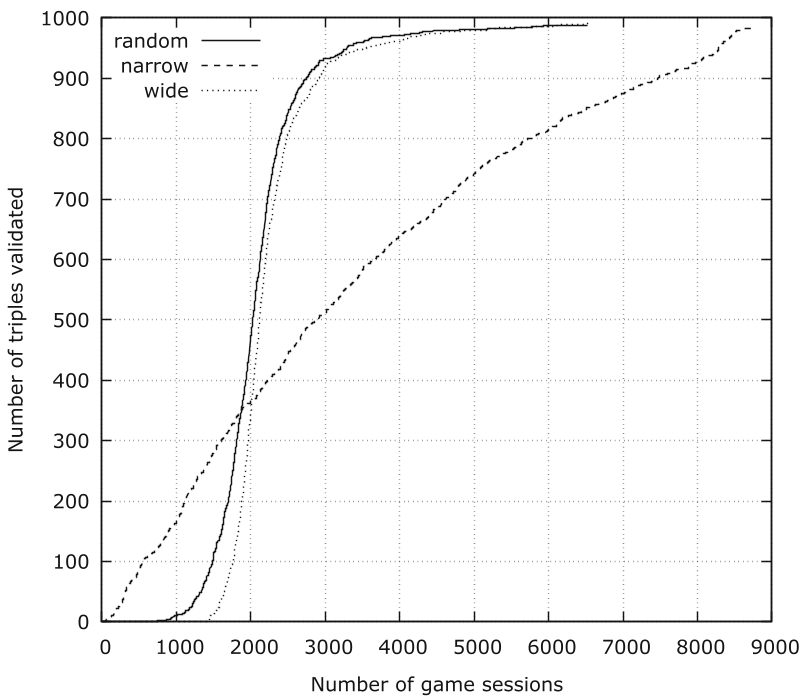 Figure: The impact of introducing User Reliability—note the sharper climb in validated triples over fewer game sessions.
Critical Analysis & Future Outlook
While the use of Naivechain and LINE demonstrates a practical, low-friction entry point for users, the study acknowledges scalability hurdles. Real-world blockchain latency can be a bottleneck for high-frequency gaming.
The Takeaway: This work moves beyond just "playing games" for data. It creates a provenance-aware environment. By recording the evolution of knowledge on a blockchain, we don't just get a cleaner knowledge graph; we get an auditable history of why we believe a certain fact is true.
Future Work: The next step is moving from simple "Validation" (Yes/No) to "Acquisition" (generating new triples) and testing the subjective "fun factor" with real human participants to ensure the game remains engaging over time.
Keywords: Blockchain, Knowledge Refinement, Gamified Crowdsourcing, Knowledge Graphs, Decentralized Trust.