
Securing the Social Fabric: Blockchain-Powered Authentication and Privacy in Community Detection
Authentication With Block-Chain Algorithm and Text Encryption Protocol in Calculation of Social Network
This paper introduces a privacy-preserving social network framework that combines the CMCR community detection algorithm with blockchain-based authentication and multi-layer hash encryption. The method ensures secure user identity verification and content recommendation by binding public keys to blockchain addresses and utilizing non-invertible text encryption for attribute matching.
TL;DR
As social networks grow increasingly complex, the risk of privacy leaks during community detection (finding your "circles") escalates. This paper presents a hybrid framework that integrates Blockchain technology for immutable identity verification and a Mixed Hash Encryption protocol to allow for "blind" similarity matching between users. The result is a system that identifies overlapping communities accurately while keeping personal attributes invisible to both malicious peers and curious servers.
Problem & Motivation: The Privacy-Utility Tradeoff
Modern social network analysis relies on "closeness" and "influence" to group users. However, calculating these metrics usually requires sharing friend lists, interests, and interaction history. This creates two major vulnerabilities:
- Identity Forgery: Malicious users can pretend to be someone else to gain access to private community data.
- Information Leakage: Even "semi-honest" users or servers can analyze intermediate calculation data to reverse-engineer a user’s private profile.
The authors argue that existing solutions, like Homomorphic Encryption, are too computationally expensive for the millions of nodes found in modern networks. They instead look toward the immutability of Blockchain and the one-way nature of Cryptographic Hashing.
Methodology: The Core Mechanics
1. Blockchain-Based Authentication
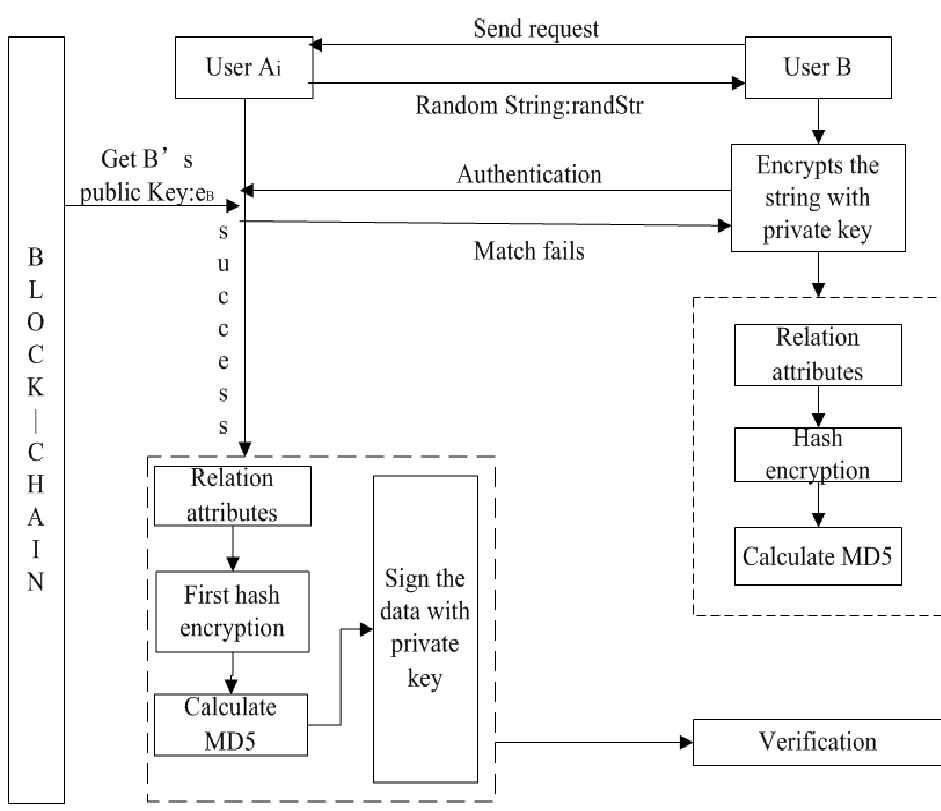
Instead of relying on a central Certificate Authority (CA), which is often a bottleneck, the researchers utilize a blockchain to store User Public Keys. By binding a public key to a specific blockchain address, the system ensures that keys cannot be tampered with or forged.
2. Mixed Hash Matching
To expansion communities without revealing plaintext data, the paper introduces a double-encryption protocol:
- The Logic: Before User A and User B compare interests, they hash their attributes using SHA1 and then MD5.
- The Result: They can compare the resulting "digests" to see if they match. If they match, intimacy is high; if they don't, the users learn nothing about what the actual attributes were because the hash is non-invertible.
3. Community Expansion (CMCR)
The core detection algorithm, CMCR, uses K-clique-community Seed Mining (KSM). It identifies "seeds" (small tightly-knit groups) and expands them based on influence and closeness metrics calculated through a PageRank-inspired random walk model.
Experiments & Results: Accuracy Meets Security
The researchers compared their enhanced CMCR algorithm against standard baselines like RSCM and K-means. The results consistently showed that CMCR identifies overlapping communities more effectively.
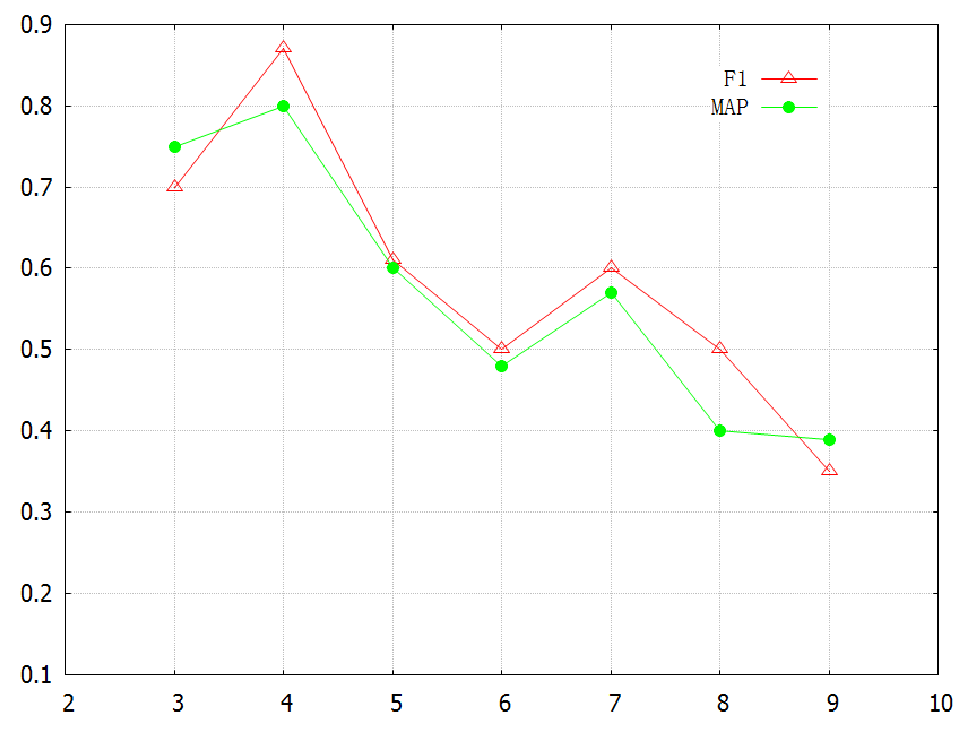
From a security standpoint, the "Brute Force" resistance was quantified. By using a multi-hash method (), the complexity of cracking the user data becomes exponentially higher, effectively neutralizing "Rainbow Table" attacks which typically target single-hash algorithms.
Critical Analysis & Conclusion
The Takeaway
The primary contribution of this work is the realization that social intimacy can be calculated through mathematical digests rather than raw data. By leveraging blockchain as a trust layer, the authors remove the need for a central authority, making the system more robust against single points of failure.
Limitations & Future Work
While the blockchain provides security, the paper does not deeply address the latency issues inherent in blockchain transactions, which could be a factor in real-time social networks. Additionally, while the multi-hash approach is strong, the field is rapidly moving toward Zero-Knowledge Proofs (ZKP), which might offer even stronger privacy guarantees without the theoretical risks associated with MD5 collisions.
Ultimately, this research provides a solid blueprint for the next generation of "Privacy-First" social platforms, where community discovery does not have to come at the cost of personal anonymity.