
Blockchain + Crowdsourcing: Decentralizing the "Last Mile" of Rural Logistics
Research on Crowdsourcing Mode of Internet + Rural Logistics Based on Blockchain
This paper proposes a decentralized crowdsourcing logistics model for rural areas by integrating "Internet Plus" strategy with Blockchain technology. It introduces a system where local farmers act as logistics providers, using smart contracts to ensure data authenticity and mutual trust in the rural supply chain.
TL;DR
The vastness and fragmentation of rural geography make traditional logistics inefficient and expensive. This paper explores how Blockchain and Smart Contracts can empower farmers to become deep participants in a crowdsourced logistics network, replacing centralized oversight with decentralized trust to solve the "last mile" delivery crisis.
The Rural Logistics Bottleneck: Why Centralization Fails
Rural logistics is often described as the "circulatory system" of rural economic development, yet it remains clogged. Existing methods rely on centralized platforms that face:
- High Supervision Costs: Managing thousands of part-time rural couriers is labor-intensive.
- Information Asymmetry: Demanders cannot verify the reliability of service providers.
- Security Concerns: High rates of package loss and lack of accountability for the "first" and "last" mile.
The authors' core insight is that farmers should be the primary logistics variables. By involving them deeply, enterprises can leverage idle local labor and transportation resources, provided a technical "trust guarantee" exists.
Methodology: The Blockchain Architecture
The paper introduces a framework where every logistics action—negotiation, pick-up, distribution, and signing—is treated as a node in a blockchain.
1. Smart Contract Logic
Once a farmer and a customer (or enterprise) agree on a task, a smart contract is triggered. This digital agreement automatically manages:
- Order Generation: Matching supply and demand.
- Execution Tracking: Time-stamped proof of delivery.
- Automatic Finalization: Remuneration is released only when the recipient’s electronic signature is verified on-chain.
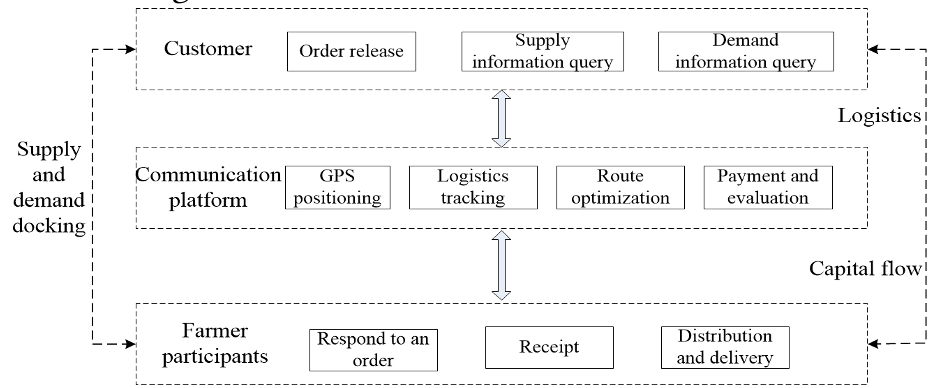 The interaction between customers, the crowdsourcing platform, and farmer participants.
2. Dual Platform Scenarios
The research delineates two deployment modes:
- Self-built Enterprise Platforms: Direct recruitment of rural labor by large logistics firms to control their own ecosystem.
- Third-party Platforms: A more open ecosystem where enterprises, farmers, and customers coexist as equal users, with the blockchain acting as the neutral arbiter.
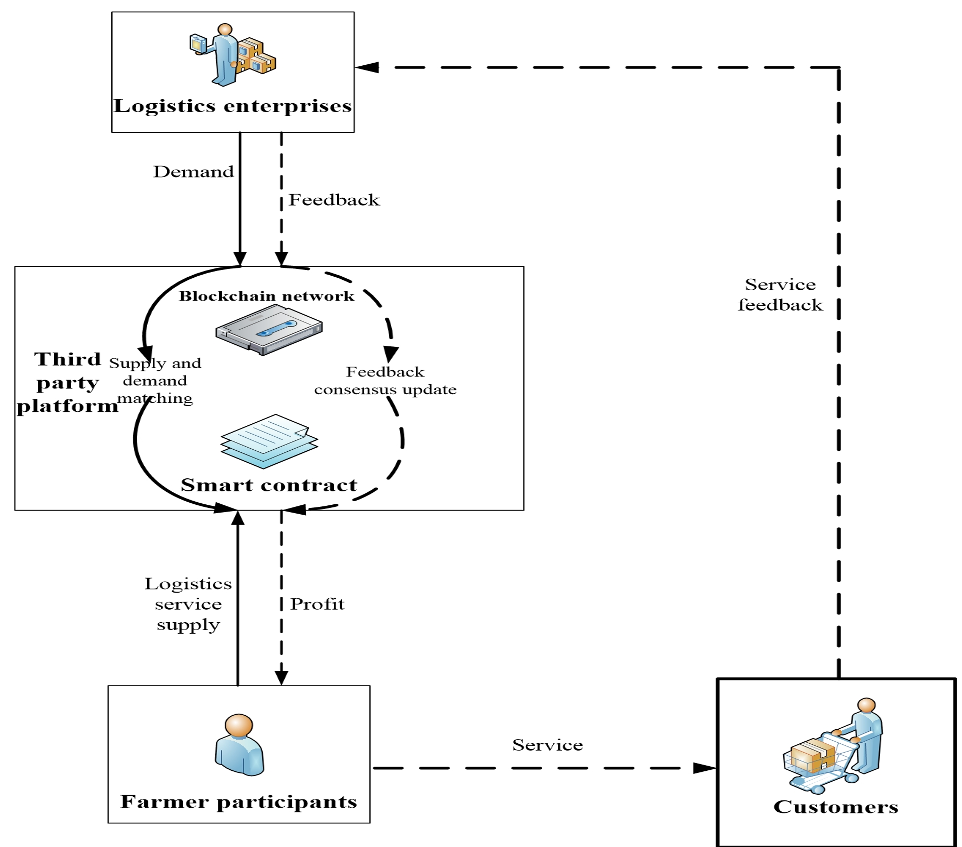 Figure: The 7-step transaction chain—from negotiation to payment—rendered as immutable blocks.
Experiments & Core Insights
By analyzing the crowdsourcing process, the authors identify several transformative impacts:
- Traceability: Each package has a distinct trail. If a loss occurs, the hash sequence identifies exactly which node failed.
- Resource Optimization: Idle labor (farmers) is transformed into an elastic logistics workforce, reducing the fixed costs of rural delivery stations.
- Incentive Alignment: The use of consensus algorithms ensures that farmers are rewarded fairly and instantly, overcoming the traditional delay in payments typical of rural labor.
Critical Analysis & Conclusion
While the paper provides a robust logical framework for trust, it acknowledges that the "Internet + Rural Logistics" mode is still evolving.
Pros:
- Strong alignment with the "Sharing Economy" philosophy.
- Effective use of Smart Contracts to automate liquidated damages and service evaluation.
Limitations & Future Outlook: The primary challenge remains the technical threshold for farmers to interact with blockchain interfaces. Furthermore, the energy consumption of Proof-of-Work (PoW) in large-scale rural networks could be a barrier. Future research should look into Permissioned Blockchains (Consortium Chains) that offer higher throughput and lower energy costs, making "Internet + Rural Logistics" not just possible, but sustainable.
By shifting from "Corporate-heavy" to "Community-light," this blockchain model offers a blueprint for rural revitalization that is technically secure and economically inclusive.