
DB-SCS: Scaling Secure Spatial Crowdsourcing in SDN-IoV with Blockchain and DRL
8695_Blockchain and Deep Reinforcement Learning Empowered Spatial Crowdsourcing in Software-Defined Internet of Vehicles.
This paper introduces DB-SCS, a Deep Reinforcement Learning (DRL) and Blockchain-empowered Spatial Crowdsourcing System designed for Software-Defined Internet of Vehicles (SDN-IoV). By integrating a multi-blockchain hierarchical structure with DQN-based optimization, it achieves secure data collection and efficient task allocation, significantly improving throughput by up to 100% compared to single-chain baselines.
TL;DR
The paper introduces DB-SCS, a framework designed to bridge the gap between heavy privacy requirements and high-performance demands in the Internet of Vehicles (IoV). By combining a hierarchical multi-blockchain structure with Deep Reinforcement Learning (DRL), the authors solve the dual challenge of preventing collusion attacks and overcoming the inherent latency bottlenecks of traditional blockchain systems.
Problem & Motivation: The Privacy vs. Efficiency Paradox
In the era of Intelligent Transportation Systems (ITS), spatial crowdsourcing is essential for traffic monitoring and smart navigation. However, the movement of vehicles involves sensitive location and Identity data.
Current solutions face three main roadblocks:
- Vulnerability to Attacks: Malicious workers can launch Sybil attacks (multiple identities) or Collusion attacks to piece together private task information.
- Centralization Risks: Traditional SDN controllers suffer from a "single point of failure."
- Performance Bottlenecks: Standard Blockchain implementations are often too slow for the dynamic "edge-speed" environment of vehicles.
The authors' core insight is that tasks are not created equal. By classifying tasks into distinct security tiers and using AI to manage the blockchain's internal clock (consensus/block timing), security can be achieved without crippling the network.
Methodology: The Three-Layer Defense
The DB-SCS architecture is split into three functional layers:
1. Spatial Crowdsourcing Layer (The Manager)
This layer handles Task Classification. Tasks are tiered (A, B, or C) based on privacy sensitivity. Workers are assigned credit scores based on their historical performance and reliability.
2. Blockchain Layer (The Vault)
Instead of a monolithic chain, the system uses Hyperledger Fabric to create "sub-blockchains" (channels).
- A worker at Level C cannot "see" or query Level A tasks.
- This physical isolation effectively kills Sybil and Collusion attacks.
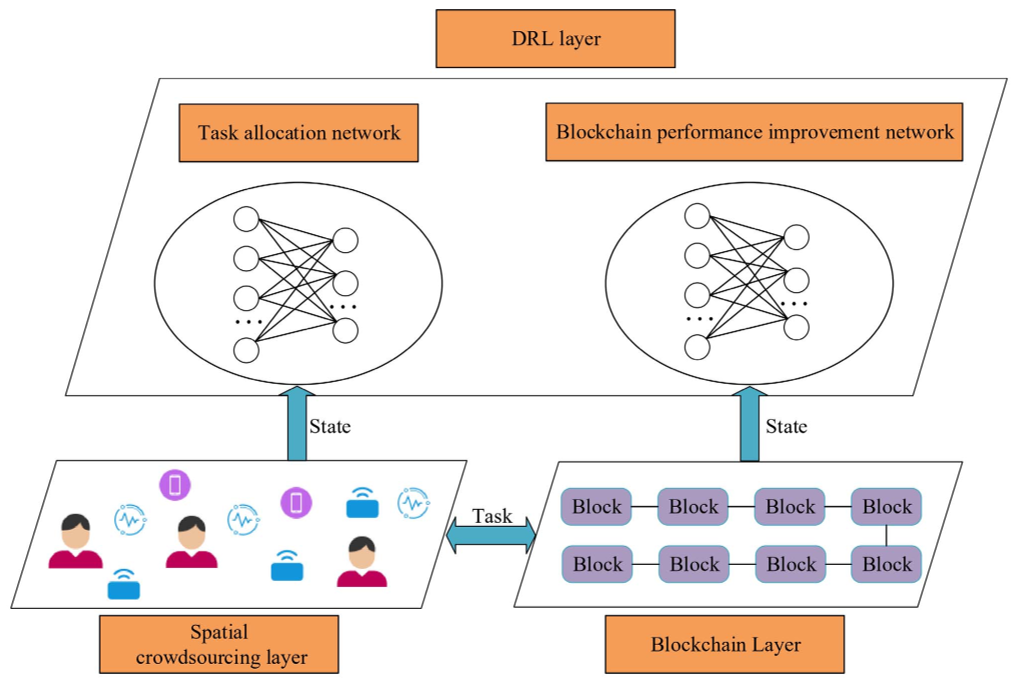
3. DRL Layer (The Optimizer)
The system uses Deep Q-Networks (DQN) to manage two critical operations:
- Privacy-Aware Allocation: Selecting workers by balancing the physical distance (Euclidean) and their creditworthiness.
- Throughput Optimization: Dynamically switching between consensus algorithms (Solo vs. Kafka) and adjusting block sizes/intervals based on real-time network load.
Experiments & Results: Triple-Chain Superiority
The evaluations were conducted using a Hyperledger Fabric 1.2 environment with 800 task receivers.
- Throughput Revolution: The proposed "triple-chain" structure showed a staggering 37% to 100% improvement in throughput over double and single-chain configurations.
- Accuracy under Pressure: Even when worker credit was low, DB-SCS maintained a 92% task assignment accuracy, significantly higher than "Server Assigned Tasks" (SAT) or "Worker Selected Tasks" (WST) baselines.
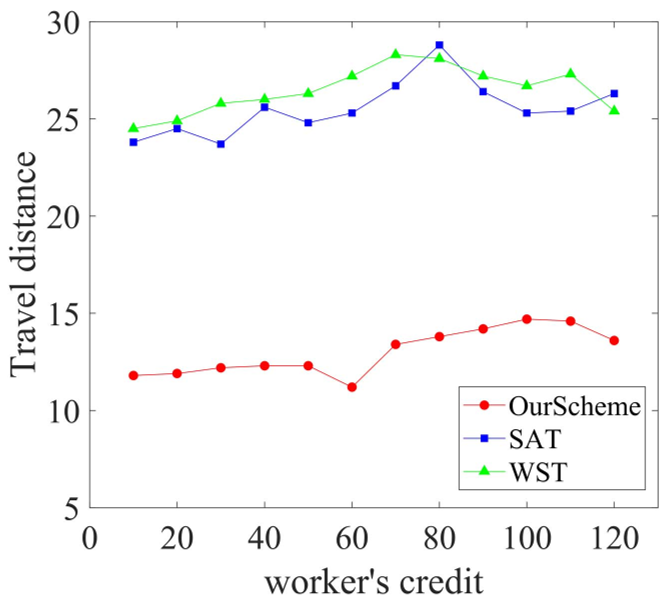
The DRL mechanism proved particularly effective at minimizing Travel Distance, ensuring that the most suitable vehicle is picked for the task, reducing carbon footprints and latency.
Critical Analysis & Conclusion
Takeaway
DB-SCS demonstrates that blockchain in IoV isn't just about security; when augmented by DRL, it becomes a high-performance orchestrator. The use of sub-blockchains to partition security domains is a pragmatic and powerful design pattern.
Limitations
- Hardware Constraints: The simulation was run on 16GB RAM/i5 systems; however, the actual deployment on vehicular OBU (On-Board Units) with limited compute may face resource contention.
- DQN Convergence: While DQN works well, more modern algorithms like PPO or Soft Actor-Critic (SAC) might offer better stability in highly non-stationary IoV environments.
Future Outlook
The next step for this research involves exploring Asynchronous Federated Learning within sub-blockchains, allowing vehicles to train local models without ever sharing raw crowdsourced data, further bolstering privacy.