
Decoupling Trust from Social Platforms: A Blockchain-CP-ABE Approach to Private Friend Discovery
A Blockchain-Based Privacy-Preserving Mechanism for Attribute Matching in Social Networks
The paper proposes a privacy-preserving attribute matching mechanism for social networks using a combination of Ciphertext-Policy Attribute-Based Encryption (CP-ABE) and a hierarchical consortium blockchain. The system enables users to discover friends based on fine-grained attribute similarity while keeping private data hidden from semi-honest platforms and resisting collusion attacks.
Executive Summary
TL;DR: This paper introduces a decentralized framework for "friend discovery" that prevents social network platforms from snooping on user attributes. By combining CP-ABE (Ciphertext-Policy Attribute-Based Encryption) for fine-grained access control and Hierarchical Blockchain for verifiable matching, the authors enable users to find like-minded peers without revealing their personal data to the intermediary.
Background: In the landscape of Online Social Networks (OSN), the platform is often a "semi-honest" entity—it follows the protocol but attempts to learn as much as possible about users for advertising or surveillance. This work shifts the matching logic from a black-box server to a transparent, traceable smart contract.
The Problem: The "Curious" Intermediary
Traditional friend-matching usually falls into three traps:
- High Overhead: Methods like Homomorphic Encryption (HE) or SMC are too slow for mobile users.
- Weak Privacy: Vector dot products are susceptible to statistical attacks that leak attribute distributions.
- Collusion Risk: Centralized servers can collude with malicious users to decrypt private profiles.
The authors argue that as long as a single entity controls the matching server, user privacy is at the mercy of that entity's integrity.
Methodology: Hierarchical Trust
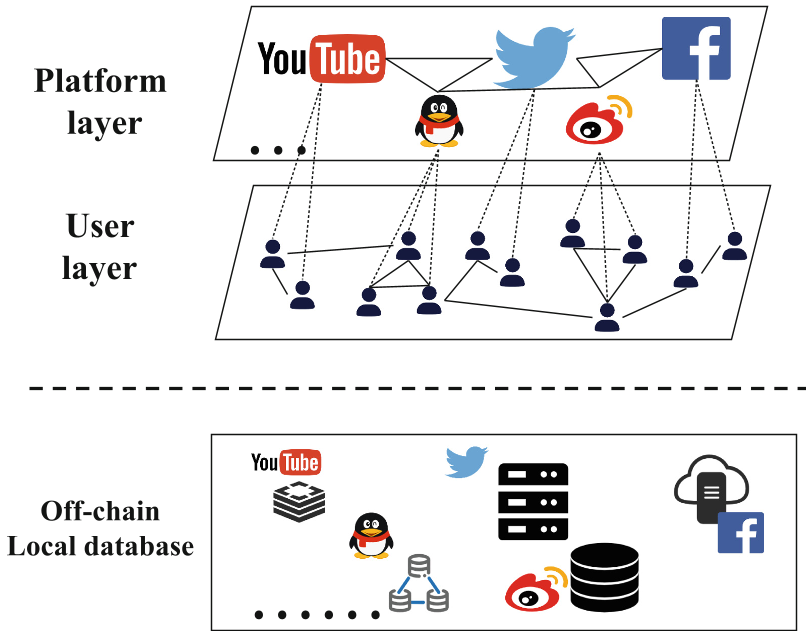
The proposed system, as shown in the architecture below, relies on four entities: the User, OSNP (acting as consensus nodes), Blockchain (the execution engine), and a Trusted Authority (TA) for initial key management.
1. The Hierarchical Blockchain Architecture
Unlike flat blockchains that struggle with scale, this scheme uses a hierarchical structure:
- User Layer: Casual communication and matching requests.
- Platform Layer (Consortium): OSNPs act as miners/consensus nodes, running smart contracts.
- Off-chain Storage: Private databases hold attribute ciphertexts to keep the chain "lean."
2. The Matching Protocol
The core logic involves a clever multi-layer encryption strategy:
- Initiator encrypts their attributes with a symmetric key ().
- Initiator broadcasts and the smart contract address, but protects them using CP-ABE. Only users meeting a specific "Access Policy" (e.g., "Age > 20 AND Hobby = Hiking") can decrypt this message.
- Responders who pass the ABE check then submit their own -encrypted attributes to the Smart Contract.
- Smart Contract (Algorithm 1) calculates the similarity on the ciphertexts and establishes a channel if the threshold is met.
Experimental Results
The authors implemented the prototype using Hyperledger Fabric, Go, and the PBC Library.
Performance Highlights:
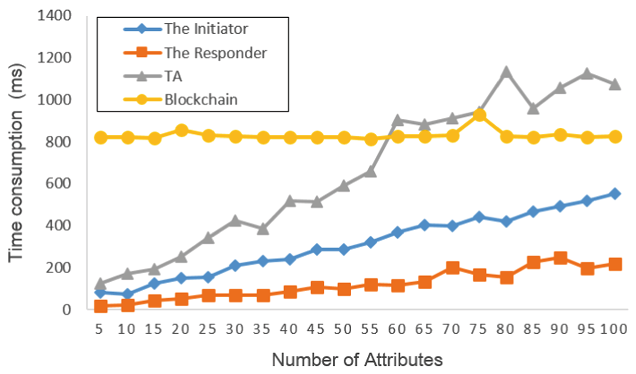
- Computational Efficiency: AES operations remain negligible (sub-millisecond) even as attributes scale to 100.
- Blockchain Latency: Smart contract execution (attribute matching) is highly optimized, taking roughly 15ms for 100 attributes.
- Scalability: The hierarchical design ensures that as the number of attributes grows, the time consumption grows linearly, not exponentially.
Deep Insight & Conclusion
Why it Works
The brilliance of this scheme lies in the separation of concerns. CP-ABE handles who is allowed to even attempt a match, while the Blockchain ensures the matching process is honest. By storing only the hash values of parameters on-chain, the system provides auditability (traceability) without sacrificing long-term privacy.
Limitations & Future Work
While robust, the current model relies on a Trusted Authority (TA) for the initial master key. If the TA is compromised, the whole system fails. The authors' future roadmap includes decentralizing the TA using the blockchain itself and introducing Proxy Cloud Servers (PCS) to offload the heavy pairing-based cryptography from mobile devices—an essential step for mass adoption.
Takeaway: The transition from "Don't be evil" (centralized trust) to "Can't be evil" (cryptographic/blockchain trust) is the future of social privacy.