
Blockchain-Based UAV Path Planning: The Identity & Security Backbone of Healthcare 4.0
14125_Blockchain-Based UAV Path Planning for Healthcare 4.0 Current Challenges and the Way Ahead.
This paper proposes a blockchain-based Unmanned Aerial Vehicle (UAV) path planning framework for Healthcare 4.0, integrating a three-layered architecture to ensure secure real-time medical data collection and transmission. By utilizing the Proof of Work (PoW) consensus mechanism and Public Key Infrastructure (PKI), the system achieves a decentralized, privacy-preserving solution for healthcare logistics.
Executive Summary
TL;DR: This research addresses the critical need for secure, decentralized logistics in modern medicine by combining Unmanned Aerial Vehicles (UAVs) with Blockchain technology. By developing a three-layered framework, the authors provide a mechanism for UAVs to plan collision-free paths while ensuring that sensitive medical data (e.g., blood samples, EHRs) remains immutable and private via Proof of Work (PoW) and SHA-256 encryption.
Positioning: This work represents a significant architectural integration in the Healthcare 4.0 domain. It moves beyond simple data storage to "Actionable Security"—using the blockchain not just for records, but as a coordination layer for physical robotic movement in medical delivery.
Problem & Motivation: The Fragility of Centralized Care
The transition from Healthcare 3.0 to 4.0 is stalled by technical bottlenecks. Current systems rely on centralized databases, creating a "single point of failure." In emergency medical delivery, a hacker hijacking a UAV or tampering with patient location data could be fatal.
Existing path planning strategies often ignore Identity Management. If a UAV's identity is spoofed, malicious actors can intercept medical supplies. The authors recognize that for UAVs to truly revolutionize medicine, we need a "Trustless Architecture" where every flight path and data exchange is verified by a distributed network rather than a single server.
Methodology: The Three-Layered Trust Architecture
The proposed model functions through three distinct yet interconnected layers:
- Patient Data Layer: Uses PKI (Public Key Infrastructure) to encrypt clinical imaging and wearable sensor data.
- Blockchain UAV Layer: The "engine" of the system. UAVs function as nodes. Miner nodes validate "blocks" of data and geographical coordinates using PoW, ensuring that the path planned is verifiable by all other drones in the vicinity to avoid collisions.
- Analytics Layer: Once data is securely transmitted, AI and machine learning models process the records to provide insights for doctors and pharmaceutical research.
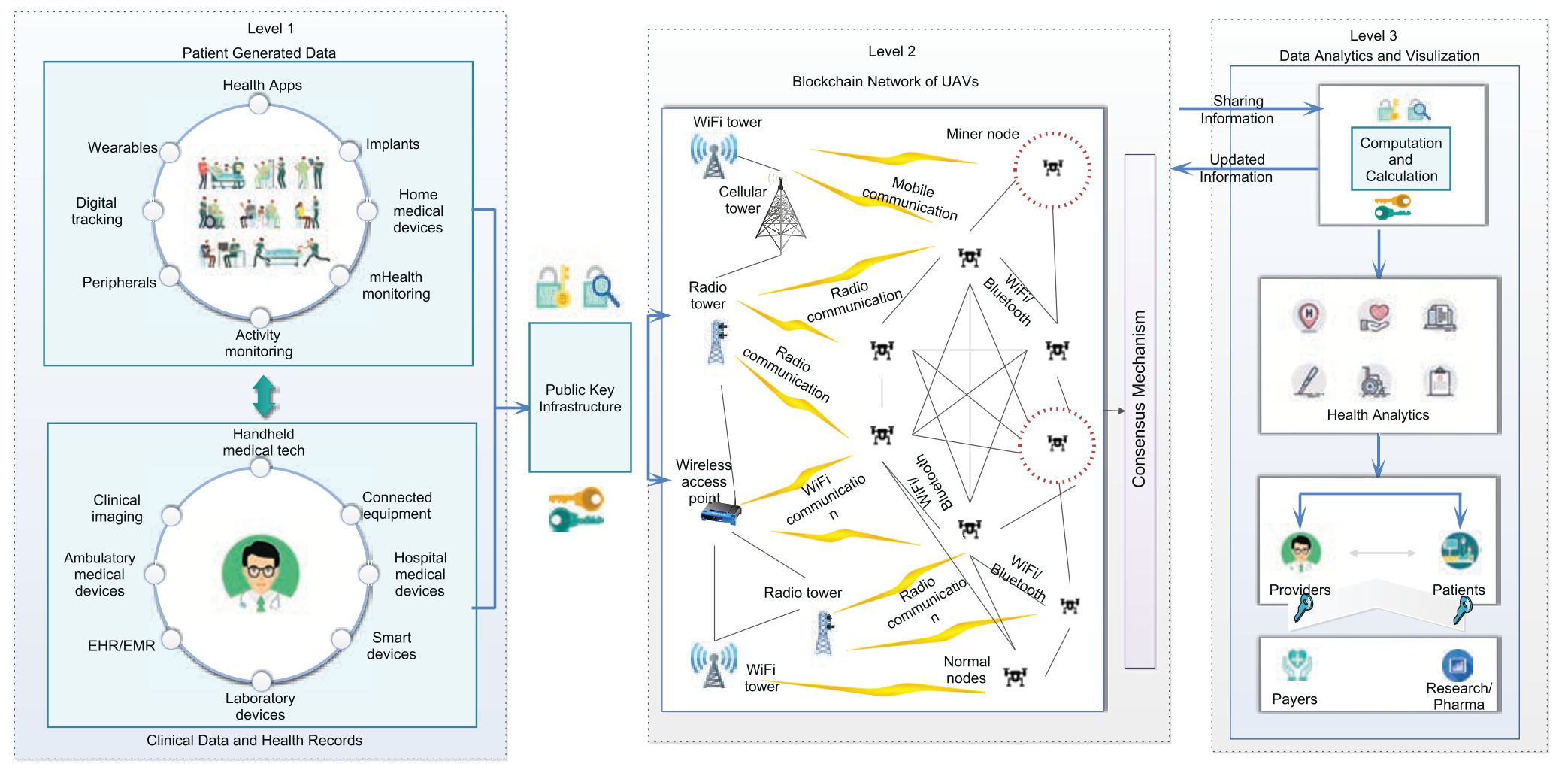 Figure 1: The Three-Layered Architecture for Data Collection and Transmission.
The paper emphasizes the use of IPFS (Interplanetary File System) for storage. Instead of storing massive video/audio medical files directly on the blockchain (which is prohibitively expensive), the system stores the hash of the file, ensuring data integrity without bloating the ledger.
Experiments & Results: Efficiency through Decentralization
The researchers compared their work against several baselines (Ying et al., Rahman et al.). The key victory for this model is in Availability and Decentralization.
- Access Speed: Simulation shows that requesting and receiving EHR data via the blockchain/IPFS hybrid is faster than traditional cloud-only authentication, as there is no centralized bottleneck during peak request times.
- Security Robustness: Unlike previous schemes, this model maintains integrity even if individual communication links are compromised, as the global ledger remains consistent across all UAV nodes.
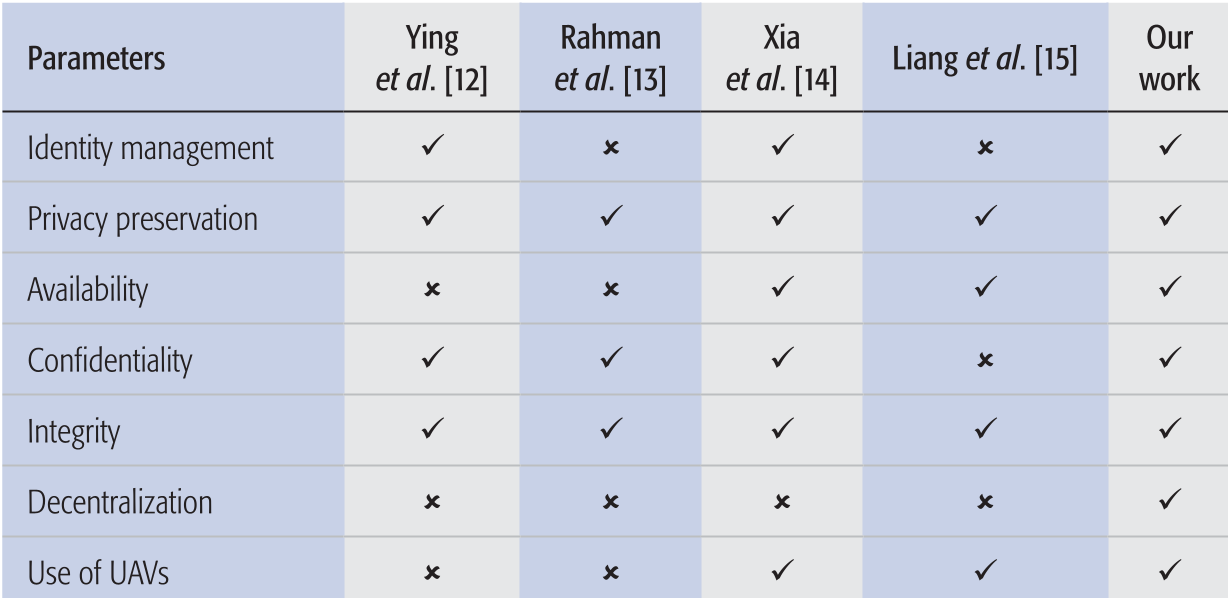 Table 1: Comparative analysis showing the proposed work's superiority in decentralization and UAV integration.
Critical Analysis & Conclusion
Takeaway: This paper successfully demonstrates that blockchain is more than a "database"; it is a safety protocol for robotic systems. By linking path planning to a distributed ledger, the risk of UAV collisions and data hijacking is significantly mitigated.
Limitations:
- Gas Costs: The authors acknowledge that storing data on networks like Ethereum is expensive (approx. $285 for 0.5 MB). Large-scale medical video files are still commercially unviable for on-chain storage.
- Scalability: With current blockchain speeds (e.g., 12 tps for Ethereum), a massive fleet of thousands of UAVs in a city might face latency issues in path updating.
Future Outlook: The next frontier will likely involve moving away from energy-intensive Proof of Work (PoW) toward Proof of Stake (PoS) or Directed Acyclic Graphs (DAG) to support the high-frequency requirements of real-time UAV swarm coordination in Healthcare 4.0.