
BNINS: Reclaiming Control—The Host Perspective in Blocking Negative Influence
Blocking negative influential node set in social networks: from host perspective
The paper introduces the Blocking Negative Influential Node Set (BNINS) problem within a social network context. It focuses on a host-controlled perspective where the network host manages seed allocation to minimize negative influence spread while maximizing positive adoptions for multiple competing companies using a novel two-phase diffusion model.
TL;DR
Social networks are battlegroups for ideas, but not all interactions are positive. This paper explores a novel scenario where the network host (e.g., Meta or X) manages how different companies launch viral marketing campaigns. By introducing the Blocking Negative Influential Node Set (BNINS) problem, the authors provide a framework to maximize positive product adoption while strategically minimizing the spread of negative opinions across a signed graph.
Background & Positioning
Since Kempe et al.'s seminal work in 2003, Influence Maximization (IM) has focused on finding "seeds" that trigger the largest cascade. However, most research assumes a "lawless" spread where nodes only have positive influence. This paper moves the needle by:
- Modeling Competition: Multiple companies vying for the same users.
- Signed Edges: Acknowledging that your friend's recommendation might actually make you not want a product (negative influence).
- Governance: Positioning the network host as the central authority in seed distribution.
The Problem: The Hidden Power of Negative Edges
In a typical social graph, we assume . Real life is messier. If node has a negative opinion on , their interaction might push further away from a target behavior. Existing models struggle when a network contains these conflicting forces. The challenge for a host is: Which seeds can I give to Company A to ensure Company B's negative "smear campaign" or opposing idea is contained?
Methodology: Two-Phase Diffusion and Amplification
The authors propose a weighted directed graph where weights are split into and .
1. The Dual-Threshold Diffusion Model
Nodes have two activation thresholds .
- Phase 1 (Influence): An inactive node accumulates influence from neighbors. It doesn't care which company is influencing it yet; it just waits for the total pressure to cross its internal threshold.
- Phase 2 (Selection): Once activated, the node picks a specific company's opinion based on the relative strength of that company's influence among its neighbors.
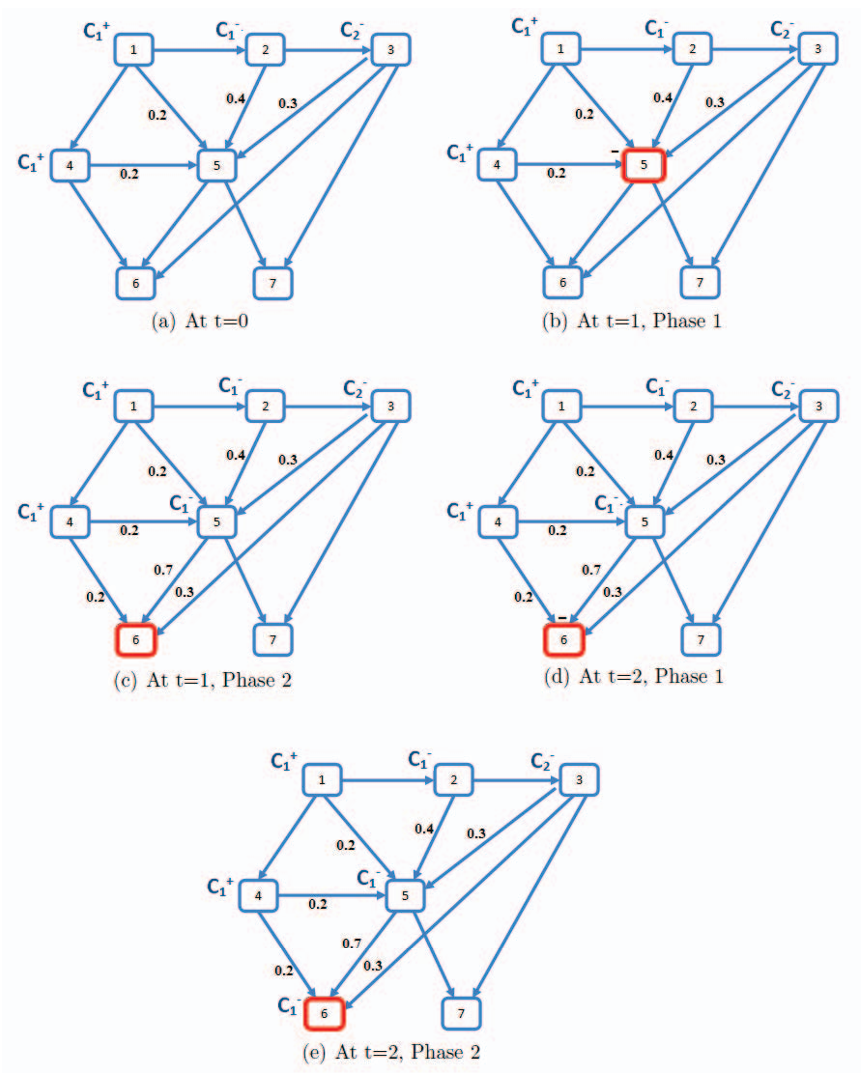
2. The BNINS-GREEDY Algorithm
To solve the selection problem, the authors define an Amplification Function . This function calculates the potential influence spread per seed by balancing positive and negative weights against the node's thresholds.
The proposed algorithm follows a greedy heuristic:
- Initialize the positive seed set as empty.
- Iteratively evaluate nodes using the Amplification Function.
- Select nodes that satisfy the condition of being positively activated while staying below the negative activation threshold.
Critical Analysis & Future Outlook
This work addresses a critical gap in Social Governance. By taking a host perspective, it offers a mathematical foundation for how platforms can mitigate "toxic" cascades or competitive interference.
Limitations: As an extended abstract, the paper currently lacks large-scale empirical validation. The complexity of the probability calculation in Phase 2 may also lead to high computational overhead in massive graphs (millions of nodes), suggesting a need for more efficient approximation techniques (like RIS - Reverse Influence Sampling) in future iterations.
Conclusion
The BNINS problem represents a sophisticated evolution of influence studies. By recognizing that social networks are not just monolithic pipes of information but complex ecosystems of positive and negative pressure, the authors provide a toolkit for more responsible and controlled viral marketing.