
Understanding Blooming Human Groups: A Multi-Modal Leap into Social Identity Recognition
Understanding Blooming Human Groups in Social Networks
This paper introduces a multi-modal framework for "Blooming Human Group" categorization in social networks, utilizing Convolutional Neural Networks (CNNs) and semantic text embeddings (Skip-gram) to recognize emerging social identities. By integrating face, upper body, and global visual features, the method enables the recognition of "new concepts" (e.g., Loli, Geek, Otaku) using only a few positive samples.
TL;DR
Researchers have developed a system that identifies emerging human social groups (like "Geek," "Mori Girls," or "Otaku") by combining specialized CNNs for face and body analysis with semantic text processing. The breakthrough lies in its ability to learn these "blooming" social concepts from just a handful of images, effectively mapping visual appearance to the ever-evolving language of social media.
Problem & Motivation: The Static Attribute Trap
For years, computer vision viewed humans through a narrow lens: age, gender, and skin color. However, social networks have given birth to "human groups"—populations defined by shared style, ideals, and visual aesthetics.
The challenge is twofold:
- Dynamic Nature: New social identities (e.g., "Hikikomori," "Gaofushuai") emerge constantly. Traditional fixed-category classifiers cannot keep up.
- Data Scarcity: While "gender" has millions of labels, a niche subculture might only have a few clear positive samples available for training.
The authors' insight was to treat social identity as a multi-modal problem, where the "truth" lies in the intersection of facial features, apparel (upper body), and the surrounding linguistic context (social tags).
Methodology: The Core Architecture
The proposed framework utilizes a triple-threat visual approach combined with a sophisticated text embedding pipeline.
1. Visual Multi-Part Modeling
The system doesn't look at the human as a single blob. It decomposes the image into:
- Face Model: A "Network in Network" (NIN) architecture pre-trained on LFW/CASIA. It captures the nuances of hairstyle, makeup, and expression.
- Body Model: A 7-layer CNN pre-trained on ImageNet, focused on the upper body. This is crucial for capturing "apparel" which defines many social groups (e.g., business suits vs. forest-style clothing).
- Global Features: Using DeCAF (Deep Convolutional Activation Feature), the model extracts scene and background context (e.g., a "Geek" might be surrounded by hardware).
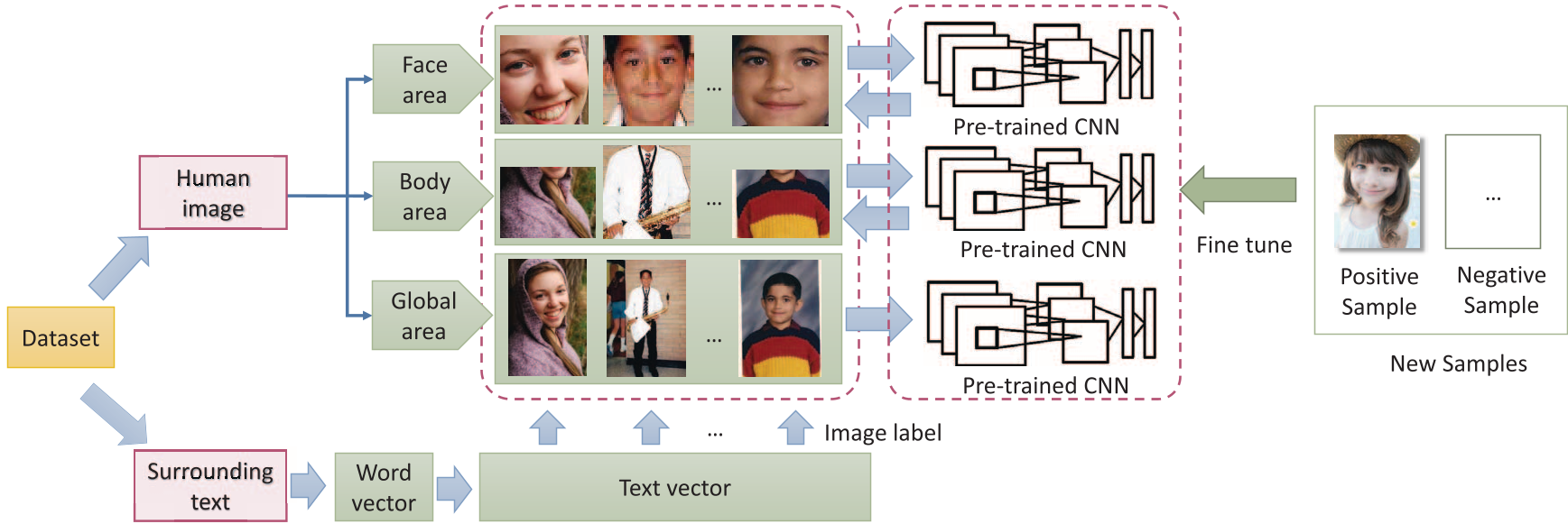
2. Turning Noisy Tags into Semantic Labels
Instead of manual labeling, the authors used Skip-gram (Word2Vec) models to transform surrounding social text into 300-D vectors. By applying sparse coding and max pooling, they converted messy, inconsistent tags into a robust 1024-D image label that carries actual semantic weight.
Experiments & Results: Learning "Loli" and "Otaku"
The researchers tested the system on 212,400 Flickr images and 8 "blooming" concepts.
- The Few-Shot Advantage: Using only ~10 samples per new category, the model was fine-tuned.
- Performance: The model performed exceptionally well on concepts with distinct visual markers. For instance, "Loli" attained 69.6% accuracy, and "Hikikomori" reached 50%.
- Ablation Insights: The inclusion of Global Features significantly reduced test errors, proving that "where" a person is (context) is often as important as "who" they look like when determining social group.
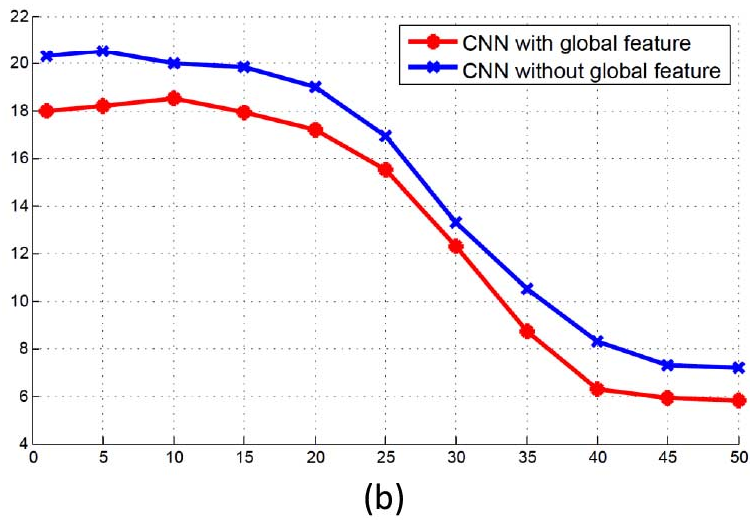
Fig: Test errors significantly decrease when merging Face, Body, and Global features compared to individual models.
Critical Analysis & Conclusion
Takeaway
This paper serves as an early pioneer in Semantic-Visual Proximity. It demonstrates that pre-trained deep features from biological traits (faces) and objects (ImageNet) can be repurposed for cultural sociology.
Limitations
- Manual Intervention: While label generation is "automatic," the system still requires face/body detection to be accurate.
- Concept Complexity: Some concepts like "Goddess" or "Geek" are more abstract and subjective, leading to lower accuracies (~33-42%) compared to visually distinct groups.
Future Outlook
The authors suggest that embedding the semantic relationship of the text deeper into the visual model (a precursor to modern CLIP/Alignment architectures) is the next frontier. As social groups continue to bloom online, this multi-modal approach remains the gold standard for adaptive human understanding.