
Engineering Reliability: Overcoming the Unique MAC Challenges in Body Area Networks
3483_Challenges in body area networks for healthcare the MAC.
This paper explores the challenges of Medium Access Control (MAC) in Wireless Body Area Networks (BANs) for healthcare. It evaluates the IEEE 802.15.6 standard and proposes four optimization techniques—Dynamic Slot Allocation, Adaptive Retransmissions, Relay Nodes, and Transmit Power Control—to achieve high reliability and energy efficiency.
TL;DR
Body Area Networks (BANs) are the backbone of the ubiquitous healthcare revolution, but they face a hostile wireless environment where the human body itself acts as a massive attenuator. This paper analyzes the IEEE 802.15.6 standard and introduces four "channel-aware" MAC techniques—Dynamic Allocation, Adaptive Retransmission, Relaying, and Power Control—that significantly boost reliability while reducing energy consumption by exploiting the slow-moving nature of body-centric wireless channels.
The "Human" Problem: Why Standard Protocols Fail
In typical wireless networks, signal degradation is a function of distance. In BANs, the primary antagonist is shadowing. When a sensor is placed on the chest and the hub is on the back, or when a patient sleeps and covers a sensor with their arm, the signal can experience attenuation exceeding 100 dB.
Current standards like Bluetooth were not built for:
- Extreme Energy Constraints: Sensors are tiny; batteries must last years.
- Deep Outages: Signal loss isn't just noise; it’s a physical blockage that can last from milliseconds (during movement) to minutes (during sleep).
- Dynamic Topology: As humans move, the network graph literally bends and stretches.
Methodology: Exploiting Channel Intuition
The authors' core insight is that the BAN channel is slowly changing compared to traditional mobile networks. If a link is currently in "outage," it is highly likely to remain so for the next few cycles. Conversely, a strong link is likely to stay strong.
1. The Flipping Algorithm (Dynamic Slot Allocation)
Instead of fixed TDMA slots, the authors propose an opportunistic scheduling strategy based on a two-state Markov model (Good/Bad).
- Good Links: Scheduled first, but in reverse order of how they were seen (prioritizing the freshest "good" data).
- Bad Links: Scheduled last to give the physical environment the maximum time to "recover" or change state.
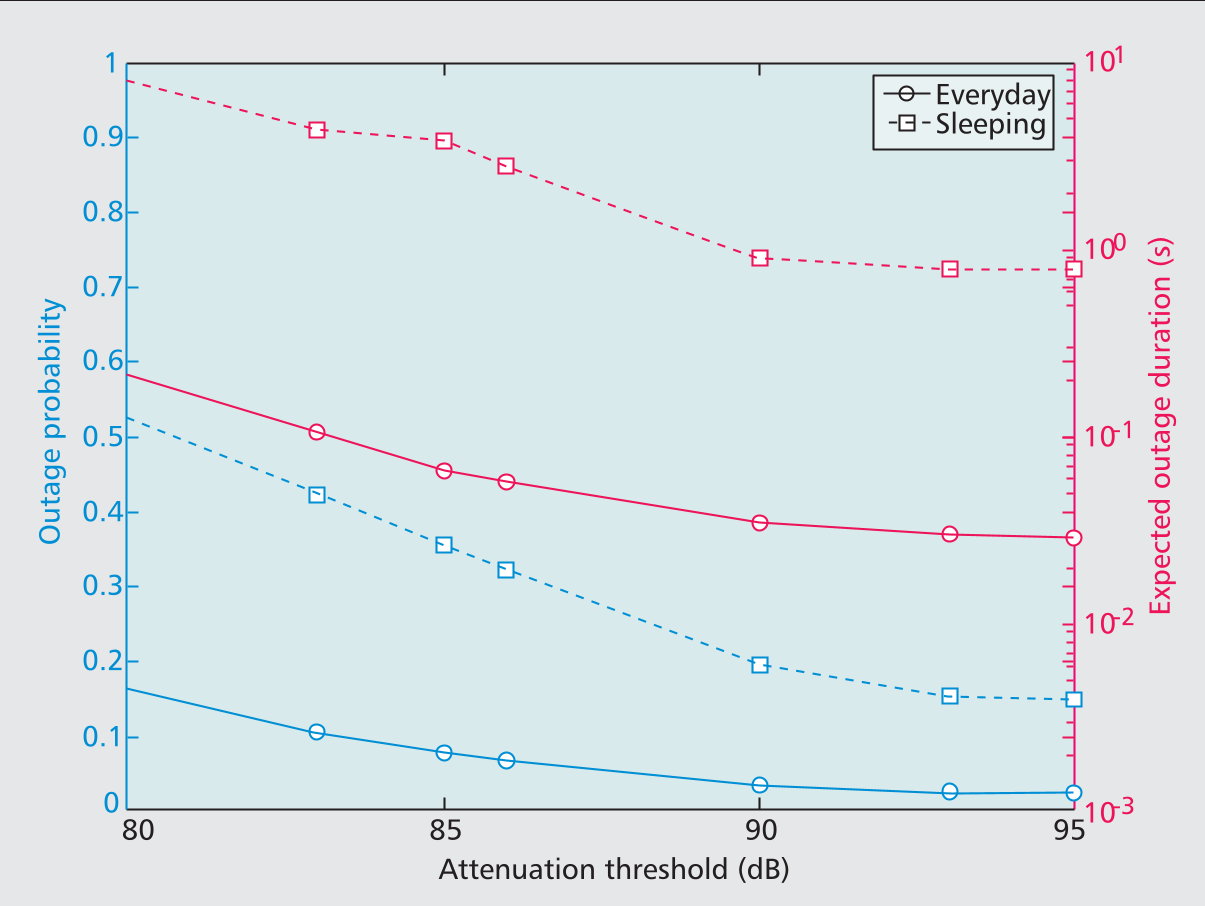 Figure 1: Statistical analysis showing the probability and duration of outages in "Everyday" vs "Sleeping" scenarios.
2. Intelligent Transmit Power Control (TPC)
By utilizing channel reciprocity (the idea that the path from A to B is the same as B to A), nodes can estimate attenuation from the last received packet and adjust their transmit power for the next one. This "sample-and-hold" approach avoids the "over-transmitting" energy waste of fixed-power systems.
Experimental Results & SOTA Comparison
The proposed techniques were validated using real-world "everyday" channel measurements rather than theoretical models.
- Reliability vs. Energy: The "Flipping" algorithm reduced packet loss by 17% with zero additional energy expenditure.
- TPC Efficiency: Compared to a fixed 0.1 mW transmitter, the predictive power control improved packet loss by 2x to 5x while actually saving 15% energy.
- Relay Effectiveness: In "sleeping" scenarios where link outages are prolonged, the authors found that a relay node (e.g., a hub on the hip) could successfully route traffic 80-85% of the time when the direct link failed.
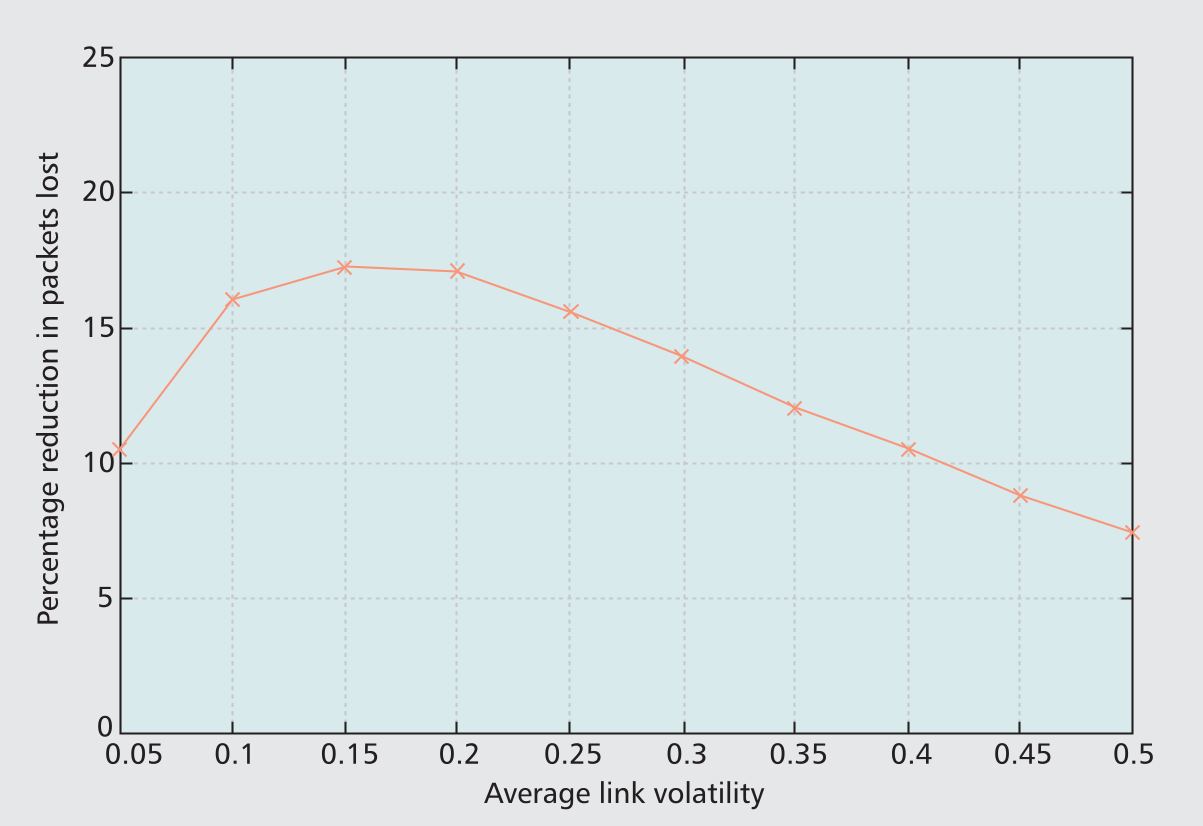 Figure 2: Percentage reduction in packet loss using the Flipping algorithm across different link volatilities.
Critical Insight: The "Sleep" Paradox
One of the most profound takeaways is the difficulty of the "Sleeping Channel." While we usually associate movement with signal instability, the lack of movement during sleep creates the longest outages. If a patient rolls over on a sensor, the link might stay dead for 20 minutes. This necessitates the use of Relay Nodes—a feature supported by IEEE 802.15.6 but historically underutilized in simple star topologies.
Conclusion
This work moves beyond the "one-size-fits-all" approach of early wireless standards. By embedding physical intuition about body movement into the MAC layer, the authors demonstrate that we can achieve the stringent reliability required for medical emergencies without sacrificing the unobtrusive, low-power nature of wearable sensors. The future of BANs lies in this cross-layer synergy, where the MAC layer understands the physics of the human body.