
Bolt: Breaking the Human Speed Barrier with Instantaneous Crowdsourcing
Bolt: Instantaneous Crowdsourcing via Just-in-Time Training.
This paper introduces Bolt, an instantaneous crowdsourcing system that achieves machine-level response speeds using the look-ahead approach. By modeling tasks as Markov Decision Processes (MDPs) and prefetching crowd responses to potential future states, the system achieves a median response latency of 2ms, effectively bypassing the fundamental limits of human reaction time.
TL;DR
Bolt is a breakthrough hybrid intelligence system that delivers crowd-sourced decisions in just 2 milliseconds. By combining the predictive logic of cache prefetching with real-time human computation, the system completes the "thinking" before the problem even happens. It treats human workers as a Just-in-Time (JIT) policy engine for an MDP agent, effectively making human-in-the-loop systems viable for ultra-low latency tasks.
Context: The 500ms Ceiling
For years, the "gold standard" for real-time crowdsourcing was getting a response in roughly 2 to 5 seconds. This is sufficient for captioning or image labeling, but useless for high-speed control tasks. The bottleneck wasn't just the network—it was biology. Human perception and motor response have a hard lower bound.
The authors of Bolt asked a radical question: What if the human doesn't wait for the event to happen?
The "Look-Ahead" Intuition
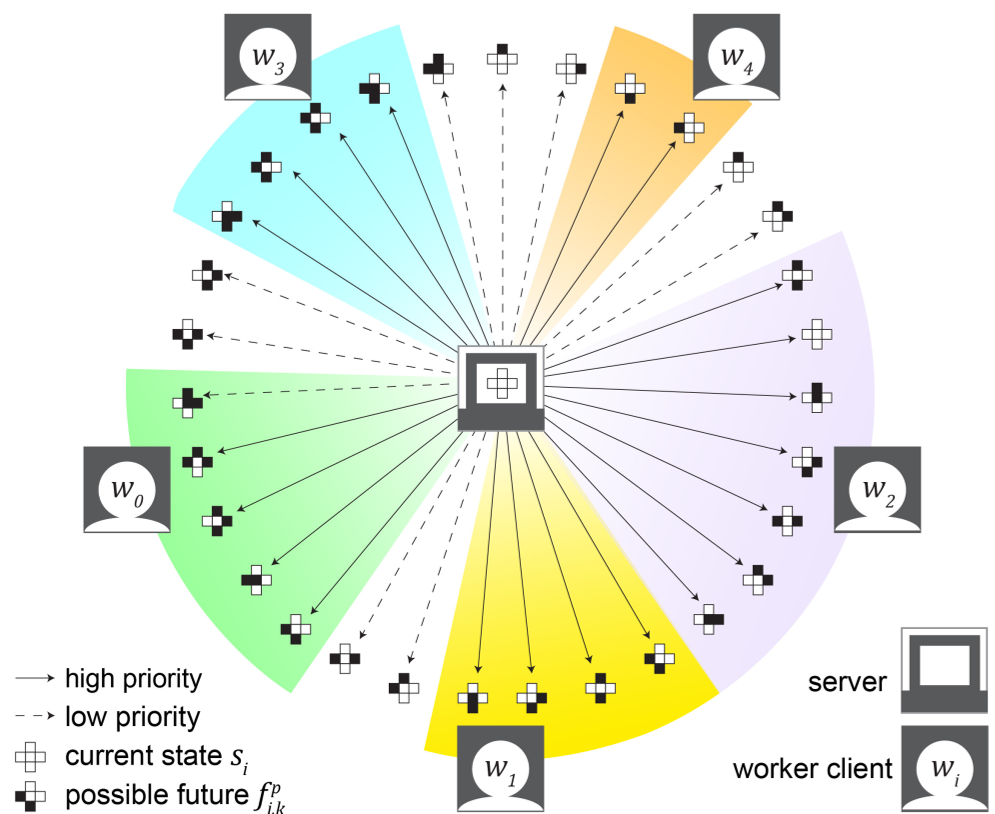
The core methodology relies on the Look-Ahead Approach. If we can model a task as a Markov Decision Process (MDP), we know the possible future states that could arise from the current one. Bolt acts like an OS-level memory manager that prefetches data into the cache before the CPU asks for it.
- Prediction Phase: The system generates a tree of possible future states (using Breadth-First Search). Each branch is sent to a worker who decides the best action for that hypothetical future.
- Execution Phase: As the actual system evolves, it checks the cache. If the current state matches a "pre-solved" state, it executes the action instantly.
Methodology: JIT Policy Training
Unlike traditional Reinforcement Learning (RL) which requires millions of trials to learn a reward function, Bolt performs Just-in-Time training. This is critical for tasks where the reward function is hard to specify mathematically (like "drive safely") but easy for a human to intuit.
The system uses a Retainer Model to keep a pool of workers ready. Even though individual workers might be slow or take time to situate themselves on the grid, the system aggregates their "future" responses.
Key Insight: Path Continuity Doesn't Matter
One of the paper's most surprising findings was that workers do not need to see a continuous "path" of gameplay to be effective. Whether they were shown a smooth sequence or a randomized set of "teleported" states, their accuracy remained stable. This allows the system to prioritize state-space coverage over player immersion.
Experimental Results: Two Orders of Magnitude
The authors tested Bolt using "Lightning Dodger," a high-speed gridworld game. The results were definitive:
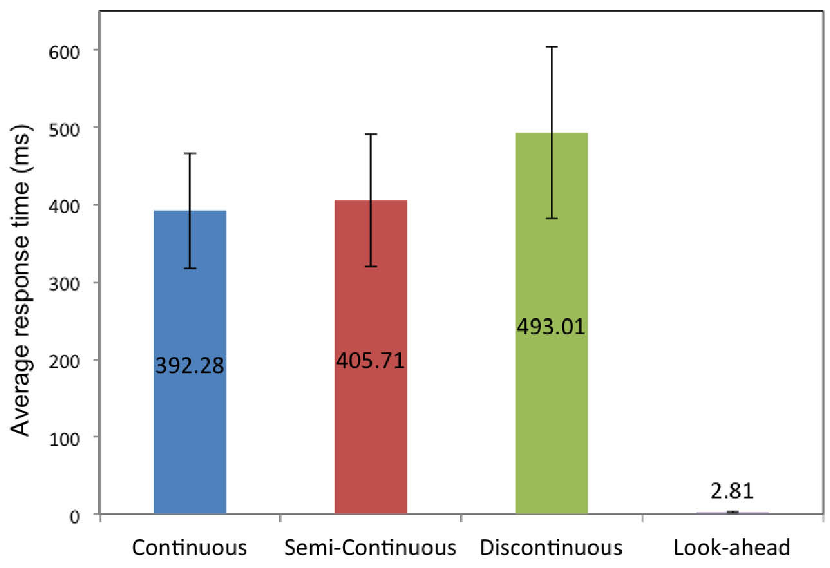
- Latency: The system returned responses in 2ms. Compared to the standard 200ms-500ms human reaction time, this is a 100x speedup.
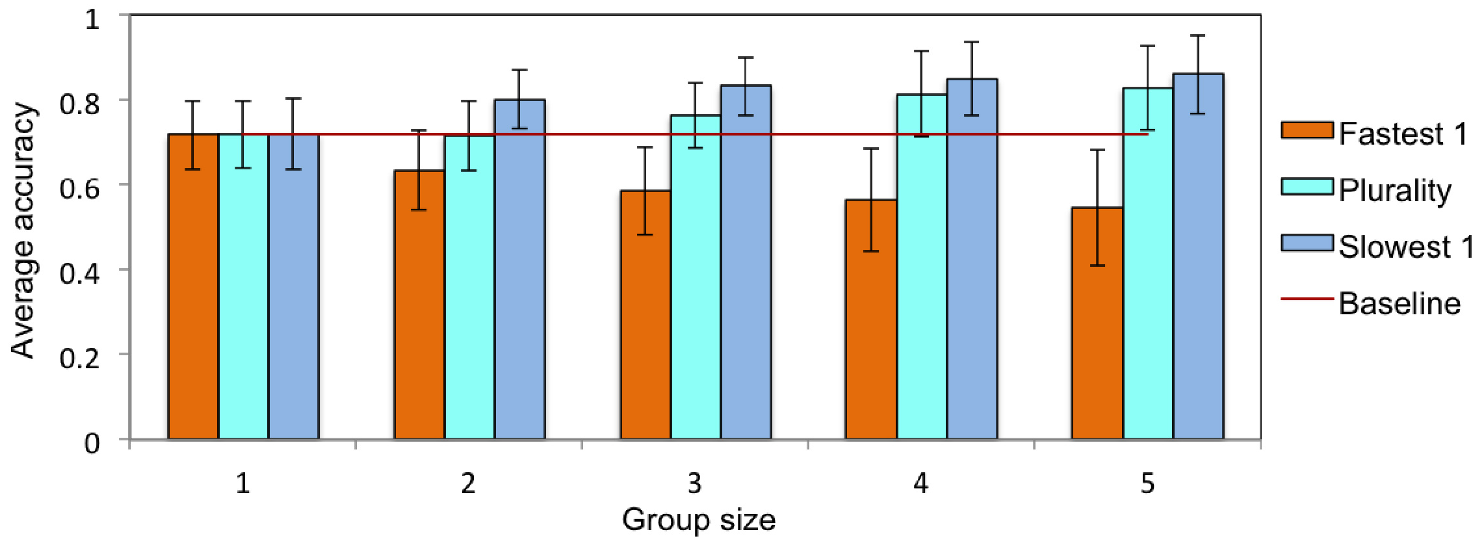
- Accuracy vs. Speed: The "Fastest 1" aggregation (taking the first response) actually lowered accuracy. The "Slowest 1" (taking the most deliberate response) and "Plurality" (voting) yielded the highest accuracy (~81%). This suggests that in crowdsourcing, speed often correlates with sloppiness, making prefetching even more essential to allow for "slow" high-quality input.
Critical Analysis & Future Outlook
Bolt effectively solves the latency problem, but it introduces a cost and scale challenge.
- State Explosion: For games like Go or real-world driving, the state space is too vast for BFS. Future work must leverage Probabilistic Sampling to only prefetch the most likely futures.
- The Slower-is-Better Paradox: The finding that slower responses are better justifies the look-ahead approach. By decoupling the human's "work time" from the system's "response time," we can finally afford the luxury of waiting for the most accurate human judgment without a performance penalty.
In conclusion, Bolt proves that "Crowds in two Milliseconds" is possible. It paves the way for hybrid systems that are as smart as humans but as fast as the machines they control.