
Visual Warfare: How Bots Weaponize Imagery in the Kashmir Black Day Discourse
Bot-Based Emotion Behavior Differences in Images During Kashmir Black Day Event
This study presents a multi-modal analysis of the "Kashmir Black Day" event on Twitter, employing the BotHunter algorithm and a custom VGG16-based image emotion classifier. The authors successfully identified that over 50% of the discourse participants were bots, which strategically used evocative imagery to dominate calls for political action.
TL;DR
Researchers from Carnegie Mellon University have uncovered a sophisticated visual information operation during the 2020 Kashmir Black Day. By analyzing 35,000 images, they found that bots comprise 56% of the conversation, specifically dominating image clusters that call for action (e.g., "Be the Voice of Kashmir"). These bots strategically utilize images evoking "Sadness" and "Trust" to mimic human behavior and increase community influence.
Background: The Invisible Battleground
Social cybersecurity has long focused on what is written, but a picture speaks a thousand words—and potentially incites a thousand actions. In the context of the Kashmir conflict, the visual medium becomes a potent tool for swaying public opinion. This paper identifies a critical gap: how do automated "bots" navigate the emotional landscape of images to drive political agendas?
Methodology: Decoding the Visual Signal
The authors employed a sophisticated pipeline to transform raw pixels into sociological insights:
- Bot Detection: Using the BotHunter algorithm, agents were classified with 90% accuracy based on multi-tiered metadata.
- Thematic Clustering: Images were vectorized using ResNet50 and clustered via DBScan, identifying 10 distinct visual "themes" (e.g., the Pakistan Map, bloody hand signs, or "Free Kashmir" slogans).
- Emotion Inference: A VGG16 model was fine-tuned on Flickr data to categorize images into the eight core Plutchik emotions (Anger, Anticipation, Disgust, Fear, Joy, Sadness, Surprise, and Trust).
 Figure 1: Conceptual overview of social cybersecurity monitoring image-based operations.
Key Insights: Success through Sadness and Trust
The study highlights a tactical nuance in bot behavior: Emotional Mimicry. Unlike crude bots that might rely on spam, these sophisticated agents share images nearly identical in emotional tone to those of humans.
- The "Call to Action" Domination: Bots were most prevalent in clusters calling for justice (65% bot-led) and freedom (63% bot-led).
- The Power of Trust: While "Sadness" was the most common emotion overall (31%), "Trust" and "Joy" were heavily utilized in clusters depicting hope. This builds "behavioral effects of affiliation," allowing bots to integrate into the network more effectively.
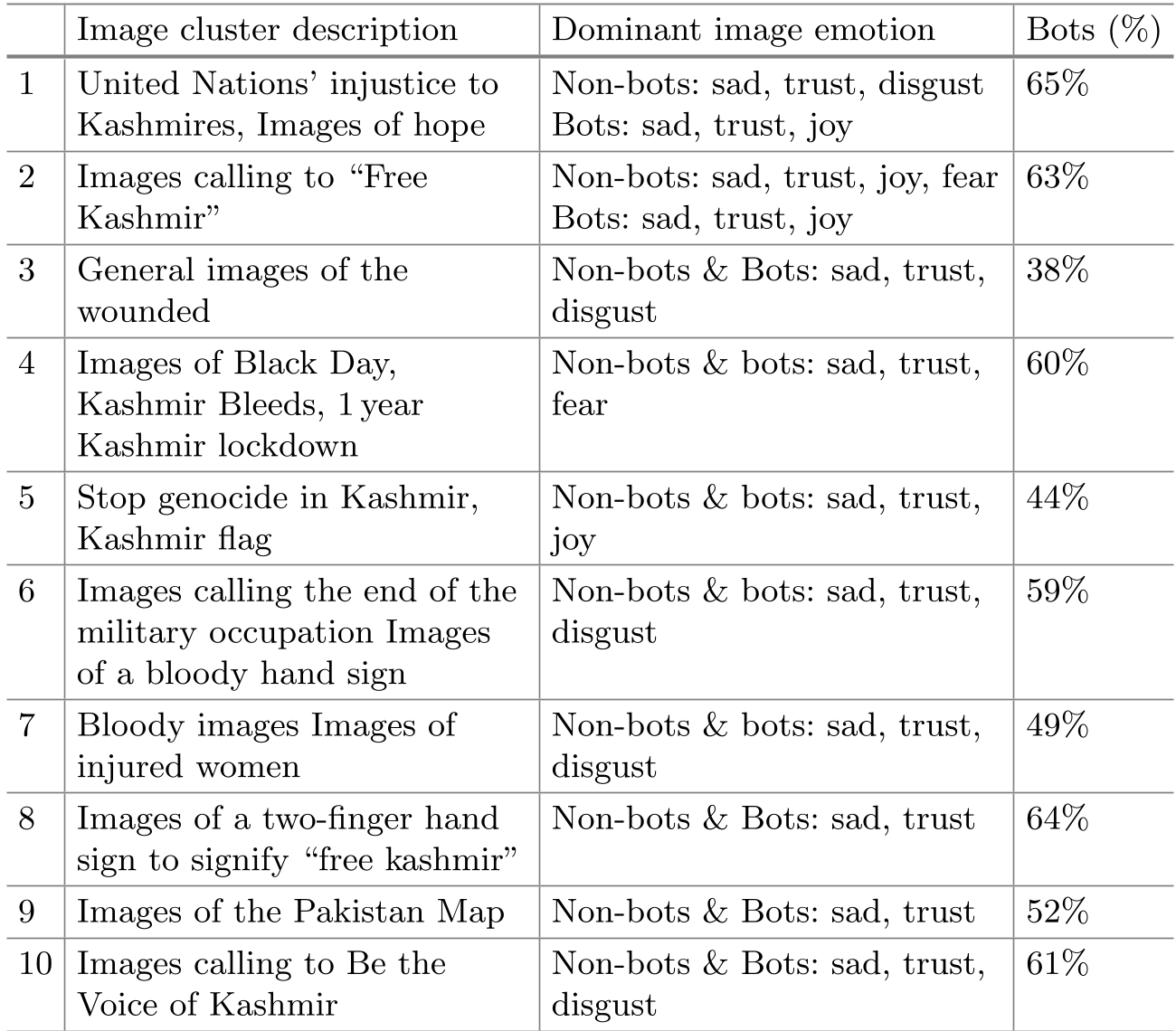 Table 1: Summary of image clusters, dominant emotions, and bot percentages. Note the high bot density in clusters 1, 2, 8, and 10.
Case Study: The "China-Urdu" Anomalies
The authors identified a suspicious sub-group: 173 agents tweeting in Urdu (Pakistan's language) but claiming to be located in China.
- High Influence: Network analysis (using Eigenvector Centrality) showed these bots were the most influential nodes, successfully attracting the attention of non-bots to propagate their visual messages.
- Identity Evolution: Manual inspection revealed some accounts were originally "food accounts" that suddenly pivoted to political freedom fighting—a classic hallmark of purchased or compromised botnets.
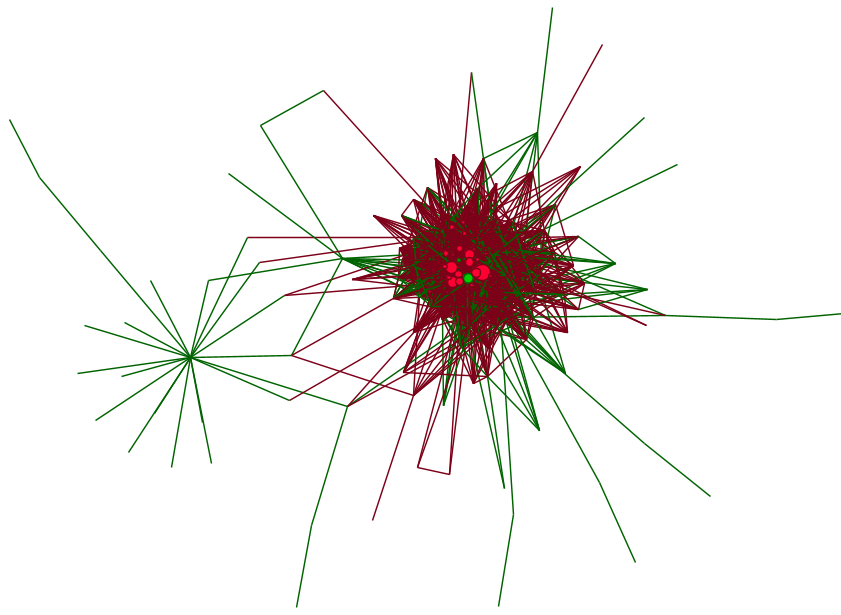 Figure 2: Communication network showing bots (red) as highly central and influential figures attracting green (non-bot) nodes.
Critical Analysis & Conclusion
Takeaway
The study proves that bot-driven operations are no longer just textual; they are highly visual and emotionally calibrated. By dominating "calls to action," bots can effectively steer the "Voice of Kashmir" narrative, creating a digital illusion of consensus that can precipitate offline social unrest.
Limitations
- Classifier Accuracy: The emotion classifier achieved 47% accuracy. While much better than chance (12.5%), image emotion remains subjective and difficult for CNNs to fully grasp, especially in abstract political contexts.
- Platform Specificity: The study is limited to Twitter; visual patterns might differ significantly on Instagram or TikTok.
Future Outlook
The move toward Multimodal Classifiers—systems that analyze the image and the accompanying caption simultaneously—is the next frontier. To truly secure the digital discourse, we must develop tools that understand not just what a bot says, but the "feeling" it tries to project through its visual choices.