
Decoding Deception: A Robust Model for Bot Detection via User Agents and Behavior
Bot Detection Model using User Agent and User Behavior for Web Log Analysis
The paper introduces a hybrid Bot Detection Model for web access log analysis that combines User Agent (UA) text features with User Behavior patterns. By utilizing Bag-of-Words (BoW) for UA strings and Gradient Boosting (LightGBM) for behavioral data, the system achieves a state-of-the-art AUC of 0.990 in identifying malicious or administrative bots.
TL;DR
In modern web analytics, bots act as "invisible noise" that skews user behavior data. This paper presents a high-performance detection model that leverages both User Agent (UA) strings and User Behavior patterns. By combining Bag-of-Words processing with LightGBM, the authors achieved an impressive AUC of 0.990, effectively filtering out bots that attempt to pass as humans by spoofing their identity.
Problem & Motivation
Most website owners rely on access logs to understand their customers. However, a significant portion of traffic comes from bots—ranging from helpful search engine crawlers to malicious scrapers and DDoS agents.
The core challenge is identity spoofing. Sophisticated bots modify their "User Agent" string to mimic popular browsers like Chrome or Safari. Traditional rule-based filters (which look for "bot" in the string) are easily bypassed. The authors recognized that while a bot might lie about who it is (User Agent), it is much harder to lie about how it acts (User Behavior).
Methodology - The Core
The authors suggest that the solution lies in the fusion of two data dimensions:
1. Textual Analysis of User Agents
Instead of simple string matching, the researchers treated User Agents as text data.
- Bag-of-Words (BoW): They converted 4,930 unique UA strings into 691 searchable "tokens."
- L1 Regularization: Using Logistic Regression with L1 (Lasso) penalty, they identified which specific words are "smoking guns" for bots. This narrowed the field from 691 terms down to 17 highly predictive keywords.
2. Behavioral Features
The model looks beyond the ID card and monitors the "daily routine." The researchers extracted 14 features, including:
- Access Timing: Humans tend to browse during the day; bots are active 24/7 or in spikes.
- Page Intervals: Bots often have mechanical, high-speed intervals or perfectly uniform delays.
- Referrers: Bots often lack a referrer (the page they "came from"), whereas humans usually arrive from search engines or ads.
 Note: The system defines a "session" as the primary unit of analysis, grouping clicks within a 30-minute window.
Experiments & Results
The researchers compared three distinct model configurations to find the balance between complexity and accuracy:
| Model | Features used | AUC | Accuracy |
|---|---|---|---|
| 1. Logistic Reg | UA Only (691 words) | 0.933 | 0.902 |
| 2. LightGBM | UA (691) + Behavior | 0.990 | 0.965 |
| 3. LightGBM | UA (17 words) + Behavior | 0.989 | 0.964 |
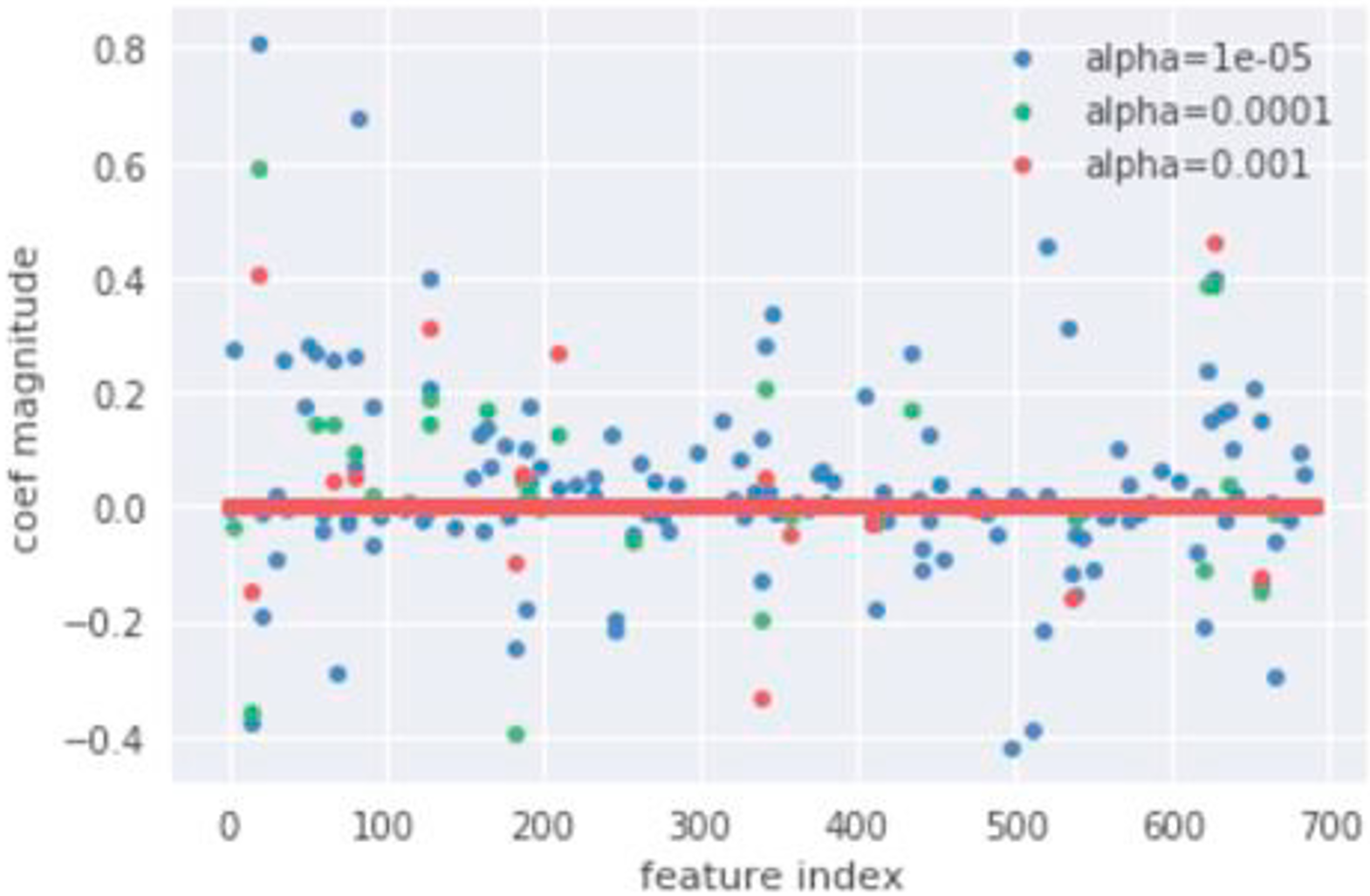 Fig 3: The L1 regularization process demonstrates how the model simplifies its logic by focusing only on the most significant textual cues.
Key Findings:
- Behavior Matters: Adding behavioral data boosted the AUC from 0.933 to 0.990.
- Efficiency: Model 3 proved that you only need 17 specific words in the User Agent to maintain elite accuracy, making the model lightweight for real-time production.
- Bot Indicators: Keywords like "ubuntu," "apple," and "linux" were strong bot signals in specific contexts, while words like "gecko" and "android" were more common in human sessions.
Critical Analysis & Conclusion
Takeaway
The study proves that bot detection is most effective when it is multimodal. Relying on what a client says they are (UA) is insufficient; you must verify it against what they do (Behavior).
Limitations
The authors acknowledge a significant rising threat: JavaScript-enabled bots. This model uses the absence of JS execution as a "ground truth" label for bot detection. However, advanced headless browsers (like Selenium or Puppeteer) can execute JS, potentially bypassing this specific classifier.
Future Work
The next frontier is using outlier detection. Instead of binary classification, future systems will likely model "normal human behavior" and flag anything that deviates from that distribution, potentially catching even the most sophisticated "human-mimicking" scripts.