
ELISA: Turning Your Social Feed into an Invisible Botnet Command Center
Boten ELISA: A novel approach for botnet C&C in Online Social Networks
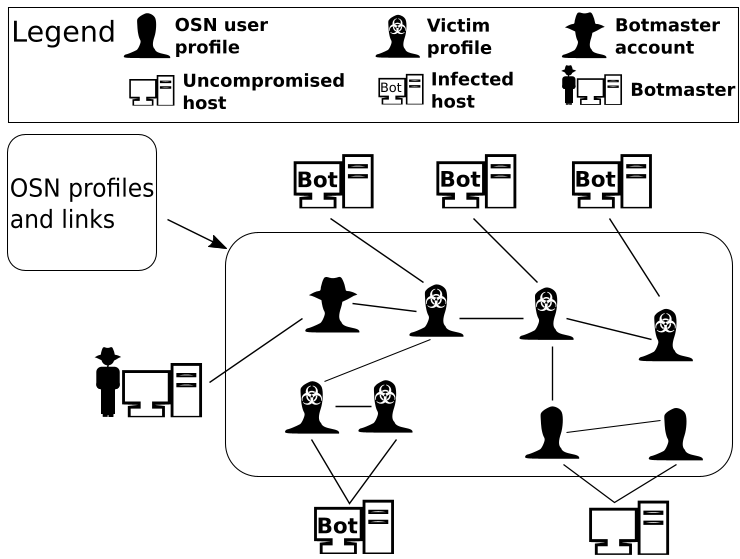
The paper introduces ELISA (Elusive Social Army), a novel decentralized botnet Command and Control (C&C) architecture that exploits Online Social Networks (OSNs). It leverages Unicode steganography to hide malicious commands within legitimate user posts, utilizing the trust relationships and communication patterns of unaware users to propagate messages.
TL;DR
ELISA (Elusive Social Army) is a sophisticated decentralized botnet that hides its Command and Control (C&C) signals in plain sight. By exploiting Unicode steganography—specifically non-printing characters—it piggybacks on the normal social interactions of unaware users on platforms like Facebook and Google Plus. It is virtually invisible to current traffic analysis tools because it generates no "new" traffic, only modifying existing legitimate user posts.
Background: The Evolution of Botnet Persistence
The "cat and mouse" game between botmasters and security researchers has moved through several stages:
- Centralized (IRC/HTTP): Easy to kill by shutting down the central server.
- Decentralized (P2P): Harder to kill, but the high volume of peer-to-peer traffic is a "smoking gun" for behavioral detectors.
- OSN-based: Using social networks provides a massive, trusted infrastructure. However, previous OSN bots (like Stegobot) used image steganography, which is computationally heavy and can be detected via entropy analysis of images.
ELISA represents the next step: Passive Textual Steganography.
Problem & Motivation: The Visibility Trap
Most botnets are caught because they act "differently" than a human. They send packets at strange intervals or connect to unusual IPs. Even advanced P2P bots stand out because of their mesh-like communication patterns.
The authors realized that if a botnet simply waited for a user to post a status update and then hid a message inside that text, the malicious activity would be statistically indistinguishable from a user's normal social media habit.
Methodology: The Art of Invisible Text
ELISA's core innovation lies in its use of the Unicode codespace. Unlike ASCII, Unicode contains "control code points" that have no visual glyph—the browser simply doesn't render them.
1. The Covert Channel
The researchers identified specific characters (e.g., bidirectional overrides for Arabic/Hebrew) that OSNs do not strip away for fear of breaking internationalization. By mapping these characters to an n-ary Huffman alphabet, they can encode encrypted and signed commands into a string that looks like an empty space to the human eye.
2. Propagation Strategies
ELISA doesn't just broadcast blindly. It uses two distinct logic flows:
- Commands (Botmaster → Bots): Disseminated via a Broadcast Strategy across the social graph.
- Control (Bots → Botmaster): Disseminated via a Shortest Path Strategy. Each bot tracks its "distance" from the botmaster and only forwards control messages if it is closer to the destination than the previous sender.
Experiments & Results: Is Stealth Scalable?
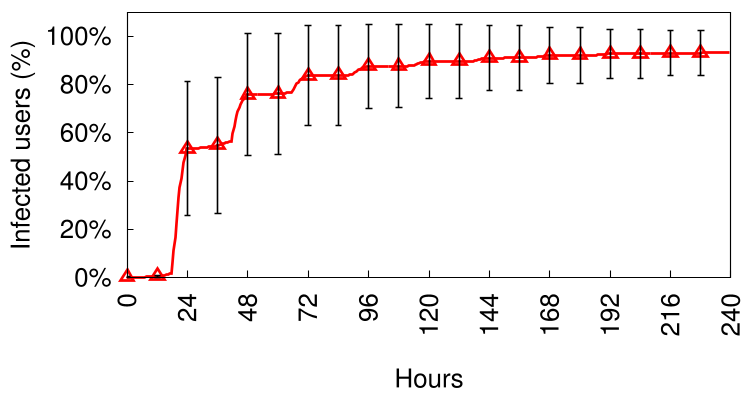
Using real-world Facebook interaction data, the authors simulated how fast ELISA could spread a command.
- Efficiency: Despite relying on "opportunistic" posting (waiting for the user to be active), the botnet is remarkably fast.
- The "Evening Surge": The propagation curves show distinct plateaus during the night and sharp climbs during evening hours when user activity peaks.
- Delivery: In a network of ~1,500 infected nodes, a command reaches the vast majority of the "army" in just a few days.
Critical Insight: Why Traditional Defenses Fail
Current C&C detection relies on:
- Signature Matching: Fails because the traffic is HTTPS-encrypted and the payload is hidden in legitimate text.
- Traffic Behavior: Fails because the timing of the "malicious" packets is identical to the timing of a human typing a Facebook post.
- Graph Analysis: Fails because the botnet's communication graph is the social graph.
Conclusion: An Internationalization Dilemma
The true brilliance (and danger) of ELISA is that its "fix" is a double-edged sword. If Facebook or X (formerly Twitter) simply banned all non-printing Unicode characters, they would break the internet for millions of users who rely on those characters for Right-to-Left (RTL) languages or complex script rendering.
ELISA highlights a fundamental vulnerability in modern web standards: as long as we require specialized characters for global accessibility, we provide a perfect hiding spot for the next generation of elusive digital armies.