
BotWalk: Outrunning the Red Queen in the Twitter Bot Arms Race
BotWalk: Efficient Adaptive Exploration of Twier Bot Networks
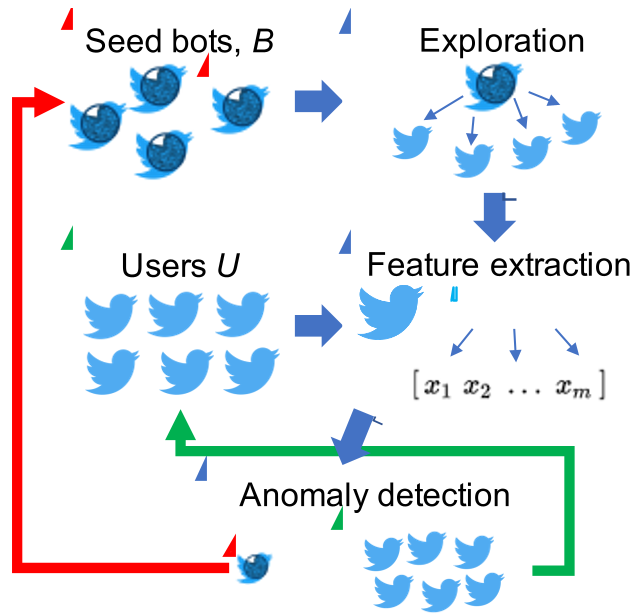
BotWalk is a near-real-time, adaptive, and unsupervised Twitter bot detection framework that utilizes an ensemble of anomaly detection algorithms to identify evolving bot behaviors. By iteratively exploring the follower networks of seed bots, it achieves a 90% detection precision and identifies approximately 6,000 potential bots daily.
TL;DR
Researchers have developed BotWalk, an unsupervised system that hunts Twitter bots by "walking" through follower networks. Unlike static detectors, it adapts to new bot behaviors in real-time. By combining four types of anomaly detection and partitioning user features, it hits 90% precision and finds 6,000 bots a day, far outstripping previous industry benchmarks.
Problem & Motivation: The Red Queen Effect
In biology and cybersecurity, the "Red Queen" effect describes a situation where one must constantly evolve just to maintain the status quo. Twitter botmasters are masters of this; as soon as a supervised model learns to catch "Spam Strategy A," they switch to "Strategy B."
Current SOTA methods suffer from two fatal flaws:
- Staleness: Supervised models are only as good as their last training set.
- Scalability: Twitter's API rate limits make it impossible to scan the entire 300M+ user base concurrently.
BotWalk’s core insight is that birds of a feather flock together. By starting with a known bot and exploring its followers using unsupervised methods, we can find new, unlabelled bots without needing a prior "cheat sheet" of behaviors.
Methodology: The Core Engine
BotWalk uses an Adaptive Exploration strategy. It populates a "Seed Bank" of bots, fetches their followers, and analyzes them across four feature dimensions:
- Metadata: Account age, verification status, and profile completeness.
- Content: URL repetition, hashtag usage, and retweet ratios.
- Temporal: "Burstiness" of tweets and p-values of activity distributions.
- Network: Out-degree of follow/mention connections.
1. The Power of Partitioning
A major contribution of this paper is Feature Partitioning. Instead of dumping all 130+ features into one giant matrix (where categorical metadata might drown out subtle temporal signals), BotWalk runs anomaly detection on each category separately and then merges the scores. This alone boosted precision by 30%.
2. The Ensemble Approach
The framework doesn't rely on a single math trick. It uses an ensemble:
- Local Outlier Factor (LOF): Density-based.
- Euclidean & Cosine Distance: Distance/Angle-based.
- Isolation Forest: Isolation-based.
Experiments & Results
The authors tested BotWalk through three "Levels" of exploration (followers of followers of followers).
Key Findings:
- High Precision: Even at "Level 3" (three hops away from the original seeds), the precision remained high, proving the "walking" strategy effectively stays within bot communities.
- Novelty Discovery: As seen in the feature distribution analysis, the bots found in Level 3 exhibited significantly different behavior than the initial "dumb" bots used as seeds.
- Massive Throughput: At 6,000 bots/day, BotWalk is nearly 4x faster at discovery than BotOrNot.
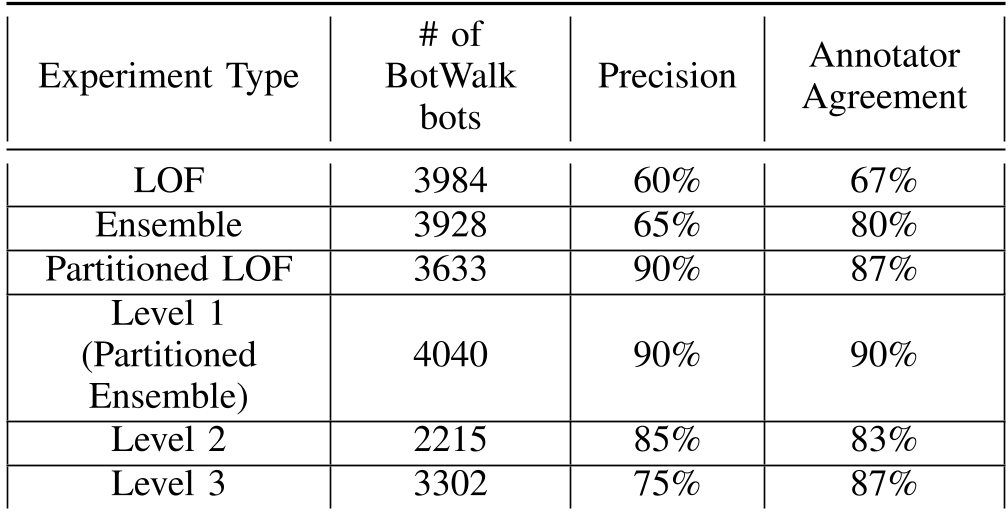
The table above demonstrates that the Partitioned Ensemble achieved the highest annotator agreement and a robust 90% precision in its first level, maintaining strong performance even as it ventured further into the network.
Deep Insight & Conclusion
The true value of BotWalk lies in its unsupervised nature. By not telling the model "what a bot looks like," the model is free to find anything that looks "un-human."
Limitations & Future Work
The slight dip in precision at Level 3 (down to 75%) suggests that "randomly" picking seeds from identified anomalies can lead to "drift" into human populations. Future iterations could benefit from Active Learning, where a human periodically validates the most uncertain cases to "re-center" the walk.
Final Takeaway: To beat an evolving adversary, your detection must be as dynamic as their evasion. BotWalk proves that unsupervised network exploration is the most viable path to securing massive social networks in real-time.