
Beyond Keywords: Filtering Brand Data with Social-Aware Multiview Embedding
6187_Filtering of Brand-Related Microblogs Using Social-Smooth Multiview Embedding.
This paper introduces a microblog filtering method using a "Discriminative Social-Aware Multiview Embedding" to identify brand-relevant content. It combines textual, low-level visual, and high-level semantic features into a latent space regularized by social and brand relations, achieving an average F1-measure of 0.74 on the Brand-Social-Net dataset.
TL;DR
In the fast-evolving landscape of social media, tracking a brand like Nike or Apple is no longer just about searching for a hashtag. This paper presents a sophisticated filtering system that looks at text, images, and social connections simultaneously. By mapping these diverse data types into a "Social-Aware Multiview Embedding," the researchers achieved a significant breakthrough in cleaning up the "noise" that plagues traditional social media monitoring.
The Problem: The Noise in the Signal
Corporate social media monitoring faces a paradoxical challenge. If you only look for specific keywords, you miss 40% of microblogs that are expressed purely through images. However, if you expand your search to include similar images or related users ("Extended Data Gathering"), you end up drowning in irrelevant posts.
Most existing methods treat text and images as separate silos or ignore the social context—who is posting, where they are, and when they are posting. The authors argue that a microblog isn't just a piece of content; it's a node in a complex social fabric.
Methodology: The Multiview Bridge
The core of this research is the Discriminative Social-Aware Multiview Embedding. Think of it as a "Universal Translator" that takes three different "views" and maps them into a single, mathematical space:
- Textual View: Term weighting (tf·idf) for words.
- Low-Level Visual View: Spatial pyramid matching of SIFT features to capture image textures and shapes.
- High-Level Semantic View: Predicting 1000 concepts from ImageNet (like "car" or "sport") and dedicated logo detection.
Architecture & Regularization
The secret sauce lies in the Graph Laplacians. The model doesn't just learn from the content; it is constrained by:
- Brand Similarity Graph: Ensuring posts that share labels stay close in the latent space.
- Social Similarity Graph: Using user friendships, timestamps, and locations to "smooth" the results. The intuition is simple: if two people are friends and one posts about a brand, the other's similar post is likely relevant too.
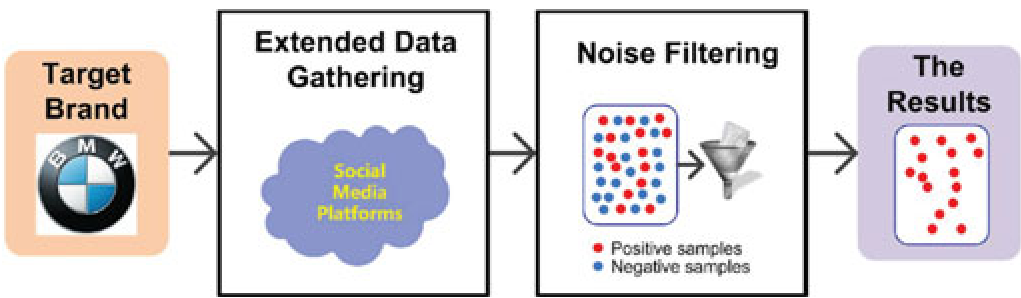 Figure 1: The dual-stage framework consisting of offline training (embedding learning) and online filtering.
Experiments: Performance at Scale
The authors tested their method on the Brand-Social-Net (BSN) dataset, which includes 3 million microblogs covering 100 global brands.
Key Findings:
- Superior Precision: The method significantly beat the previous state-of-the-art (EDG), raising Precision by nearly 39%.
- The Power of Social: For brands with "influential users" (like official Apple accounts), the social regularization provided a much higher performance boost compared to niche brands.
- Latent Space Stability: The team found that a latent dimensionality (K) of 100 was the "sweet spot" for balancing computational cost with accuracy.
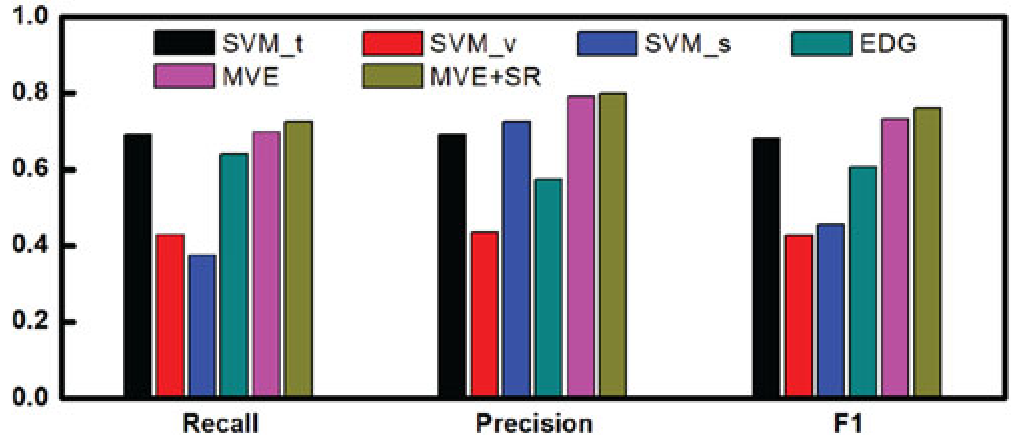 Figure 2: Performance metrics (Recall, Precision, F1) showing MVE+SR consistently outperforming single-view SVMs and baseline gathering methods.
Critical Insight: Why Does This Matter?
This paper proves that multimodal features are better than the sum of their parts. A blurry logo might be useless on its own, but when localized near a relevant textual post within a user's social circle, it becomes a high-confidence signal.
Limitations: The primary bottleneck is computational complexity. Social graphs are expensive to compute for millions of users. Furthermore, the model currently struggles with brands that share visual DNA (e.g., Mazda and BMW both feature cars), suggesting that "between-brand" correlation is the next frontier for this research.
Conclusion
This work sets a new standard for brand analytics. By transforming heterogeneous social media "noise" into a structured, discriminative latent space, the authors have provided a robust tool for companies to listen more accurately to their customers. The future of AI in social media isn't just about understanding what is in a post, but understanding the context of who posted it and why.