
Bridging the Gap: How Your Daily Commute Reveals Your Social Life
Bridging the gap between physical location and online social networks
This paper presents a framework for bridging physical location data with online social network structures by analyzing the location traces of 489 users via the "Locaccino" platform. It introduces novel features such as "location entropy" to distinguish between social encounters and chance co-locations, ultimately predicting Facebook friendships with high precision.
TL;DR
Researchers from Carnegie Mellon University have developed a method to predict your Facebook friendships simply by looking at your GPS traces. By moving beyond "how often you meet" to "where you meet" and introducing the concept of Location Entropy, they can distinguish between a chance encounter at a mall and a meaningful meeting at a private residence.
The Problem: The "Stranger in the Crowd" Noise
In the era of smartphones, we leave digital breadcrumbs everywhere. Intuitively, if two people are often in the same place, they are likely friends. However, in technical terms, this is a "noisy" assumption. If you take the same subway every morning as 500 other people, you are "co-located," but you are likely strangers.
Existing research often struggled to filter this noise without looking at private communication logs. The authors of this paper asked: Can we infer social structure using only location data by understanding the "personality" of the places themselves?
Methodology: The Power of Context and Entropy
The core innovation is the introduction of Location Entropy.
1. Defining Location Entropy
Imagine two locations:
- A Coffee Shop (High Entropy): Visited by hundreds of different people, each spending a small fraction of their total time there.
- A Private Apartment (Low Entropy): Visited by only a few people who spend a significant portion of their time there.
If two people overlap at the apartment, the probability of them being friends is exponentially higher than if they overlap at the coffee shop. The formula for Entropy is: where is the fraction of observations at location belonging to user .
2. Feature Engineering
The researchers extracted 67 features categorized into:
- Intensity/Duration: How long and how often.
- Location Diversity: The entropy and frequency of visited spots.
- Specificity: Using a "TF-IDF" style metric to see how unique a location is to a specific pair of users.
- Structural Properties: Overlap in their wider physical "neighborhoods."
 Table 2: Breakdown of features used to categorize social mobility.
Experiments & Results: Beyond Simple Proximity
The study utilized data from Locaccino, a location-sharing app. The results were striking:
- Friendship Prediction: Using AdaBoost with decision stumps, the model achieved a 92% accuracy in identifying non-friends and a significantly higher precision than baselines that only looked at "number of co-locations."
- The "Social" Routine: There is a positive correlation between the number of social ties a user has and their MaxEntropyWeekend. In other words, people with more friends tend to visit more diverse, "social" locations on weekends.
- Regularity: Users with less regular schedules (higher schedule entropy) actually tended to have more online social ties.
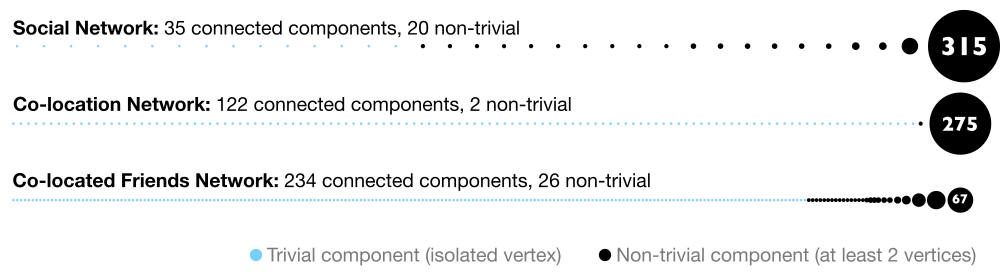 Figure 2: The structural difference between the "Co-location Network" (noisy) and the actual "Social Network" (sparse but connected).
Deep Insight: Why This Matters
The most profound takeaway is that physical mobility is a mirror of social capital. The researchers proved that while co-location is frequent among strangers (only about 8.4% of co-locations were actually between friends), the contextual fingerprint of those locations is a highly reliable signal.
Limitations & Future Work
- Homogeneity: The study was limited to a university population (CMU), which may not represent general urban mobility.
- Privacy: The ability to reconstruct a social graph from "anonymous" GPS traces raises significant privacy concerns that future designers must address.
- Hardware: Most data came from laptops, which are less mobile than phones; the authors suggest that results would be even stronger with pure smartphone data.
Conclusion
This work bridges the gap between our offline movements and our online identities. By treating geographic locations not just as coordinates but as social entities with their own "entropy," we can build smarter recommendation engines and gain deeper insights into the fabric of human connection.