
Beyond Content: Transforming Web Communities into Social Spaces with People and eTree
12101_Browsers to Support Awareness and Social Interaction.
This paper introduces two novel social browsers, People and eTree, designed to enhance awareness and social interaction in Web communities. By utilizing automatic clustering and botanical metaphors, these tools visualize human interaction patterns and group identities within the CHIplace and Portkey platforms.
TL;DR
Online communities often feel like "ghost towns" or flat data repositories because Web browsers are designed for documents, not people. This paper presents two innovative social browsers—People and eTree—that use data visualization to give digital communities a "public face," allowing users to "see" social dynamics, member roles, and the growth of conversations through intuitive, evolving metaphors.
The Social Blindness of the Web
In the physical world, we use "social cues"—the crowd in a cafe, the layout of a park—to understand a space's vibe. The Web lacks this. When you land on a forum, how do you know who the leaders are? Or if the community is welcoming to newcomers?
The authors argue that social information exists in the digital world but is buried in content. Most current tools are built for administrators to track metrics, not for regular users to feel "socially aware." The goal here is to move from visual analytics to social browsing.
Methodology: Two Visions of Community
1. The People Browser: Mapping Roles
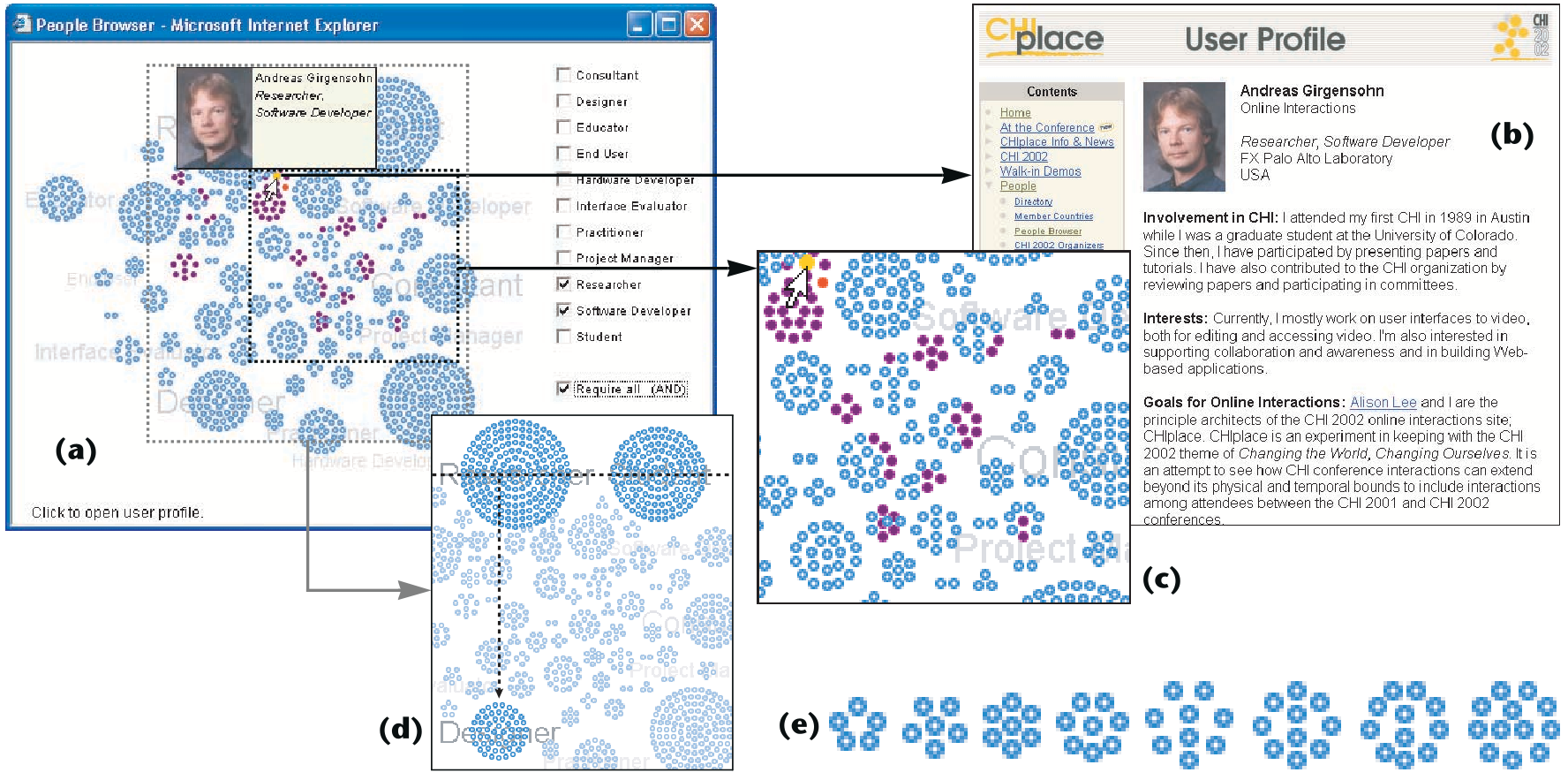
For the CHIplace community (HCI professionals), researchers focused on identity. Since users often have overlapping roles (e.g., "Researcher" and "Practitioner"), a simple list fails.
- The Mechanism: The system uses Hierarchical Agglomerative Clustering and the Jaccard coefficient to group people based on shared roles.
- The Layout: A spring-model algorithm places these clusters in 2D space. The result is a "Community Map" where dots represent people.
- Interaction: Hovering triggers tooltips with photos; clicking takes you to a profile. It turns a database into a neighborhood.
2. The eTree Browser: The Organic Discussion
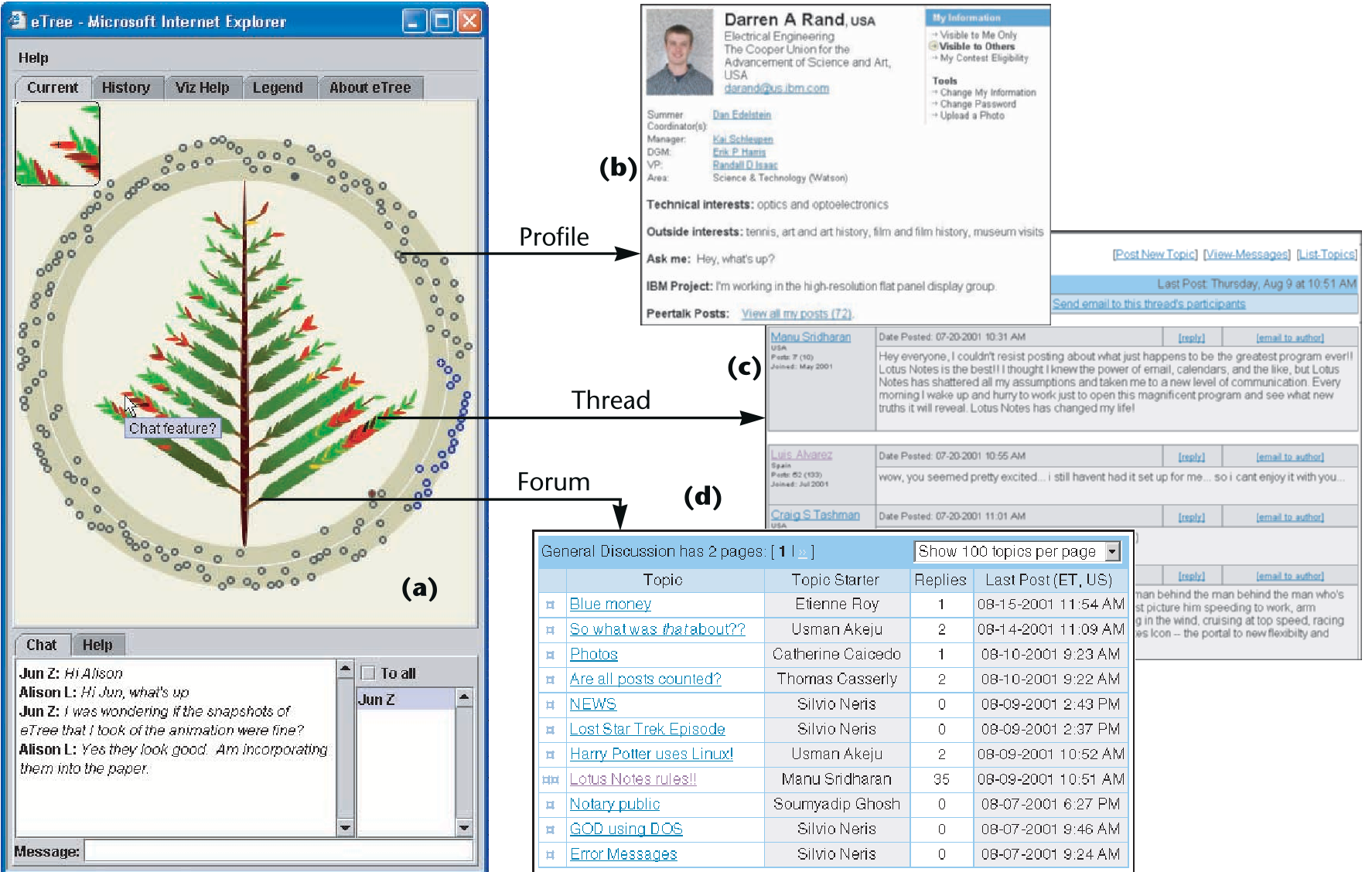
For internal IBM interns (Portkey), the authors used a botanical metaphor to visualize discussion forums.
- Trunk & Branches: Represent the site's structure and different forums.
- Leaves: Represent individual threads. Color-coding (light green for new, dark for old) shows the community's "freshness."
- Vibrancy: "Hot topics" turn into yellow leaves. Participant involvement is shown as a ring of circles around the tree, providing a literal "ecosystem" view of interaction.
Key Experiments & Results
The researchers didn't just build these; they deployed them.
- Engagement: The People browser became a staple for power users (25% usage rate among active users).
- Evolution: One of the most praised features of eTree was the growth animation, which allowed newcomers to watch a "time-lapse" of how the community's discussions evolved over the summer.
- Navigation: The browsers functioned as a "social interface," where users used the visualization as a starting point to dive into specific content—a pattern the authors call "overview first, zoom and filter, then details on demand."
Critical Analysis: Privacy and Scalability
While highly effective, the paper acknowledges two major hurdles:
- Privacy: Highlighting "buried" data makes it more salient. While the data was public, the visibility prompted concerns about how a user's "electronic self" is portrayed.
- Scalability: The tree metaphor breaks down once you hit hundreds of forums. The authors suggest "time-range sliders" to manage this, but the visual density of the spring-model also reaches a limit at about 80 clusters.
Conclusion: The Future of the Social Web
This work marks a shift in how we think about "Browsing." Instead of just fetching URLs, a browser can be a lens into the social heartbeat of a group. By making the "Social Translucence" (visibility of collective activity) explicit, the People and eTree browsers help turn static Web sites into vibrant, "Great Good Places."
Key Takeaway: For future AI agents and community platforms, building "socially aware" interfaces is not just about aesthetics—it's about providing the legibility required for human connection.