
Precise Incentives: Maximizing Viral Spread through Probabilistic Budget Allocation
Budget Allocation for Maximizing Viral Advertising in Social Networks
This paper addresses the problem of Budget Allocation for Maximized Viral Advertising (BAMVA) in social networks using a probabilistic utility model. It proposes the DiscreteGreedy++ algorithm, which achieves a near-optimal approximation ratio by leveraging the submodularity of the influence spread function.
TL;DR
Most viral marketing research asks who to target, but few ask how much to pay them. This paper shifts the focus from binary seed selection to Optimal Budget Allocation. By treating user adoption as a probabilistic outcome of incentives (using concave utility functions), the authors propose DiscreteGreedy++, a scalable algorithm that achieves near-optimal influence spread with a theoretical guarantee.
The Motivation: Moving Beyond Fixed Costs
In the classical Influence Maximization (IM) framework, a user is either "bought" as a seed or not. This assumes every influencer has a "sticker price."
However, human behavior is messy. A small incentive might convince a micro-influencer with a 10% probability, while a massive incentive might only reach 90% certainty. This follows the Law of Diminishing Returns: the first $100 spent on a user is usually more "effective" than the next $100. This paper captures this reality by introducing concave utility functions , where the marginal gain in adoption probability decreases as the budget increases.
Methodology: Submodularity in a Discrete Lens
The core challenge is that the budget is continuous, and the search space is infinite. The authors solve this through three strategic moves:
- Discretization: They break the total budget into small pieces. This transforms the problem into a set selection problem.
- Submodularity Proof: They rigorously prove that the total expected spread is a monotone submodular function over these budget pieces. This is crucial because it allows the use of greedy algorithms to find a near-optimal solution.
- Matroid Constraints: To ensure the budget is spent wisely, they apply a partition matroid constraint, essentially ensuring we don't pick redundant "budget pieces" for the same level of investment.
 Figure 1: The process flow—Phase 1 involves budget distribution and probabilistic adoption; Phase 2 involves the actual information cascade.
Scaling Up with DiscreteGreedy++
Calculating "marginal gain" in a social network requires massive Monte Carlo simulations or BFS traversals, which are computationally expensive. The authors introduce:
- Lazy Forward Optimization: Only recalculating gains for the most promising candidates.
- BFS Estimation: A novel way to estimate pairwise diffusion probabilities without full graph traversals.
Experimental Results
The authors tested their algorithm on several real-world social graphs (NetHEPT, HepPh, and others).
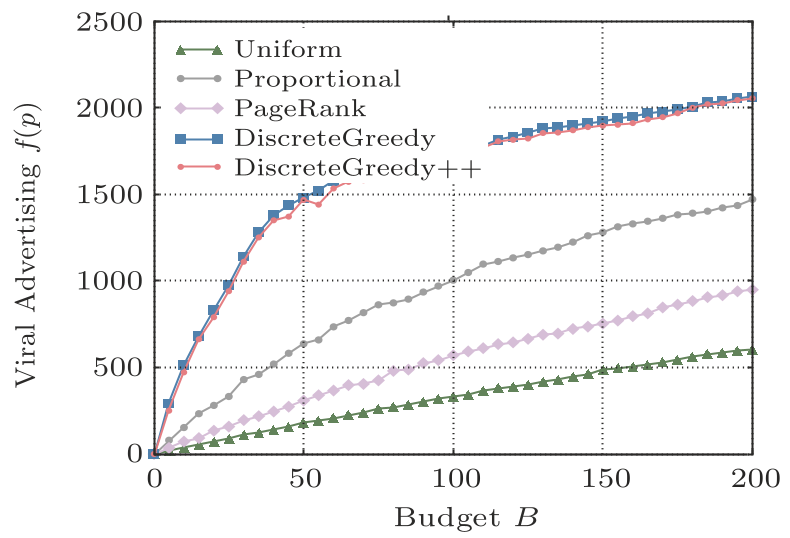 Figure 2: Performance comparison across different models. DiscreteGreedy++ (marked as DG++) consistently stays at the top of the spread curve.
Key Findings:
- Superiority: DiscreteGreedy++ significantly outperforms PageRank, Uniform distribution, and Proportional allocation.
- Budget Efficiency: As the total budget increases, the gap between the proposed greedy approach and simple heuristics widens, proving that "smart" allocation matters more when you have more to spend.
- Speed: Thanks to the BFS estimation and scaling scaling techniques, the algorithm handles large graphs efficiently, bridging the gap between theory and industrial application.
Critical Analysis & Conclusion
The Takeaway
The shift from "targeting" to "allocating" is a major step toward realistic viral marketing. By proving that this complex probabilistic model still retains submodularity, the authors give marketers a mathematically grounded way to run campaigns.
Limitations & Future Work
While the paper assumes the utility functions are given, in a real-world scenario, these are hard to estimate. Future research needs to focus on online learning—adjusting budget allocation in real-time as users respond to incentives. Furthermore, the model assumes the content of the ad is constant; however, the "virality" of an ad often depends on the creative content as much as the incentive provided to the sharer.
In summary, this work provides a robust algorithmic foundation for the next generation of social media advertising platforms.