
Viral Video Distribution: Cracking the Multi-Topic Influence Code
18813_Budget-Efficient Viral Video Distribution Over Online Social Networks Mining Topic-Aware Influential Users.
This paper introduces a multi-topic-aware influence maximization framework for viral video distribution over Online Social Networks (OSNs). The authors propose the Estimation-Based Dynamic Algorithm (EBDA) to select influential seed users and assign specific video clips (topics) to them, achieving a 1-1/e approximation ratio while significantly reducing computational overhead compared to traditional Monte Carlo methods.
TL;DR
Researchers have developed a new framework to maximize the "viral" reach of videos on social networks by treating different video clips as distinct "topics." By introducing the Estimation-Based Dynamic Algorithm (EBDA), they have moved beyond slow Monte Carlo simulations, enabling large-scale influence maximization that is both mathematically rigorous (1-1/e bound) and computationally efficient.
Background: Why "One Size Fits All" Fails in Social Marketing
Most viral marketing research assumes that a product or message is a monolithic entity. However, a single NBA game video might contain highlights of a superstar (appealing to fans) and high-intensity defense (appealing to coaches). In OSNs, users have diverse interests. The core challenge is not just who to pick as seeds, but which specific clip to give them to trigger the largest cascade.
The Problem: The Computational Wall
Influence Maximization (IM) is NP-hard. The standard Greedy algorithm provides a nice theoretical guarantee (1-1/e), but it relies on calculating the "Expected Posting Number" (EPN). Doing this via Monte Carlo simulations over a network like Digg (279k nodes) is like trying to count every grain of sand on a beach—it's too slow for real-world campaigns.
Methodology: Precision Pruning with Submodularity
The authors solve this by proving that their multi-topic EPN function is submodular—a property of "diminishing returns." This allows them to use greedy selection. To avoid the "Counting Sand" problem, they developed two key innovations:
- Upper Bound Estimation: Instead of calculating exact influence, the algorithm estimates a "ceiling." If a user's potential influence ceiling is lower than a known value, they are skipped.
- EBDA Architecture: As shown in the system model, it integrates a cloud-clone layer to handle the heavy lifting of video transcoding and clip extraction.
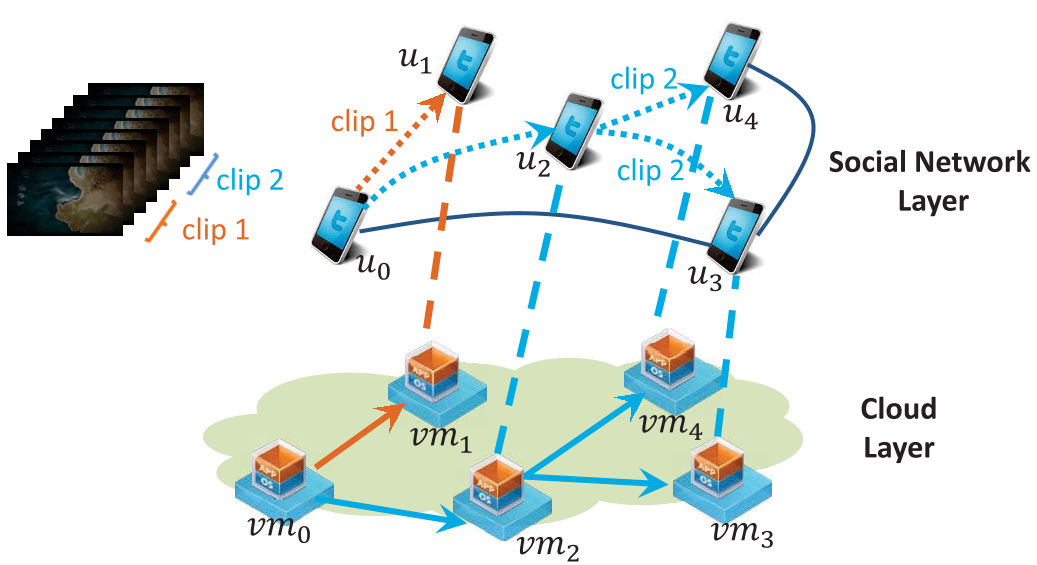 Fig 1: The Cloud-Assisted Mobile Video Spreading System, featuring Cloud Clones for transcoding and clip extraction.
The algorithm jointly manages seed selection and topic assignment by maintaining a priority queue and updating states (Initial -> Estimation -> Exact) only when absolutely necessary.
Experimental Results: Speed Without Sacrifice
The team tested their approach on four massive datasets: Wiki-Vote, NetPHY, Slashdot, and Digg.
- Accuracy: EBDA's EPN results were nearly identical to the ground-truth Monte Carlo simulations (G-MC).
- Speed: On the Slashdot dataset, the approximation version (EBDA-ε) reduced execution time by over 30% compared to the standard EBDA, and by orders of magnitude compared to G-MC.
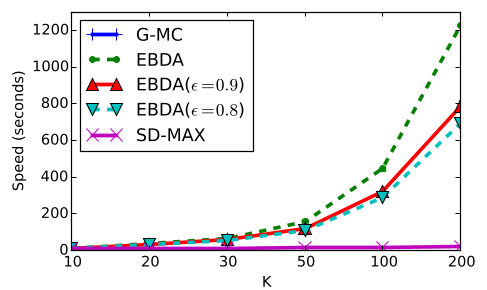 Fig 2: EPN Comparison across different datasets. EBDA consistently tracks at the top of the performance curve.
Critical Insight & Conclusion
The real brilliance of this work lies in its Heuristic-Bound Dualism. By using graph properties (in-degree/out-degree) to calculate lower bounds and path-based probability for upper bounds, the authors created a "sandwich" effect that traps the true influence value without needing millions of random simulations.
Takeaway for the Future: As social media shifts toward short-form, multi-topic content (like TikTok or Reels), algorithms that can pivot clip-to-user assignments dynamically will become the backbone of digital advertising. The limitation remains the initial "Topic Discovery" phase—knowing exactly which topic a video clip belongs to—but with modern AI tagging, this framework is ready for production.