
Building a Semantic Ontology for Virtual Peers: Bridging Commonsense and Classroom Narratives
Building a Semantic Ontology for Virtual Peers in Narrative-Based Environments
The paper introduces the design of semantic ontologies for two virtual peers, Ellie and Carla, within narrative-based learning environments. Using ConceptNet-derived commonsense knowledge and template-based generation, these agents facilitate social skill training for children with autism and emotional regulation during reading comprehension.
TL;DR
Researchers have developed a way to give "personality" and "social logic" to virtual learning companions. By creating a specialized semantic ontology—essentially a digital map of everyday concepts—they built two virtual peers: Ellie, who teaches social behaviors to children with autism, and Carla, who uses friendly dialogue to boost a student's mood during reading lessons. The system uses filtered commonsense knowledge to ensure interactions are safe, relevant, and educational.
Background: Why "Commonsense" is the Missing Piece
In virtual learning, agents usually act as rigid tutors. However, for a virtual agent to be a "peer," it needs to understand the world like a child does. It needs to know that a swing is found at a playground and that meeting new people might make someone feel shy. Standard AI often lacks this "world knowledge" or "commonsense." While databases like ConceptNet exist, they are often too messy or inappropriate for children. This paper solves that by architecting a curated semantic ontology specifically for pedagogical exchange.
Problem & Motivation: The Challenge of Social Nuance
For children with autism, generalizing social rules from one environment (like home) to another (like school) is notoriously difficult. Existing agents fail because:
- Lack of Contextual Variation: They repeat the same scripts rather than adapting the story to new settings.
- Missing Emotional Logic: They don't explicitly explain why characters feel or think a certain way—a crucial element of the "Social Story" methodology.
- Generalist Noise: Broad AI models may suggest concepts that are confusing or unsuitable for young learners.
Methodology: The Core Architecture
The researchers categorized their ontology into two distinct types of knowledge:
1. Classic vs. Social Relations
Instead of just knowing what an object is, the ontology stores:
- Classic Relations:
usedFor(ball -> catch),locatedAt(teacher -> school). - Social Relations:
mayFeel(school -> shy),expectedTo(playground -> see others).
2. Template-Based Story Generation
To ensure the language remains grammatically correct and pedagogically sound, the system uses a template-filling approach.
 Figure 1: A sample template showing how [ontology queries] and <story tags> are combined to create natural sentences.
By swapping concepts in these templates, the agent (Ellie) can generate multiple versions of a story about "Sharing" or "Greetings" in different locations, helping the child generalize the lesson.
3. Affective Dialogue Steering
For Carla, the conversational peer, the system integrates SenticNet. Every concept has a "polarity" (positive or negative). If a student is feeling "sad," Carla searches her ontology for concepts with positive polarity (e.g., "fruit," "exercise") to pivot the conversation and improve the student's mood.
Experiments & Results
The systems were tested with real students to measure comprehension and engagement.
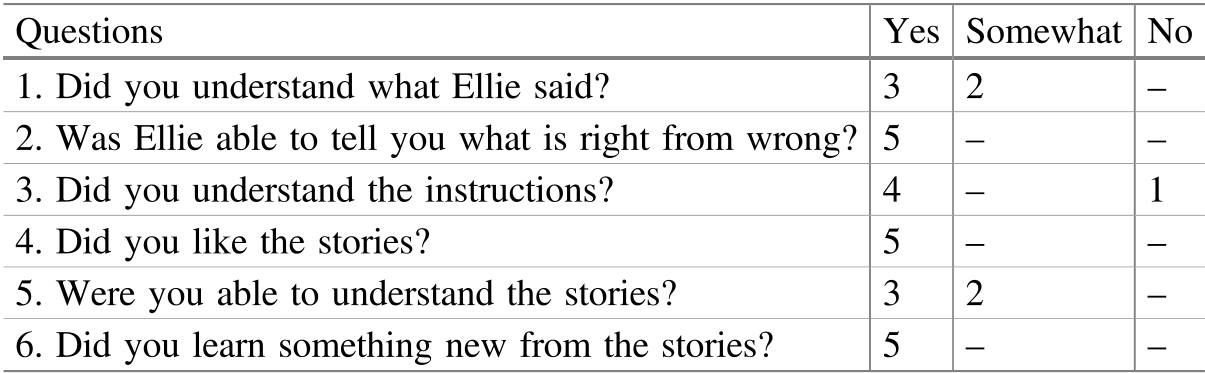 Table 1: Evaluation results for Ellie. Note the 100% success rate in teaching "right from wrong" and learning new things.
Key Findings:
- Role Performance: Children preferred Ellie in her "Teacher" role (telling stories) over her "Facilitator" role (giving instructions).
- Persistence: Carla could maintain a 20-turn conversation, proving that semantic ontologies can sustain long-form engagement.
- Content Issues: The primary limitation was "nonsense" or "repetitive" responses in Carla (seen in 53.8% of cases), such as recommending a "flower at a park" and then a "flower in the park."
Critical Analysis & Conclusion
Takeaway
The study proves that curated knowledge beats raw data in pedagogical AI. By layering "social sense" on top of basic commonsense relations, the researchers created a tool that doesn't just talk but teaches.
Limitations & Future Work
- Manual Effort: Populating these ontologies is currently a manual, time-consuming process. The authors suggest moving toward semi-automatic corpus extraction in the future.
- Visual Authenticity: The peers are currently 2D static faces. Future iterations will explore animated, expressive avatars to match the emotional depth of the dialogue.
- Language Barriers: The study noted that non-native English speakers struggled, suggesting a need for multi-lingual or localized ontologies.
This work marks a significant step toward "Socially Intelligent" virtual companions that can support specialized learning needs through the power of structured narrative.