
Building a Bio-Ontology: Letting Reasoning Take the Strain with OIL
10703_Building a bioinformatics ontology using OIL.
This paper introduces the development of the TAMBIS Ontology (TaO) for bioinformatics using the Ontology Inference Layer (OIL). It leverages a hybrid approach that combines frame-based modeling with the formal reasoning power of Description Logics (DL) to manage complex biological metadata.
TL;DR
Building a comprehensive ontology for bioinformatics is a daunting task due to the sheer complexity of molecular biology. This paper presents the TAMBIS Ontology (TaO) developed using the Ontology Inference Layer (OIL). By combining intuitive frame-based modeling with the rigorous reasoning of Description Logics, the authors demonstrate how to move from handcrafted "tree-like" hierarchies to logically inferred, high-fidelity knowledge structures.
Background: The Semantic Challenge in Biology
In the early 2000s, the bioinformatics community faced a "data explosion." Knowledge was trapped in disconnected databases with varying terminologies. Ontologies were proposed as the "glue" for resource interoperation, but creating them was a manual, error-prole process. The authors identify a key bottleneck: the inability of early tools to handle the dynamic and shifting nature of biological definitions.
The "Insight": Descriptive vs. Asserted Modeling
The core philosophy of this work is a shift in the ontologist's role. Instead of manually deciding exactly where a concept fits in a deep hierarchy (Asserted Modeling), the ontologist describes what the concept is through its properties (Descriptive Modeling).
The methodology follows a three-step cycle:
- Skeleton Construction: Build a basic framework of primitive classes.
- Property Elaboration: Define "Necessary and Sufficient" conditions (e.g., "An atom is an element if and only if it contains only one kind of atom").
- Automated Classification: Use a reasoner to "compute" the hierarchy.
Methodology: The Architecture of TaO
The authors transitioned the TaO from the older GRAIL language to OIL. This transition allowed them to utilize the OilEd editor and the underlying FaCT reasoner.
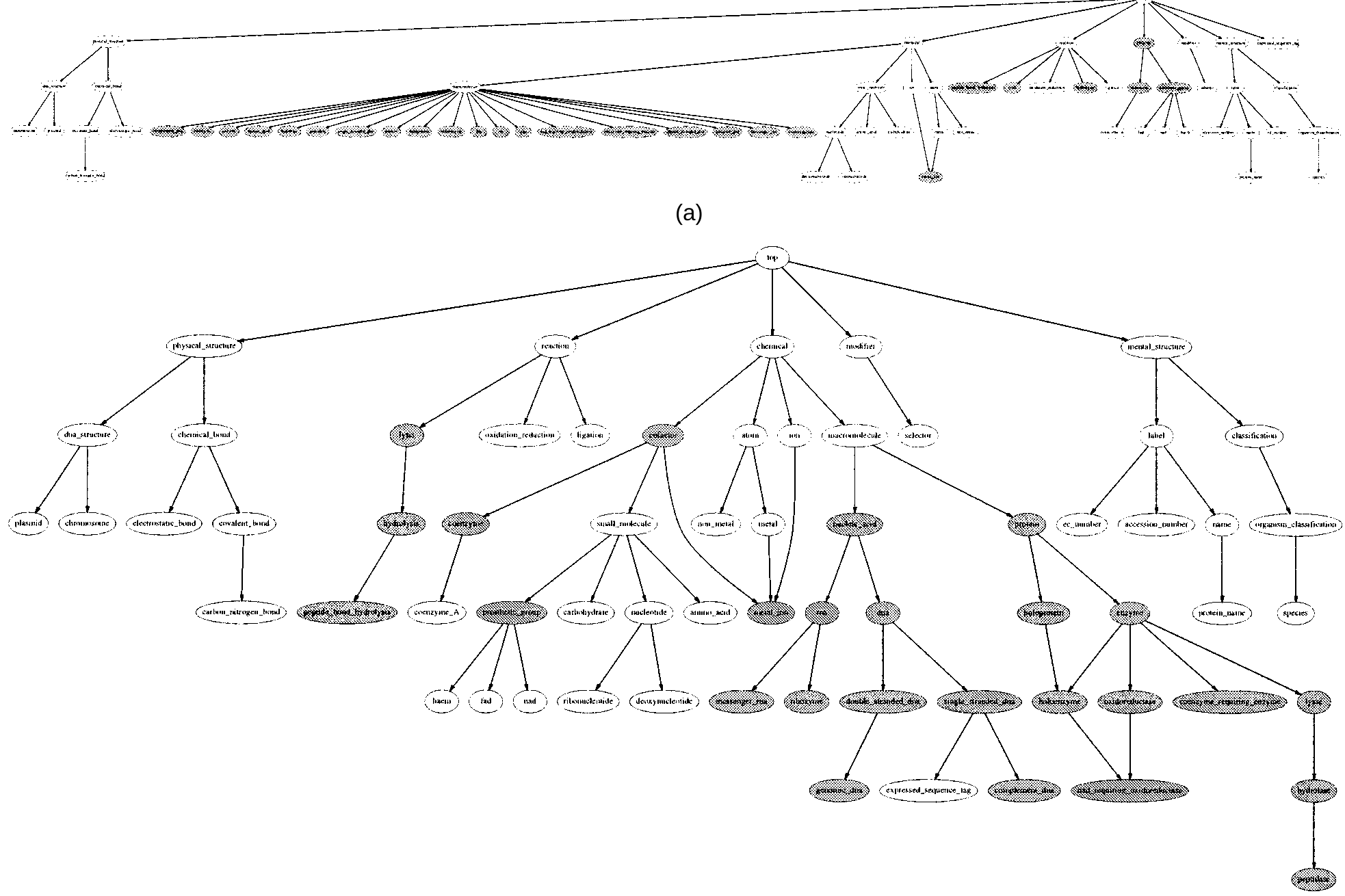 Note: The figure above illustrates the transition from a "flat" asserted structure (a) to a "deep" inferred hierarchy (b) after the reasoner processes the defined properties.
The Power of Necessity and Sufficiency
One of the most striking examples in the paper is the definition of chemicals:
- Primitive Concepts: A concept is "primitive" if we only describe its necessary properties. You can't be sure something belongs to this class just by looking at its properties.
- Defined Concepts: Using "Necessary and Sufficient" conditions allows the reasoner to perform Automatic Subsumption. For instance, if you define a
Cationas a chemical with a positiveelectrical-charge, and later define aDivalent-Cationwith a charge of+2, the reasoner automatically realizes that allDivalent-Cationsare types ofCations.
Experimental Validation: Correcting Human Error
The value of the OIL reasoner was proven when it identified "overmodeling" and logical contradictions in the handcrafted versions:
- Conflict Resolution: A biologist initially conceptualized a
Cofactoras both aMetal-ionAND aSmall-molecule. When these two parent classes were marked as disjoint (meaning an entity cannot be both), the reasoner flaggedCofactoras logically inconsistent, forcing a correction of the model's semantics. - Property-Based Taxonomy: By defining
Hydrolaseas an enzyme that catalyzesHydrolysis(a sub-type ofLysis), the system automatically inferred thatHydrolaseis a subclass ofLyase.
Critical Insight & Future Outlook
This paper serves as a seminal use-case for what would eventually become the Semantic Web. By using OIL, the authors moved bioinformatics away from "labels and strings" toward "logic and meaning."
Limitations: The authors acknowledge that defining sufficiency conditions in biology is notoriously difficult due to exceptions (e.g., defining a "species" is harder than defining an "atom").
Legacy: The principles discussed here—iterative refinement and the use of DL reasoners—laid the groundwork for the OWL (Web Ontology Language) standard used today in everything from Gene Ontology to clinical decision support systems.
Conclusion
The TaO project demonstrates that in complex domains like bioinformatics, we should "let the reasoning take the strain." By focusing on local property definitions rather than global hierarchy maintenance, researchers can build more accurate, flexible, and interoperable knowledge bases.