
Sensing the Social: Mapping Biometrics to Your Digital Inner Circle
Building Dynamic Social Network From Sensory Data Feed
This paper presents a framework that bridges Body Sensor Networks (BSNs) and Social Networks by dynamically mapping real-time sensory data feeds to a specific subgroup of a user's social circle, known as the Community of Interest (COI). This is achieved through an overlay network that utilizes Ant Colony Optimization (ACO) for data harvesting and Fuzzy Ontology for semantic mapping.
TL;DR
This research introduces a novel framework that bridges the gap between Body Sensor Networks (BSNs) and Social Networks. By harvesting social data through swarm intelligence and applying fuzzy logic, the system automatically identifies a "Community of Interest" (COI) to receive real-time alerts from wearable sensors, ensuring that critical health data (like an erratic heartbeat) reaches the right people instantly across diverse platforms.
The Social-Sensory Gap
We live in a hyper-connected world where our heart rate, location, and activity are constantly monitored by wearables. Simultaneously, our social lives are mapped across Facebook, LinkedIn, Twitter, and professional databases. Yet, these two worlds remain silos. If you have an emergency, your watch knows, but it doesn't "know" who in your 1,500+ social ties is the most relevant person to alert—is it your physician, your spouse, or a nearby colleague?
The challenge is multi-fold:
- Data Fragmentation: Social ties are scattered across proprietary services.
- Context Blindness: Traditional social networks treat "friends" as a flat category, failing to distinguish who should receive medical vs. professional alerts.
- Dynamic Discovery: Social ties change; a static contact list is insufficient for a dynamic life.
Methodology: From Swarm Intelligence to Fuzzy Reasoning
The authors solve this through a sophisticated three-phase pipeline:
1. Swarm Discovery (ACO)
To aggregate a user's entire social footprint, the system uses Ant Colony Optimization (ACO). "Forward Ants" explore URI routes across the "Open Stack" (OpenID, OAuth), while "Backward Ants" reinforce the most efficient paths to harvest metadata. This treats the Internet as a gigantean graph where data ants crawl to find e-mail interactions, co-authorships, and social media links.
2. Categorization (The SIENA Model)
Once gathered, the system applies the SIENA (Simulation Investigation for Empirical Network Analysis) model. This isn't just a random shuffle; it uses stochastic actor-oriented modeling to group your "alters" into Personal Social Networks (PSNs): Kin, Colleagues, Friends, or Healthcare Providers.
3. Semantic Mapping (Fuzzy Ontology)
This is the "Brain" of the system. Using a Mamdani Fuzzy Inference Engine, the framework maps a BSN trigger (e.g., "High Heart Rate") to a PSN group.
- The Logic: If (Heart Rate is HIGH) and (Relation is KIN), then (Push Data to Mobile). The use of fuzzy logic allows for the "vagueness" of human relationships, assigning membership values to ties rather than a binary "yes/no" connection.
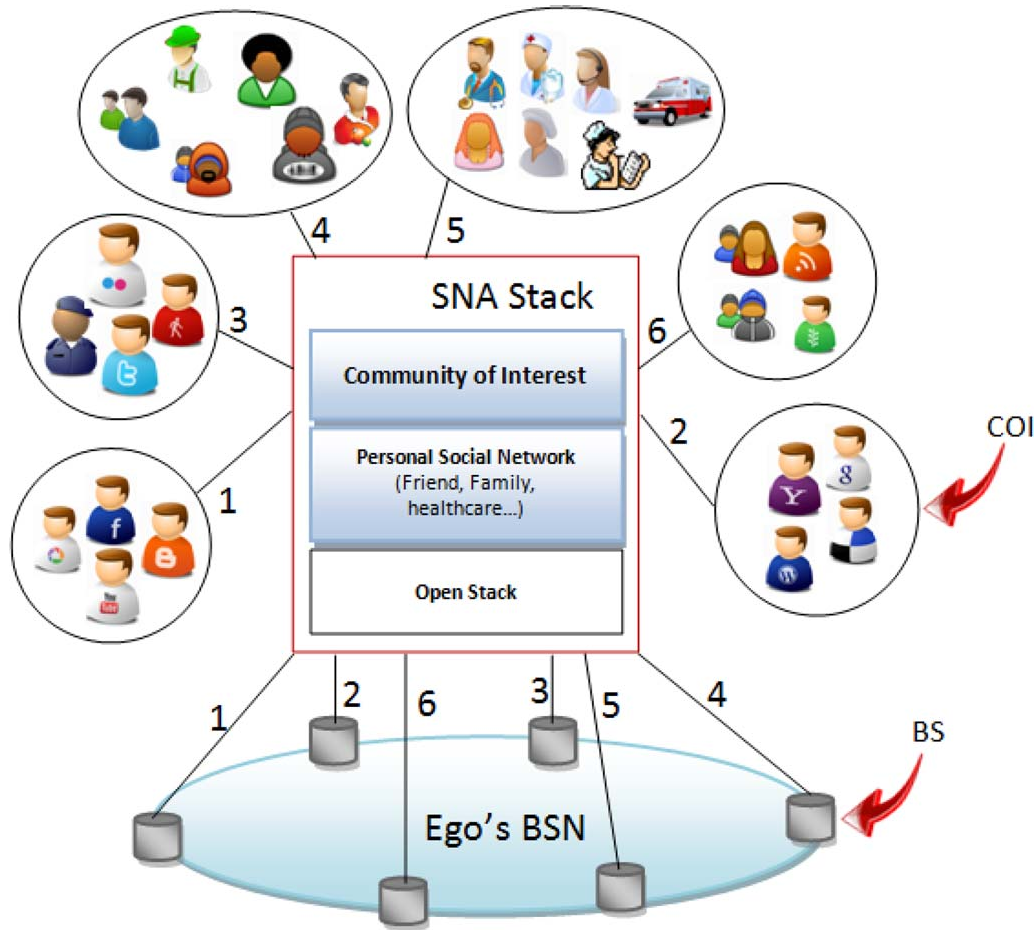 Fig 1: The overlay network forming the COI on top of existing social layers.
Experiments and Real-world Performance
The system was put to the test using Lego Mindstorm NXT bricks, Garmin heart rate monitors, and Nokia N95 smartphones.
Key Findings:
- High Reliability: The success ratio for pushing sensory data (Motion, Accelerometer, Temperature) hovered between 94% and 97%.
- Latency: Average response times were impressive, with heart rate data reaching the COI in ~1.23 seconds. GPS data took slightly longer (~3.25s) due to satellite fix requirements.
- SNA Accuracy: The SIENA model correctly categorized social ties with a 95% success rate, requiring minimal manual intervention.
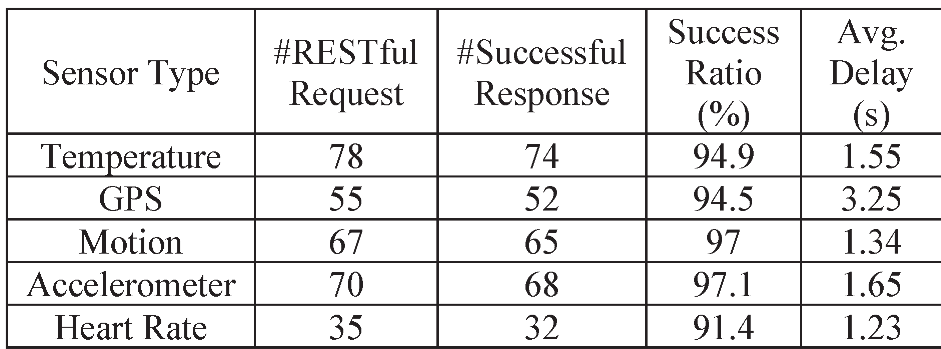 Table 1: Successful response rates and average delays for different sensor triggers.
Critical Insight: Why This Matters
The genius of this work lies in its "Overlay" approach. By not trying to build a new social network, but rather building a dynamic intelligence layer on top of existing ones (Facebook, E-mail, etc.), the authors have created a scalable way to integrate our physical bodies with our digital identities. This is a foundational step toward Cyber-Physical Social Networks (CPSN).
Limitations
Despite the success, the authors note that mobile OS restrictions and network switching (Wi-Fi to Cellular/VPN) accounted for the majority of missed data packets. Future work will likely need to address these "handover" issues to ensure 100% reliability in critical medical emergencies.
Conclusion
This framework transforms a Body Sensor Network from a passive monitoring tool into an active, social participant. By automating the discovery of a "Community of Interest," we ensure that in our moments of physical vulnerability, our digital infrastructure works as hard as our biological one to keep us safe.