
Beyond Proximity: Inferring Semantic Social Ties through Bayesian Life-log Mining
Building Mobile Social Network with Semantic Relation Using Bayesian NeTwork-based Life-log Mining
This paper introduces a novel approach to building mobile social networks by mining semantic relations from multi-modal life-logs. Using a Bayesian Network (BN) framework, the system infers complex relationships like "close friend" or "colleague" by integrating low-level sensor data (GPS, Bluetooth, call logs) with high-level user context (activity and emotion).
TL;DR
Most social apps know where you are, but few understand who you are to the people around you. This paper proposes a system that goes beyond simple GPS proximity. By using Bayesian Networks to process "life-logs"—a mix of call histories, Bluetooth traces, activities, and emotions—the authors can automatically categorize relationships into specific semantic tiers like "close colleague" or "acquaintance," achieving accuracies up to 75.9%.
Background: The Gap in Social Sensing
While platforms like Facebook or LinkedIn rely on explicit user input to define links, mobile devices offer a "passive" window into real-world dynamics. Early mobile social research (like MIT's Reality Mining) focused on physical co-presence. However, being in the same room doesn't distinguish a boss from a best friend. The challenge lies in the uncertainty of mobile data and the absence of high-level context (what are you actually doing together?).
Methodology: High-Level Context Meet Probabilistic Logic
The authors argue that to understand a relationship, you must understand the activity and emotion associated with interactions. They implemented a manual annotation system for users to log:
- Activities: Categorized from the General Social Survey (GSS) into Work, Education, Socializing, etc.
- Emotions: Based on the Valence-Arousal model (e.g., Excited, Relaxed, Upset).
The Bayesian Network Architecture
To handle the noisy nature of mobile sensors, a Bayesian Network (BN) was designed. Unlike traditional deterministic algorithms, a BN calculates the probability of a relationship state.
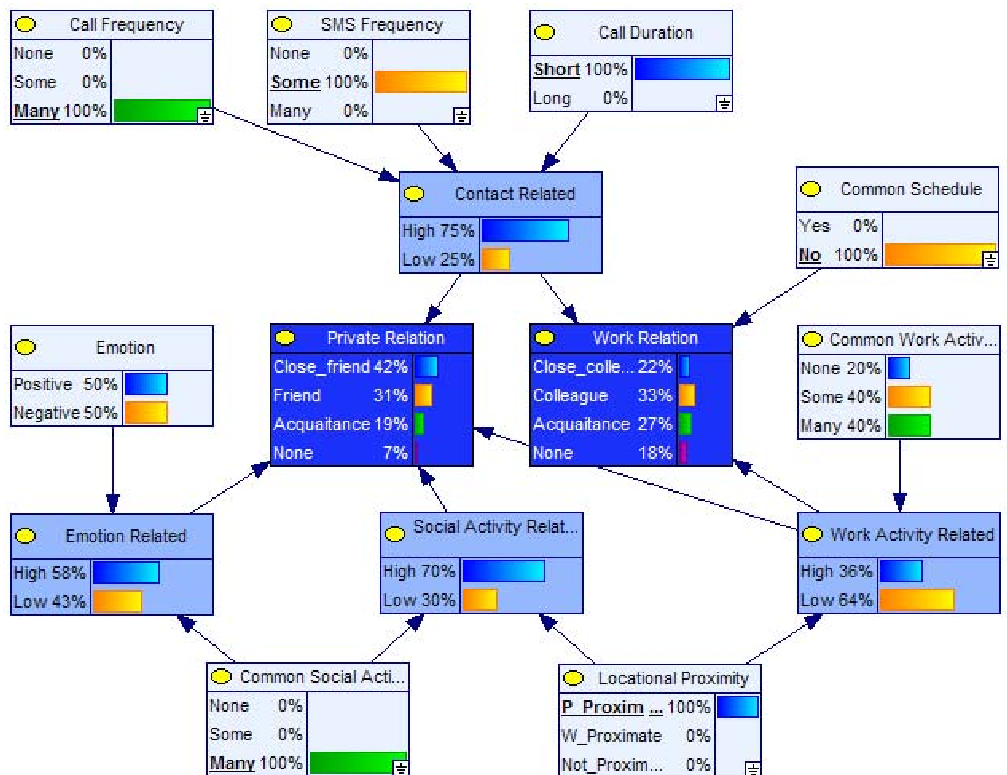
The model bifurcates into two main query nodes:
- Private Relation: Influenced heavily by
SocialActivityRelatedandEmotionRelatednodes. - Work Relation: Driven by
WorkActivityRelatedandCommonSchedule.
Experimental Results & Insights
The study followed 11 graduate students over three weeks. The results highlights a critical distinction between different social "layers":
- The Proximity Trap: The "Work Relation" network (Fig 5) was found to be overly dependent on location. Because colleagues sit in the same office, proximity alone couldn't distinguish the strength of the work bond.
- Interaction as a Refiner: When call and SMS logs were prioritized (Fig 6), the model correctly identified "teams" within the lab that location data missed.
- Performance:
- Private Relation Accuracy: 72.2%
- Interaction-based Link Accuracy: 75.9%
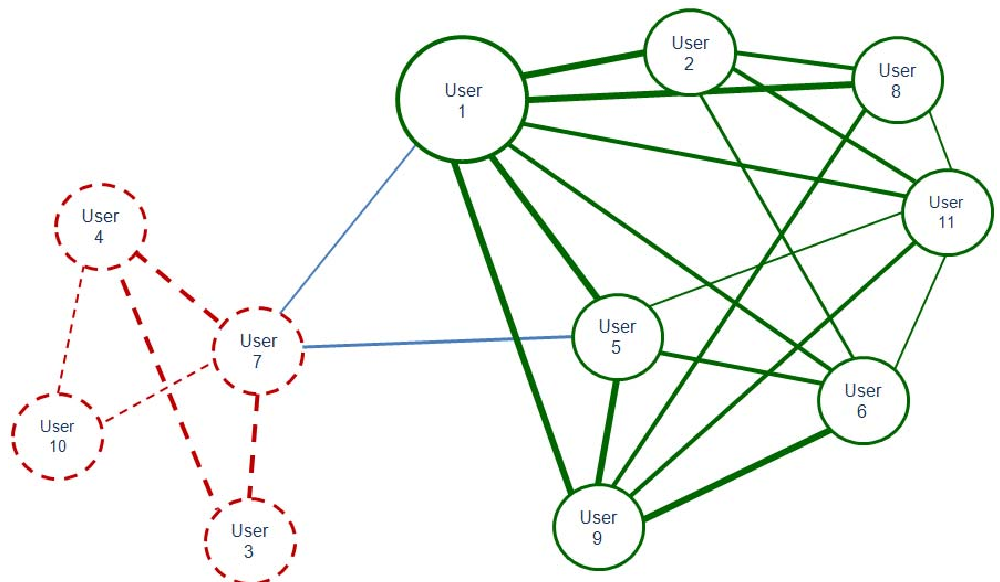 Fig 3 & Fig 5 illustrate the difference between Private-based (left) and Work-based (right) social structures.
Critical Analysis & Conclusion
Takeaway
The core value of this work is the validation that semantic labels (Close friend vs. Acquaintance) are discoverable through a combination of interaction frequency and activity type. This moves mobile social networking closer to a human-centric understanding.
Limitations & Future Work
The primary bottleneck is the manual annotation of life-logs. For a consumer product, users will not manually enter their emotions and activities every hour. The authors acknowledge this, pointing towards automated context recognition (using accelerometers and microphones) as the next frontier. Furthermore, the small sample size (11 students) suggests the model needs testing in more heterogeneous environments, such as corporate offices or residential neighborhoods.
Final Thought
As we move into an era of "Smart Assistants," the ability for a device to realize that a person nearby is a "Close Friend" versus "Colleague" could revolutionize how our phones filter notifications, share location, or suggest tasks.