
Collective Intelligence: Reimagining Term Suggestion through Wikipedia’s Hidden Networks
15698_Building term suggestion relational graphs from collective intelligence.
The paper introduces Collective Intelligence based Term Suggestion (CITS), a novel framework for conceptual Web search that generates semantic relational graphs of search terms. It leverages Wikipedia’s editorial history to identify hidden connections between terms via a social-network-based approach, outperforming traditional keyword extraction.
TL;DR
Searching for complex concepts often fails when search engines only suggest textual completions rather than conceptual relatives. CITS (Collective Intelligence based Term Suggestion) bridges this gap by mining the editorial history of Wikipedia. Instead of just looking at text, it looks at people. If the same experts (editors) are writing about two different topics, those topics are likely related. This human-centric approach creates a semantic graph that outperforms Google and Yahoo! in conceptual search satisfaction.
Problem & Motivation: Beyond Keyword Co-occurrence
Most search engines suggest terms based on how often words appear together in documents. However, this "frequent co-occurrence" is a shallow metric. It often captures noise from irrelevant high-frequency words and fails to understand the underlying intent of a user.
The authors argue that semantic proximity cannot be measured solely by hyperlinks. Just because a page links to another doesn't tell us how closely they are related in the minds of experts. To find a better signal, they turned to the creators of the content: the Wikipedia contributors.
Methodology: The Power of the Bipartite Graph
The core innovation of CITS lies in its use of Social Network Analysis applied to information retrieval. The framework operates in three main steps:
- Network Construction: The system crawls Wikipedia to build a bipartite graph connecting articles (Topics) and their editors (Contributors).
- Semantic Weighting: The team uses a mathematical "folding" technique. If Topic A and Topic B are both edited by a large group of the same individuals, the link between A and B is weighted heavily.
- Visualization: Instead of a simple list, suggested terms are presented as a relational graph, allowing users to navigate through "ego-centric" social networks of ideas.
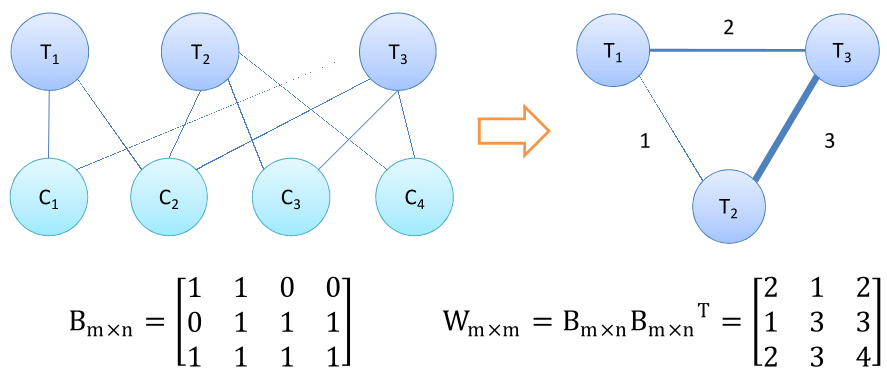 Fig 1: The mathematical intuition behind CITS: folding a topic-contributor bipartite graph into a weighted semantic graph.
The weight between two terms is calculated by the inner product of their contributor vectors: This captures the "Collective Intelligence" buried in human behavior—diverse interests of editors act as a natural sampling scheme for semantic relatedness.
Experiments & Results: Human Intuition vs. Algorithms
The researchers compared CITS against the gold standard of lexical databases, WordNet, and the giants of 2009 search, Google and Yahoo!.
- Qualitative Superiority: When searching for "Number Theory," CITS suggested "Goldbach's conjecture" and "Riemann zeta function"—terms deeply relevant to a mathematician. Google, meanwhile, largely suggested "Number theory web."
- Quantitative Success: In a study involving 50 search terms, users overwhelmingly preferred CITS suggestions.
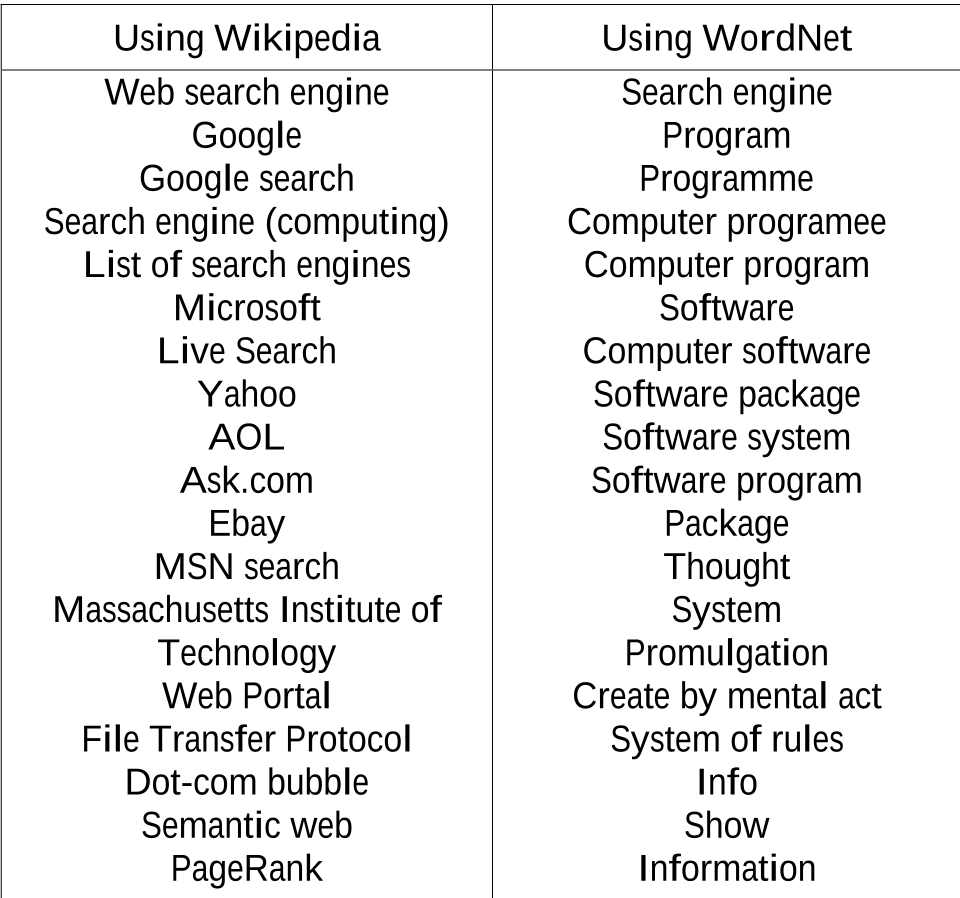 Table 1: Comparison between Wikipedia-based CITS and WordNet. CITS captures modern, contextually rich terms (e.g., Google, MSN Search) that static ontologies like WordNet miss.
The user study revealed that 68% of participants found CITS better or much better than Google for conceptual exploration.
Critical Analysis & Conclusion
CITS represents a significant shift from "Text Mining" to "Behavior Mining." By treating terms as nodes in a social network of human contributors, the authors successfully captured an inductive bias that is much harder for standard NLP models to learn: expert association.
Takeaway
The paper proves that collective human behavior is a more robust source of semantic truth than raw text frequency. For modern developers, this insight suggests that signals from user interaction, editorial history, and community curation are more valuable for building "intelligent" interfaces than simple lexical matching.
Limitations
- Data Latency: The system relies on crawling editorial history, which may lag behind real-time trends compared to search query logs.
- Computational Cost: Constructing and folding large-scale bipartite graphs from millions of Wikipedia revisions is computationally intensive.
Future Outlook
While this paper was published in 2009, the logic of using "human-centric graphs" persists in modern Recommendation Systems and Knowledge Graph embeddings. Future iterations of this work could involve real-time clickstream data or LLM-augmented graph traversal to refine the weights even further.