
Engineering Trust: Lessons from CouchSurfing on Bridging the Online-Offline Safety Gap
Building Trust in Hospitality and Culture Exchange Travel Sites: Lessons from Heuristic Evaluation of CouchSurfing
This study presents a novel evaluation framework for building trust in hospitality and culture exchange platforms. By conducting a Heuristic Evaluation of CouchSurfing with six experts, the authors identify systemic barriers in trust-building and provide actionable design recommendations to enhance user reliability and safety.
TL;DR
In the world of hospitality exchange, "trust" isn't just a buzzword—it's the difference between a life-changing cultural experience and a dangerous encounter. This paper evaluates CouchSurfing through a rigorous academic lens, identifying why current UI/UX designs fail to facilitate deep trust and proposing a framework to fix it.
The "Leap of Faith" Problem
Hospitality exchange (e.g., CouchSurfing, BeWelcome) operates on a social norm entirely different from hotels: welcoming strangers into the privacy of one's home for free. While social media has flourished, the transition from an online "click" to an offline "stay" remains fraught with risks like deception and privacy violations. The authors argue that current platforms haven't mastered the Calculative and Prediction phases of trust—where users calculate risks and try to predict a stranger's behavior based on digital cues.
Methodology: The Unified Trust Framework
The researchers didn't just look at "usability"; they built a multi-dimensional lens to view "trust" through:
- The Trust-Building Process: Moving from calculating rewards to transferring trust through "proof sources."
- Online Trust Principles: Elements like identity authentication, security, and risk warnings.
- Trust-Inducing Interface Design: The "look and feel"—Graphic Design, Structure, and Social Cues.
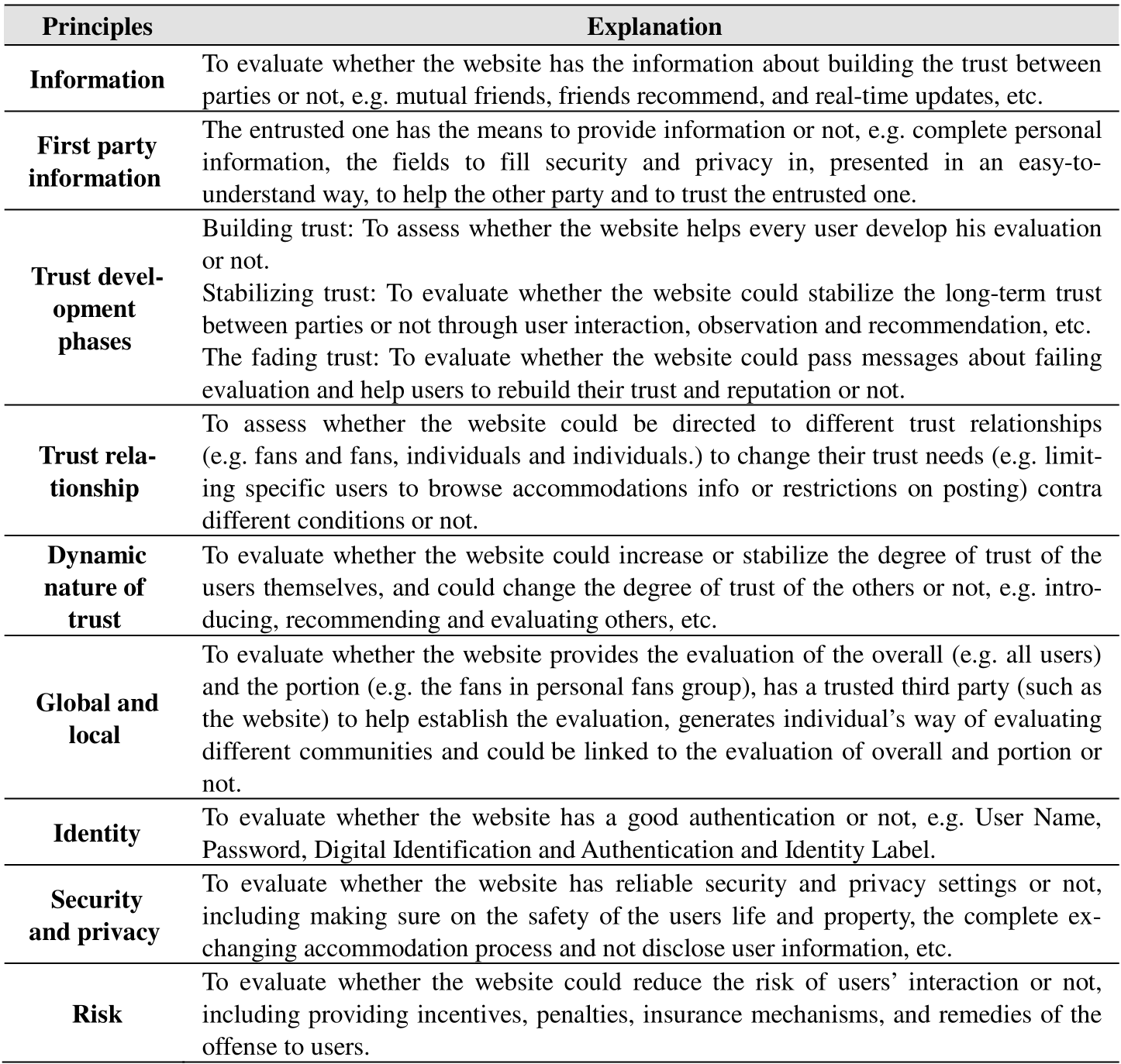 Table: The online trust principles used for the heuristic evaluation.
Key Findings: Where CouchSurfing Falls Short
The heuristic evaluation conducted by six UX and industrial design experts found several "trust barriers":
- Lack of Prediction Tools: It is extremely difficult for users to confirm the authenticity of data. The scores for "Prediction" were among the lowest (Mean: 2.33).
- Visual Cognitive Dissonance: CouchSurfing's bright orange palette and high contrast were perceived as "too energetic" and potentially less "reliable" compared to cooler tones like light blue, which are psychologically linked to trust.
- Social Cue Deficit: The platform relied too heavily on static text. The experts argued for synchronous communication tools (like video telephony) to allow users to "vibe check" each other before meeting in person.
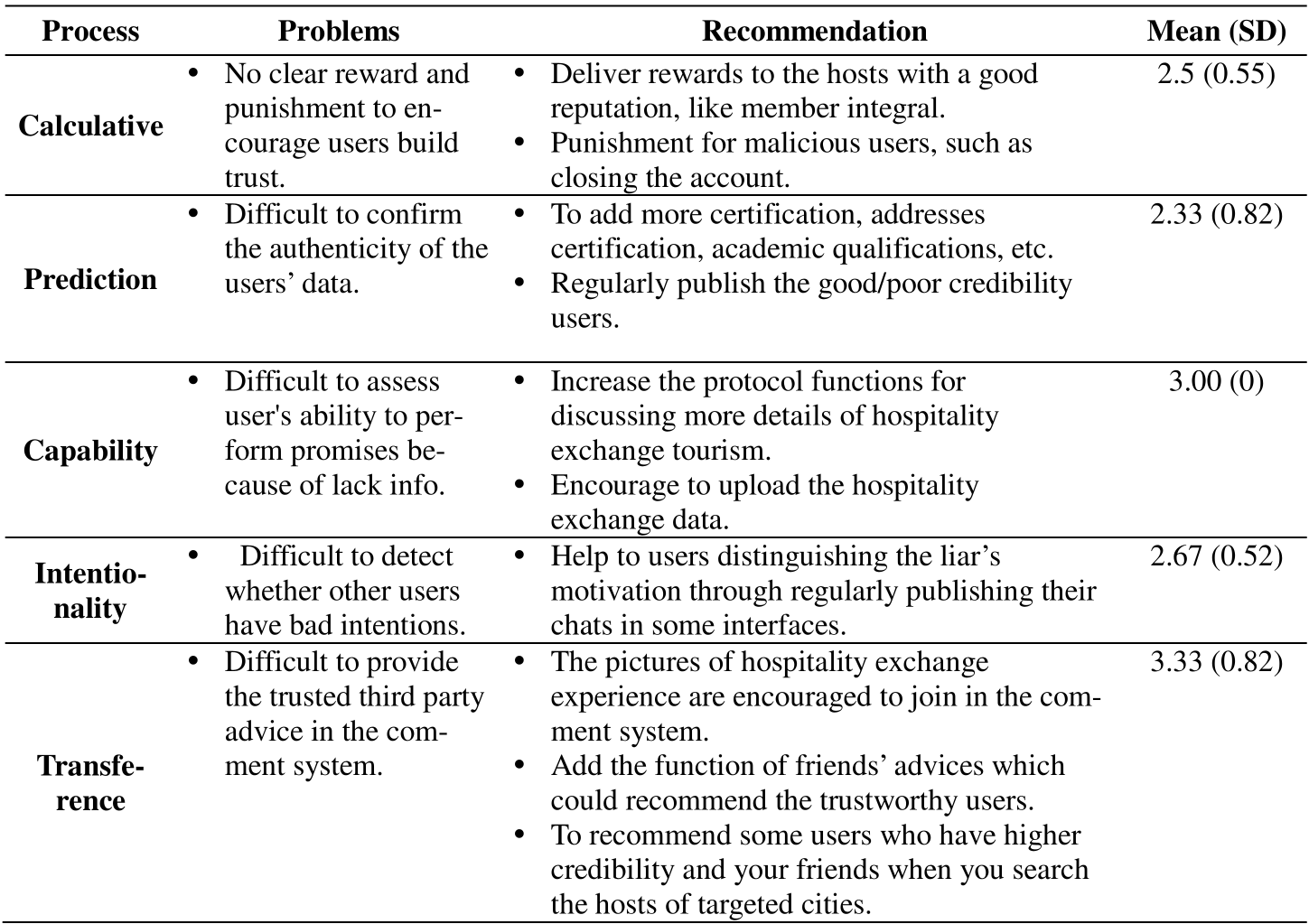 Table: Mean scores showing that Calculative and Prediction phases are the weakest links.
Designing for Radical Reliability
The authors don't just critique; they offer a roadmap for the next generation of culture-exchange platforms:
- The Interactive Photo Wall: Moving away from static profile pictures to "dynamic photo walls" that refresh regularly, showing a user's recent interactions and living environment.
- Smart Search Recommendations: Instead of just luck-of-the-draw, the search system should prioritize "Transference"—showing you hosts who are friends of friends or have verified high-credibility scores.
- The "Cool" Rebrand: Switching to a light blue visual identity to foster a sense of calm and professional security.
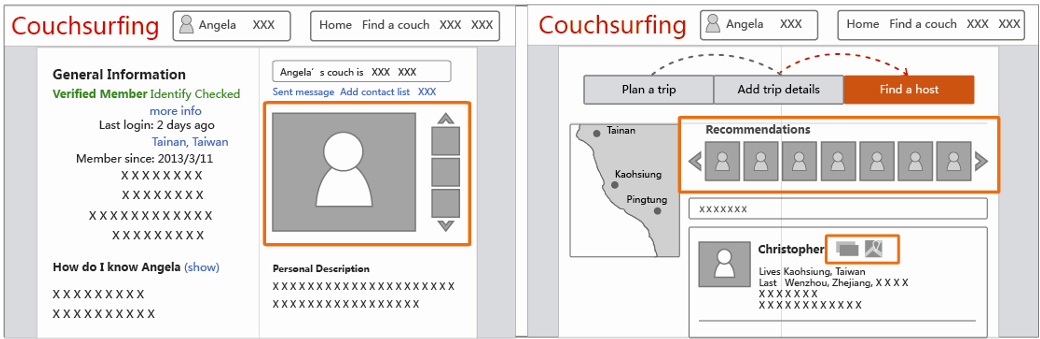 Figure: Proposed UI improvements for searching and profile verification.
Critical Insight & Conclusion
The genius of this paper lies in its realization that trust is a process, not a feature. You cannot simply "add" a security badge and expect users to feel safe. Trust must be designed into the information architecture (Structure Design) and the emotional resonance of the UI (Graphic Design).
While limited by a small sample size of student experts, this study provides a crucial blueprint for any developer building in the "sharing economy" space. To get a stranger to open their door, you must first open the communication channels with high-fidelity social cues and transparent risk-reduction mechanisms.