
BullyBlocker: Bridging Psychology and Data Science to Protect Adolescents
BullyBlocker: Towards the identification of cyberbullying in social networking sites
This paper introduces BullyBlocker, a cross-disciplinary identification model and mobile application (Facebook-integrated) designed to detect cyberbullying. It leverages a unique "Bullying Rank" (BR) that combines linguistic insult detection with psychological vulnerability profiles to notify parents of potential online aggression.
TL;DR
Cyberbullying remains a silent epidemic, with over half of adolescents keeping their victimization a secret from parents. BullyBlocker is a novel identification framework that moves beyond simple keyword filtering. By integrating established psychological "states of vulnerability" (like moving to a new school) with automated insult detection on Facebook, it generates a Bullying Rank to provide parents with actionable, real-time alerts.
Problem & Motivation: The Gap in Detection
Existing automated tools often treat cyberbullying as a static text-classification problem. However, the authors argue that the impact of a message is inherently tied to the context of the recipient. A single insult might roll off the back of a socially established student but could be devastating to a "fringe" student in a new environment.
The core challenge lies in the disconnection between social data and psychological reality. BullyBlocker aims to close this by quantifying both the "Warning Signs" (the aggression) and the "Vulnerability" (the context) to create a more holistic risk assessment.
Methodology: The Bullying Rank (BR)
The heart of the paper is the Bullying Rank, a composite score computed through two primary modules.
1. The Architecture
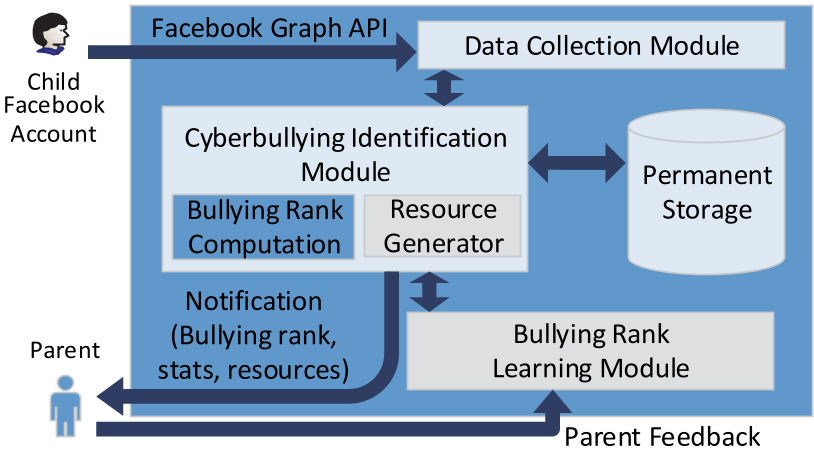
The system follows a modular pipeline: a Data Collection Module extracts wall posts and profile metadata (with consent), which is then processed by the Cyberbullying Identification Module.
2. Warning Signs (WS) vs. Vulnerability Factors (VF)
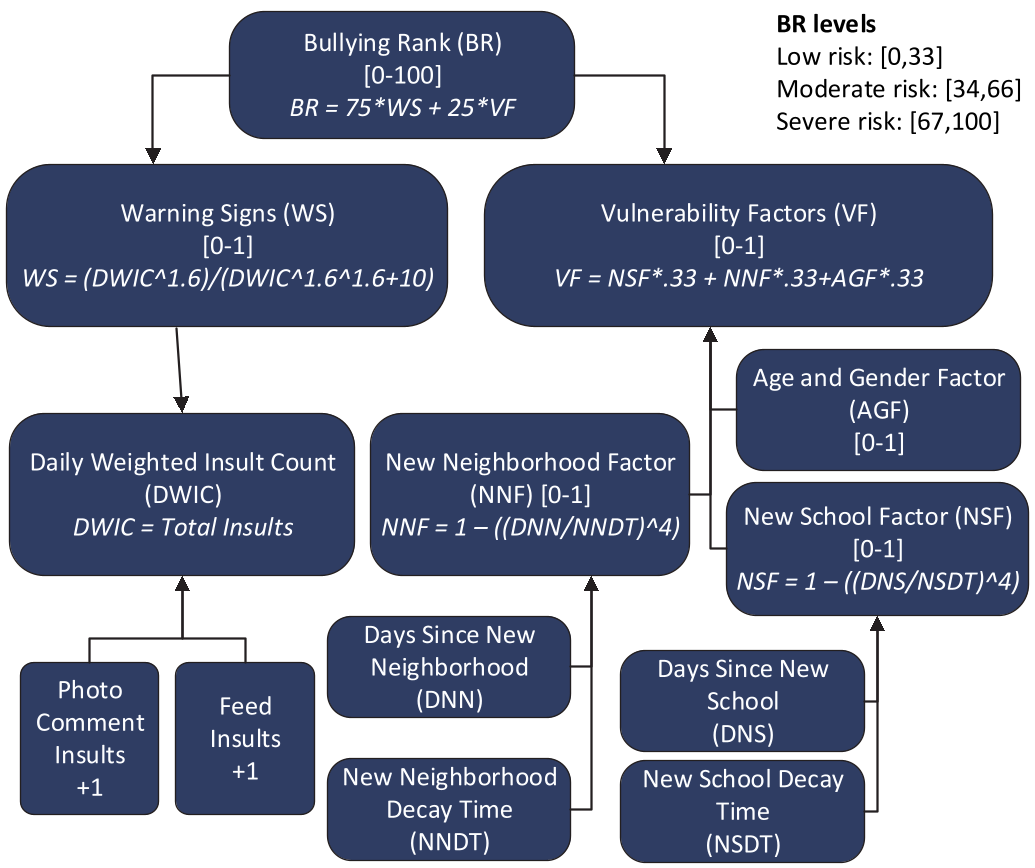
The BR is calculated as a weighted sum of these two components:
- Warning Signs (WS): Based on the Daily Weighted Insult Count (DWIC). Interestingly, the authors use a non-linear function where the "weight" of insults tapers off after a certain threshold (around 30 insults), reflecting the psychological reality that the onset of bullying provides the most significant shift in risk.
- Vulnerability Factors (VF): This includes the Age-Gender Factor (AGF), New School Factor (NSF), and New Neighborhood Factor (NNF). The NSF and NNF are time-decaying; the risk is highest immediately after a move and decreases as the adolescent integrates into their new environment.
Experiments & Results
The authors validated the model by applying it to varied user profiles on Facebook. The system successfully distinguishes between users with low-risk interactions and those exhibiting high-vulnerability patterns combined with frequent offensive wall content.
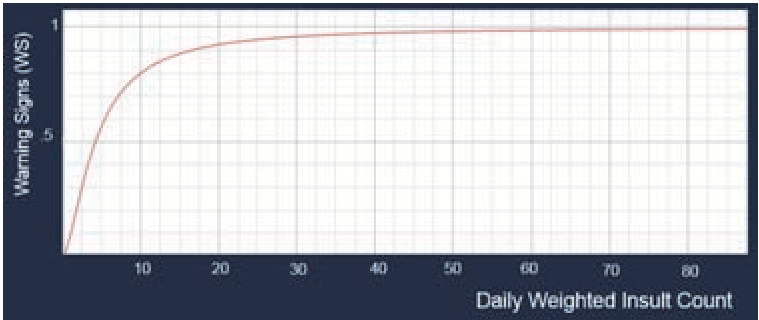 Figure: The non-linear relationship between insult count and risk weight, emphasizing the importance of early-stage intervention.
The study demonstrates that incorporating metadata (like how many days since a student changed schools) drastically changes the "Bullying Rank" compared to models that only look at text. This confirms that Vulnerability is a necessary dimension for accurate risk estimation.
Critical Analysis & Conclusion
Takeaway: BullyBlocker’s strength lies in its theory-driven approach. While many AI models are "black boxes," BullyBlocker is grounded in the Social Determinants of Bullying, making its outputs interpretable for parents and psychologists alike.
Limitations:
- Linguistic Depth: The current version uses hash-based lookups for insults, which might miss sarcastic, nuanced, or evolving slang.
- Privacy Parity: The requirement for parents to have the adolescent's login credentials presents a barrier to trust and widespread adoption.
Future Work: The authors propose integrating Machine Learning to refine weights based on parent feedback and expanding factors to include socio-economic status, race, and sexual orientation—factors known to significantly influence bullying victimization.
By turning "social noise" into a "Bullying Rank," BullyBlocker provides a blueprint for how social media platforms can move from reactive moderation to proactive protection.