
Graph Burning: A New Metric for Social Contagion Speed
Burning a Graph as a Model of Social Contagion
This paper introduces the burning number , a new graph parameter quantifying the speed of social contagion under a discrete-time process. The authors establish the NP-completeness of computing , provide sharp bounds for connected graphs, and derive asymptotic results for Cartesian grids and the Iterated Local Transitivity (ILT) model.
TL;DR
How fast can a rumor or a virus take over a network if you can strategically "seed" one new person every day? This paper introduces the burning number, a graph-theoretic parameter that measures the minimum time to ignite an entire network. The researchers prove that even on simple grids, the growth of this number follows specific power laws, and they provide a foundational framework for understanding contagion speed in complex systems.
Problem & Motivation: Beyond Passive Spreading
Most models of social influence focus on a single initial trigger. However, real-world marketing and emotional contagion often involve continuous intervention. The authors identify a gap: we need a metric that accounts for both external influence (choosing a new source each round) and internal diffusion (neighbors infecting neighbors).
The "burning" process operates in discrete rounds:
- External Burn: You pick any unburned node to set on fire.
- Internal Spread: Any node already on fire spreads the flame to its immediate unburned neighbors.
- Persistence: Once burned, a node stays burned.
The challenge? Minimize the number of rounds to burn the entire graph.
Methodology: The Geometry of Contagion
The core insight of the paper is the Rooted Tree Partition. Burning a graph in steps is equivalent to covering the graph with balls of decreasing radii.
If you start a fire at node in round 1, by round it has spread to everything within distance . A source started in round 2 reaches distance , and so on.
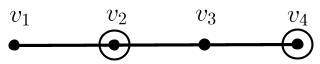 Figure 1: An optimal burning sequence for a path . Selecting then covers the graph in 2 steps.
The Governing Equation
For a sequence of sources to be valid, the union of their neighborhoods must cover the vertex set :
Key Results: From Paths to Grids
The authors derive specific values and bounds that define the "speed limit" of information in various architectures:
- Paths and Cycles: For a path , the burning number is exactly . This sets a baseline: in a linear network, time grows with the square root of the population.
- The Grid Transition: In a Cartesian grid , there is a fascinating shift in complexity (Theorem 9):
- If the grid is "thin" ( is small), it behaves like a path: .
- If the grid is "thick", it behaves like a 2D surface: .
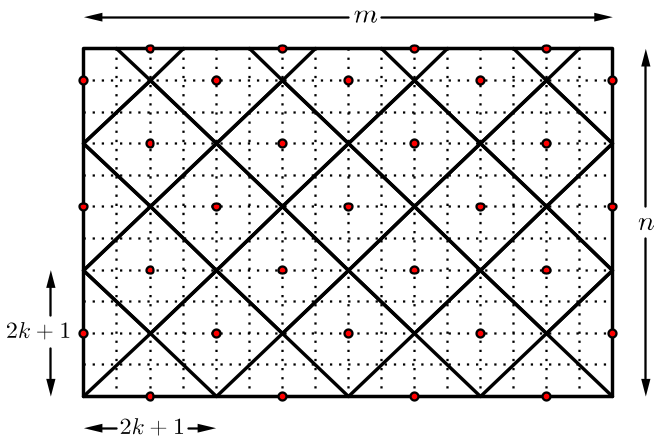 Figure 2: Optimal covering of a grid using "diamond" shaped neighborhoods to minimize burning rounds.
Social Network Implications: The ILT Model
One of the paper's most salient contributions is applying the burning number to the Iterated Local Transitivity (ILT) model. Social networks often exhibit "cloning" behavior where new members copy the connections of existing ones. Specifically, the authors show that even as an ILT network grows exponentially in size, its burning number remains constant or increases by at most 1.
Takeaway: Real-world social networks are structurally optimized for rapid spread; adding more people doesn't necessarily make the network harder to "burn" if the underlying transitivity remains high.
Conclusion and Deep Insights
The burning number is a powerful abstraction. While calculating it is NP-hard (meaning it's computationally "expensive" to find the perfect marketing strategy), the bounds provided in this paper offer reliable heuristics.
Limitations: The model is deterministic. In reality, contagion is often stochastic (probabilistic). Furthermore, the model assumes you can pick any node to burn, whereas, in reality, some nodes (influencers) might be harder or more expensive to "ignite" than others.
Future Work: The authors suggest looking into directed graphs and models where a node only burns if it has multiple burned neighbors—a phenomenon known as complex contagion.