
BusinessDetect: Bridging Big Data and Intelligent Marketing with Deep Learning
BusinessDetect: An Advanced Business Information Mining Application for Intelligent Marketing
2020-08-01
Summary
Problem
Method
Results
Takeaways
Abstract
This paper introduces BusinessDetect, an advanced business information mining application that integrates multi-source data to support intelligent marketing. By employing ALBERT-CRF, BiLSTM-CRF, and fastText, it moves beyond simple retrieval to provide deep insights like attribute extraction and sentiment-based public opinion analysis.
## Executive Summary
**TL;DR**: BusinessDetect is a full-stack intelligence application that automates the "Information-to-Insight" pipeline for sales professionals. By crawling encyclopedia data and news, it uses a suite of NLP models (ALBERT, BiLSTM, fastText) to extract corporate attributes and public sentiment, visualized through an intuitive map-based interface.
**Background**: In the landscape of industrial AI, this work sits at the intersection of **Information Extraction (IE)** and **Decision Support Systems**. It transitions the industry from "search engines for companies" to "insight engines for salesmen."
## The Problem: The Manual "Data Silo" Tax
Traditional marketing is plagued by the **manual filtering tax**. Salesmen spend hours on search engines, manually comparing company scales and assessing creditworthiness. Prior tools like *TianYanCha* or *Innonation AI* solved the "access" problem but failed the "analysis" test—they provide raw data strings but don't tell you *how big* the company is or *what the public thinks* of them automatically.
## Methodology: The "Brain" of BusinessDetect
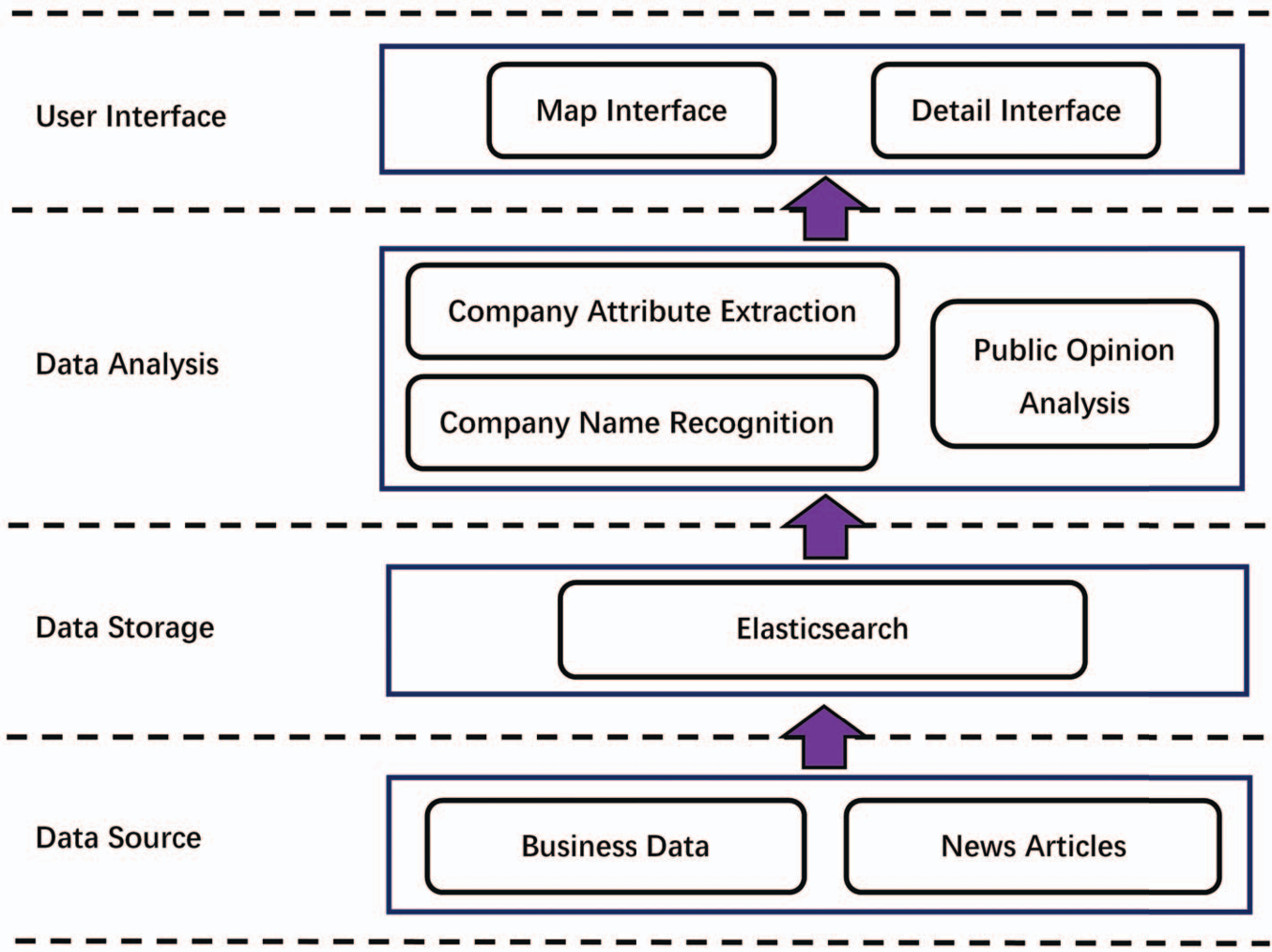
The core innovation lies in the **Data Analysis Module**, which creates a structured profile from unstructured noise.
### 1. Attribute Extraction via ALBERT-CRF
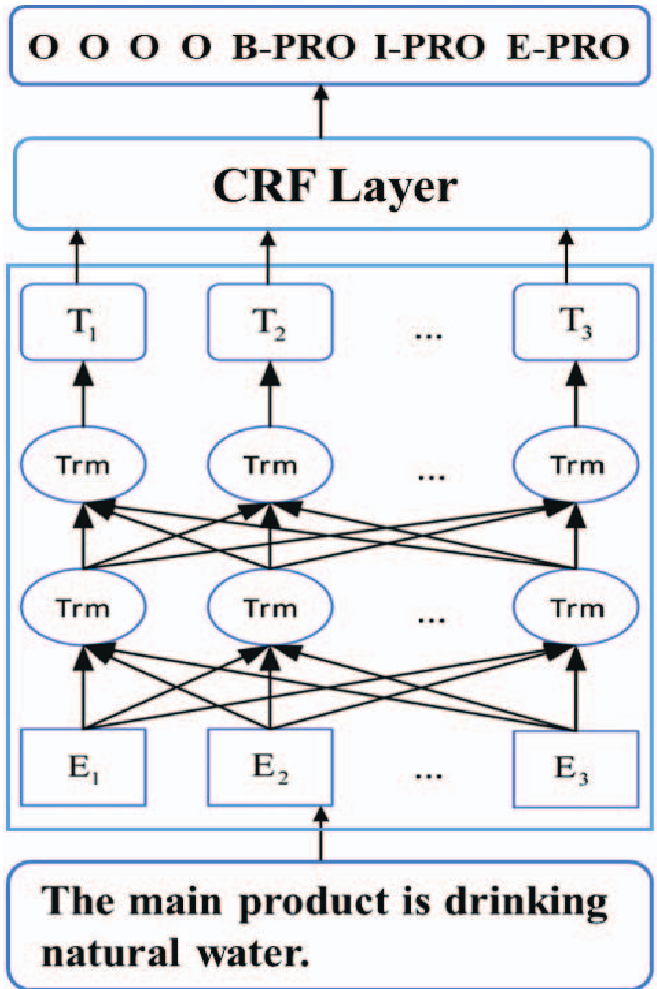
To capture latent variables like annual turnover (TUR) and employee counts (EMP), the authors treat extraction as a **sequence labeling task**. They chose **ALBERT** (A Lite BERT) for its parameter efficiency, crucial for production deployment, and topped it with a **CRF (Conditional Random Field)** layer.
* **Why CRF?** While BERT understands semantics, CRF understands *constraints* (e.g., a "Begin" tag shouldn't be followed by an unrelated tag), ensuring the extracted values are syntactically valid.
### 2. Deep Sentiment & Recognition
* **BiLSTM-CRF**: Used for Company Name Recognition in news, allowing the system to link hot news stories directly to company profiles.
* **FastText**: Used for "Public Opinion Analysis." Chosen for its extreme speed and CBOW-based efficiency, it classifies news as Positive, Negative, or Neutral to track a company's reputation trend.
## Experiments: Outperforming the Baselines
The researchers haven't just built an app; they've validated a high-performance pipeline. By testing against 17 million company records and 10 million news articles, the results show a significant lead over traditional methods:
| Task | Model | F1-Score | Improvement over Baseline |
| :--- | :--- | :--- | :--- |
| Attribute Extraction | ALBERT-CRF | 85.96% | +14.1% vs CRF |
| Name Recognition | BiLSTM-CRF | 87.88% | +8.8% vs CRF |
| Sentiment Analysis | fastText | 86.82% | +4.4% vs CNN |
## Strategic Insight: The Map-Based UX
A unique contribution of BusinessDetect is its **Map Interface**. By geocoding addresses into longitude-latitude coordinates via Amap API, it allows salesmen to "scout" a physical region virtually. This spatial indexing, combined with Elasticsearch's near real-time retrieval, enables complex filtering (e.g., "Find all tech companies in Haidian with >300 employees and positive news sentiment").
## Critical Analysis & Future Outlook
**Takeaway**: BusinessDetect successfully demonstrates that the "manual labor" of marketing can be offloaded to an ALBERT-driven extraction engine.
**Limitations & Future Work**:
1. **Internal Data**: The current model relies on public web data. Integrating internal CRM data could provide even deeper "Private Insights."
2. **Entity Disambiguation**: As the database grows to 17M+ companies, resolving similar names (e.g., "Apple" the tech giant vs "Apple" the fruit wholesaler) remains a significant challenge for the BiLSTM-CRF layer.
3. **LLM Transition**: Given the release of even smaller, more powerful models since ALBERT, moving towards a quantized LLM (like Llama-3-8B) might further improve extraction nuances.
BusinessDetect marks a solid step towards **Intelligent Marketing 2.0**, where the map is not just a guide, but a live dashboard of corporate health.