
CADET: Decoding Account Hijacking through Nonlinear Multi-View Fusion
CADET: A Multi-View Learning Framework for Compromised Account Detection on Twitter
This paper introduces CADET, an unsupervised multi-view learning framework designed to detect compromised Twitter accounts. By utilizing nonlinear autoencoders and a variant of generalized canonical correlation analysis (GCCA), the model integrates diverse data modalities—content, source, location, and timing—to identify anomalous user behavior based on reconstruction errors in a shared latent subspace.
TL;DR
Social media account hijacking is a silent epidemic. CADET (Compromised Account DEtection on Twitter) is a sophisticated unsupervised framework that identifies "hacked" accounts by analyzing the mismatch between a user's historical behavior and current activity across four dimensions: Content, Source, Location, and Timing. By projecting these views into a shared nonlinear subspace, it flags accounts that "deviate from their own norm" without needing a single labeled example.
Problem & Motivation: The "Noise" and "Label" Bottleneck
Detecting a compromised account isn't as simple as looking for spam keywords. A user might change their topic or language naturally. Traditional security systems face two massive hurdles:
- High Noise: Social media text is full of slang and typos, making NLP-only models brittle.
- Label Scarcity: Getting ground-truth data on how different hackers (from state actors to petty vandals) behave is nearly impossible at scale.
The authors' core insight is that while a hacker might mimic a user's "voice," they rarely mimic their infrastructure—the specific apps they use (source), the hours they are awake (timing), and the physical cities they frequent (location).
Methodology: The Two-Layer Convergence
CADET avoids the "concatenation trap" (where different data scales mess up the model) by using a hierarchical approach.
Layer 1: Independent Nonlinear Encoding
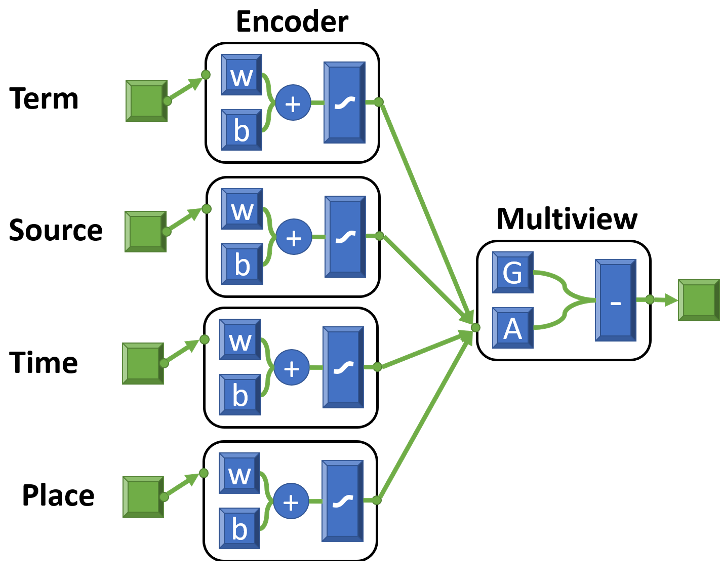
Each data view (Content, Source, Time, Location) is fed into its own Nonlinear Autoencoder. This compresses high-dimensional, sparse data (like thousands of possible Twitter sources or vocabulary terms) into a dense, nonlinear "topic" vector.
Layer 2: Shared Latent Subspace
Once we have these "topics," CADET uses a variant of Generalized Canonical Correlation Analysis (GCCA). It finds a shared mathematical space where all these views should agree for a normal user. If a user’s "Source" view suddenly points in a different direction than their "Location" view (e.g., tweeting via an API from a city they've never visited), the reconstruction error spikes.
Experiments: Proving the Metadata Advantage
The study analyzed over 5,500 accounts. The results were telling:
- The Power of "Where" and "When": Location and Timing were found to be far more predictive of a hack than the actual words in the tweet.
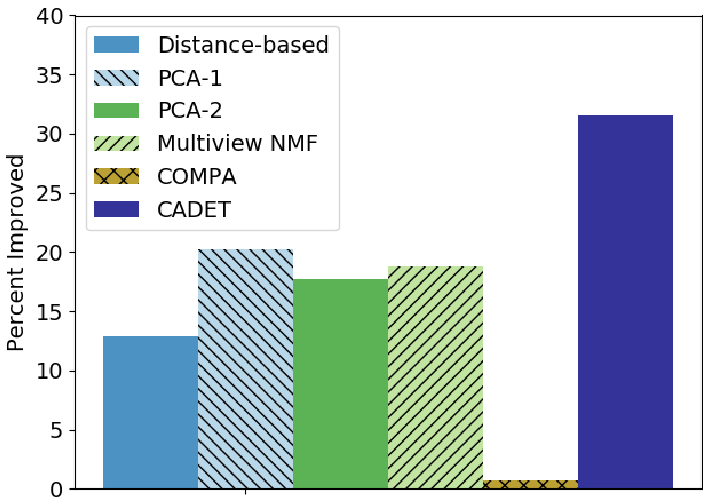
- Precision at the Top: In security, we only care about the most suspicious cases. CADET achieved its highest precision in the Top 1% of users, outperforming the industry-standard supervised model COMPA.
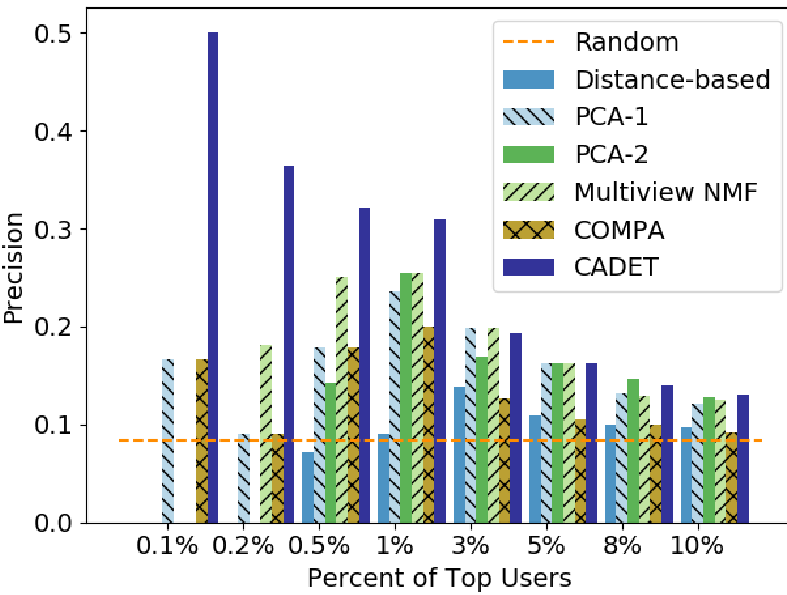
As shown in the PR-curve analysis, CADET maintains significantly higher precision at low recall levels, which is precisely what security teams need to minimize "alert fatigue."
Critical Analysis & Conclusion
CADET represents a shift from "content-centric" to "context-centric" security.
The Takeaway: You don't need labels to find hackers; you just need to understand the structural consistency of a legitimate user.
Limitations: Being unsupervised, CADET is susceptible to false positives if a user's life changes drastically (e.g., traveling to a new country and using a new phone). Future iterations could benefit from Temporal Dynamics, learning how a user’s profile evolves over years rather than days.
Future Outlook: The integration of Deep Learning with Multi-View CCA opens doors for detecting sophisticated bots and "Deepfake" social personas that are designed to bypass textual filters but fail to replicate human metadata patterns.