
CALBA: Balancing User Tolerance and Ad Relevance in Temporary Social Networks
CALBA: Capacity-Aware Location-Based Advertising in Temporary Social Networks
The paper introduces CALBA (Capacity-Aware Location-Based Advertising), a framework for selecting third-party vendor advertisements in Temporary Social Networks (TSNs) like hotels or concerts. It optimizes commercial relevance and user preference while strictly adhering to a user-defined message capacity constraint, achieving SOTA efficiency in mobile environments.
Executive Summary
TL;DR: CALBA is a sophisticated framework designed for "Temporary Social Networks" (TSNs) that intelligently filters location-based advertisements. It solves the dual challenge of maximizing ad relevance (spatial and preference-based) while respecting a user's "tolerance capacity" to prevent spam. By utilizing a Safe Region technique based on 0-1 Knapsack approximation, CALBA reduces server load and mobile battery consumption by an order of magnitude compared to standard periodic updates.
Background: In the landscape of Location-Based Services (LBS), CALBA represents a critical bridge between database optimization and user-centric marketing, moving beyond simple proximity alerts toward intelligent, context-aware content delivery.
Problem & Motivation: The Spam Crisis in Local Venues
Imagine staying at a hotel (a Temporary Social Network). If every nearby restaurant and gift shop blasts your phone with coupons, you'll likely disable the service. This creates a conflict:
- Vendors want exposure.
- Service Providers want commission.
- Users want useful info but hate clutter.
Prior works focused on the "What" (Relevance) but ignored the "How much" (Capacity). The technical difficulty arises because as a user moves, the Relative Relevance of every vendor changes, potentially requiring a complete recalculation of the "optimal" set of ads every second—a nightmare for mobile bandwidth and battery life.
Methodology: Knapsack Modeling and the Safe Region
The authors break the solution into two phases: the Snapshot and the Continuous selection.
1. The Snapshot: 0-1 Knapsack + FPTAS
CALBA treats ad selection as a 0-1 Knapsack problem.
- Profit: The relevance score (a hybrid of Foursquare category preferences and Euclidean distance).
- Weight: The frequency of ads sent by the vendor.
- Capacity: The user's maximum tolerated messages per hour.
Because the exact solution is computationally heavy (NP-Hard), they use a Fully Polynomial Approximation Scheme (FPTAS). This allows the system to trade a tiny, controlled amount of accuracy for a massive gain in speed.
2. The Continuous Solution: Safe Regions
Instead of re-calculating the knapsack at every step, CALBA defines a Safe Region.
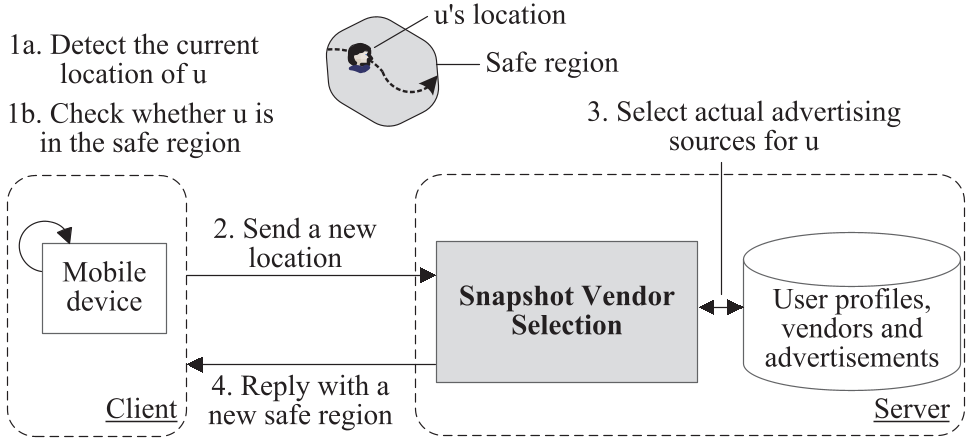
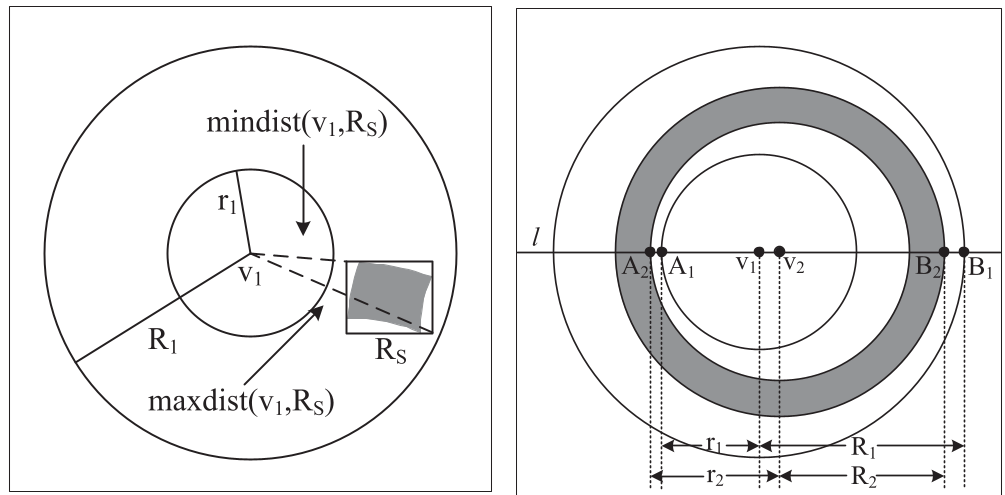
The "Insight" here is mathematical: As long as the user stays within a certain distance from a vendor, the "Profit" (Relevance) only fluctuates within the margin of error ignored by the FPTAS. By intersecting these distance ranges (Annuli) for all vendors, they create a geometric "Safe Zone." If the user is inside this zone, the ad set is guaranteed to remain optimal.
Efficiency through Pruning
Calculating the intersection of 100+ annuli on a mobile phone is still demanding. CALBA introduces three pruning rules:
- Rectangle Approximation: Using Minimum Bounding Rectangles to quickly discard irrelevant vendors.
- Complete Coverage: If one vendor's annulus completely swallows another's, the larger one can often be ignored.
- Arc-based Pruning: A complex geometric check ensuring that only "influential" vendors—those that actually shape the boundaries of the safe zone—are sent to the mobile client.
Experiments & Results
Using real-world Foursquare data and NYC road maps, the researchers proved that CALBA isn't just a theory:
- Accuracy: The relative error is a negligible ~2.4%.
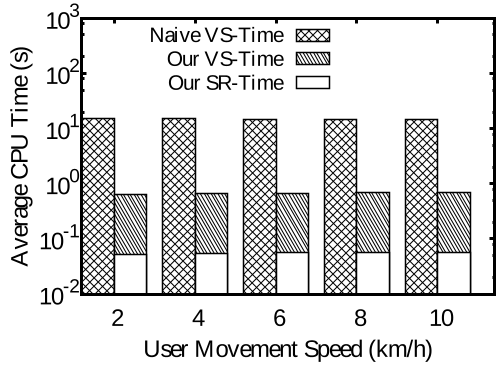
- CPU Time: While a naive approach's cost spikes as users move faster or more vendors are added, CALBA’s CPU usage remains nearly flat and significantly lower (log scale improvement).
- Communication Efficiency: Even with 100 candidate vendors, the pruning rules ensure only ~15-20 are ever sent to the user's device for local monitoring.
Critical Analysis & Conclusion
Takeaway: CALBA proves that we can deliver personalized, high-frequency location data without nuking the user's data plan or battery. The use of approximation-based "Safe Regions" is a high-yield strategy for any LBS application.
Limitations: The model assumes a static preference profile. In reality, a user's interest in a "Restaurant" category might spike at noon and die at 2 PM. Future iterations would benefit from temporal weighting in the relevance function.
Future Outlook: As we move toward 5G/6G and edge computing, frameworks like CALBA will be essential for "Smart Cities" where thousands of IoT sensors need to decide which one piece of information is most critical to a passing citizen.