
The Calendar as a Sensor: Fixing the Bridge Between Digital Schedules and Physical Reality
The calendar as a sensor: analysis and improvement using data fusion with social networks and location
The paper introduces "The Calendar as a Sensor," a framework that transforms enterprise calendars into reliable context-aware sensors by filtering "noise" (reminders/placeholders) through data fusion. By integrating Bluetooth-based location data and social network graphs, the authors achieve a 14x reduction in false event identifications compared to standalone calendar data.
TL;DR
Your digital calendar is lying to you—and to your office's presence-aware systems. This paper reveals that only 8% of enterprise calendar entries represent real-world meetings. To fix this, the authors propose a multi-sensor data fusion model that merges Bluetooth location and social networks with calendars, successfully slashing "false" meetings by up to 93%.
Contextual Tension: The "Fake" Meeting Problem
In most modern offices, the shared calendar (like Outlook) is the de facto standard for organization. However, as a "sensor" of what a person is actually doing, it is remarkably noisy. We use calendars for:
- Personal Reminders: "Pick up dry cleaning."
- Shared Placeholders: Recurring blocks for meetings that often get cancelled.
- Back-to-back blocks: Tasks used to protect deep-work time.
Current systems like Microsoft Teams or Slack often automatically set your status to "Busy" based purely on these entries. This creates availability lag, where you appear busy but are actually free, or vice versa.
Methodology: Fusing Physical and Social Signals
The researchers moved beyond the calendar by introducing a three-layered fusion model. The core intuition is that a "real" meeting requires three specific signals to align:
- Co-presence (Temporal/Spatial): Are two or more people actually in the same room? (Detected via Bluetooth scans).
- Social Tie (Social): Do these people actually know each other or work together? (Verified via Outlook contact lists).
- Planning (Mental/Organized): Is there a record of an intended meeting? (The Calendar itself).
The Two Fusion Strategies
The authors tested two distinct heuristic paths to find the most accurate "truth":
- Method 1 (Social First): Finds who is together, checks if they are friends/colleagues, and then finds a calendar entry to name the meeting.
- Method 2 (Planning First): Groups people by their calendar entries first, then uses the social network to "clean up" who actually showed up nearby.
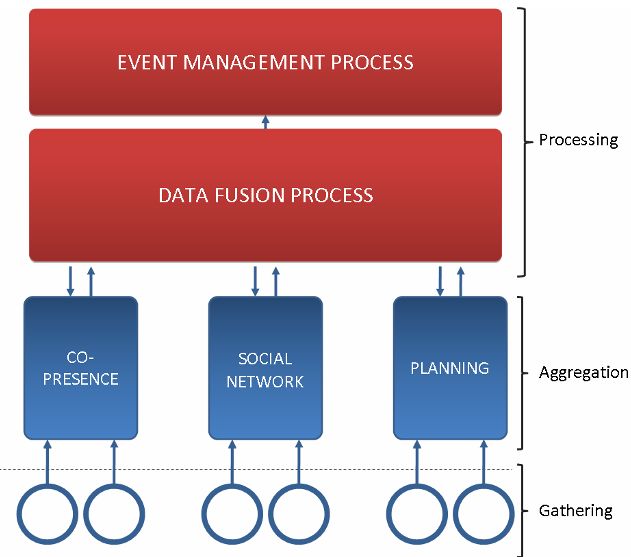 Figure 2: The layered model showing the Aggregation (Enablers) and Processing (Fusion) layers.
Experiments: Data vs. Reality
Through a 6-week field study involving 20 participants, the researchers captured 594 unique calendar events but only 38 real-world shared events.
| Category | Calendar Only (Baseline) | Data Fusion (Method 2) |
|---|---|---|
| Genuine Meetings | 38 | 32 |
| False Identifications | 204 | 14 |
| Failed Identifications | N/A | 6 |
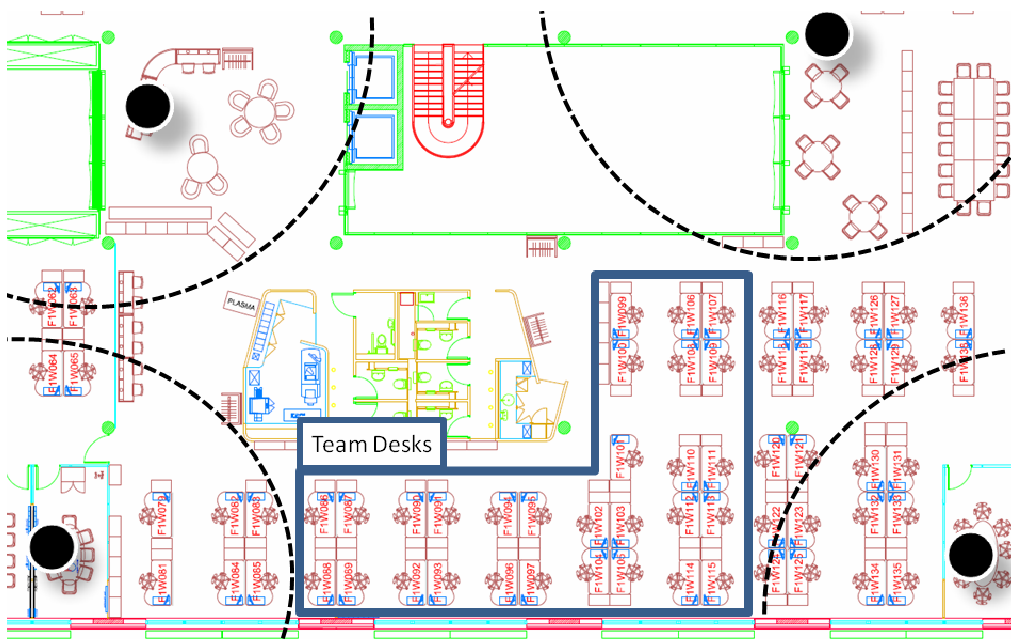 Figure 1: The office layout where Bluetooth "static devices" acted as the physical ground truth for meeting areas.
The "Passage-By" Problem
While Method 2 was highly effective at filtering out the "spam" of placeholders, it struggled with Participant Mobility. If a colleague walked past a meeting room to get coffee and had a social tie to the people inside, the system would occasionally "kidnap" them into the meeting digitally!
Critical Insight: Why Fusion Wins
The value of this paper lies in its proof that Location + Social acts as a powerful filter for Intent.
- Time Improvement: Fused data more accurately reflected when meetings actually started (often later than the calendar suggested).
- Semantic Meaning: By fusing the calendar back in, the system doesn't just know "User A and B are together"; it knows "User A and B are having the Project Sync."
Conclusion and Future Outlook
This 2010 study laid the groundwork for modern "Smart Office" infrastructures. The takeaway remains evergreen: The more we use calendars as personal scratchpads, the less useful they become as organizational sensors.
Future systems will likely solve the "passage-by" problem using Ultra-Wideband (UWB) for centimeter-level accuracy, but the logic of fusing Social Graphs with Physical Sensors remains the "Gold Standard" for accurate context awareness.
Limitations to Consider:
- Battery & Privacy: Continuous Bluetooth scanning can be a drain, and accessing contact lists/locations raises significant privacy concerns.
- Ad-hoc Meetings: The system currently discards "water-cooler chats" because they lack a calendar ID, leaving a gap in capturing informal collaboration.