
Birds of a Feather Shoot Together: Brand Congruence in the Flickr Social Graph
Camera brand congruence in the Flickr social graph
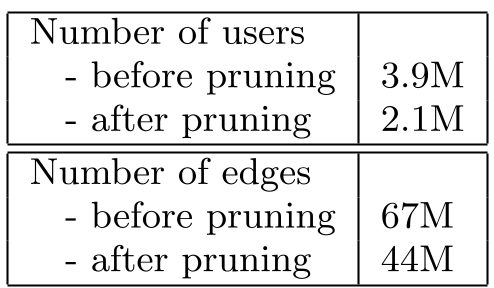
This paper explores "brand congruence"—the phenomenon where social connections influence consumer choices—within the Flickr social graph. By analyzing 67 million edges and 3.9 million users, the authors use Exif metadata from images to correlate camera brand ownership with social ties.
TL;DR
Does your choice of camera depend on what your friends use? This study analyzes millions of Flickr users to prove that social ties are powerful predictors of brand choice. Specifically, the "tighter" your social circle (cliqueness), the more likely you are to mirror your friends' gear. While geography plays a role, social influence—especially among professional DSLR users—is the dominant force in brand loyalty and adoption.
Background Positioning
In the landscape of social network analysis (SNA), this work serves as a pivotal bridge between theoretical graph properties and real-world consumer behavior. Published at WSDM'09, it moves beyond simple "link prediction" to explore how offline purchase decisions (camera brands) correlate with online social structures.
Problem & Motivation: Beyond the Survey
Traditional marketing research relied on surveys of a few hundred people to understand "peer pressure." However, these studies lacked the scale to account for:
- Geographical Bias: Do friends use the same brand because they live near the same shops?
- User Expertise: Does a professional (DSLR) photographer care more about their friends' opinions than a casual (Point-and-Shoot) user?
- Network Topology: Does the structure of a friendship (e.g., being part of a tight-knit clique) change the influence?
The authors leveraged Flickr's unique ecosystem, where every uploaded photo acts as a data point for the specific hardware used, allowing for a "planetary-scale" observation of brand preference.
Methodology: Mapping Metadata to the Graph
The researchers combined two massive datasets:
- The Social Graph: 3.9 million users and 67 million friendship edges.
- Exif Metadata: Information extracted from 500 million images to identify the specific camera manufacturer (e.g., Canon, Nikon, Sony).
The "Cliqueness" Metric
A key contribution is the use of the Jaccard coefficient to measure Cliqueness (FJ). If User A and User B share almost all the same friends, their cliqueness is high (~1.0). The study hypothesizes that high cliqueness creates a "peer pressure" environment that drives brand uniformity.
Experiments & Results: The Power of the Clique
The findings confirm that friendship is a massive driver of congruence, but the effects vary wildly by user type.
1. The Pro vs. Amateur Divide
The study discovered a fascinating dichotomy between DSLR (Digital Single-Lens Reflex) and P&S (Point-and-Shoot) users:
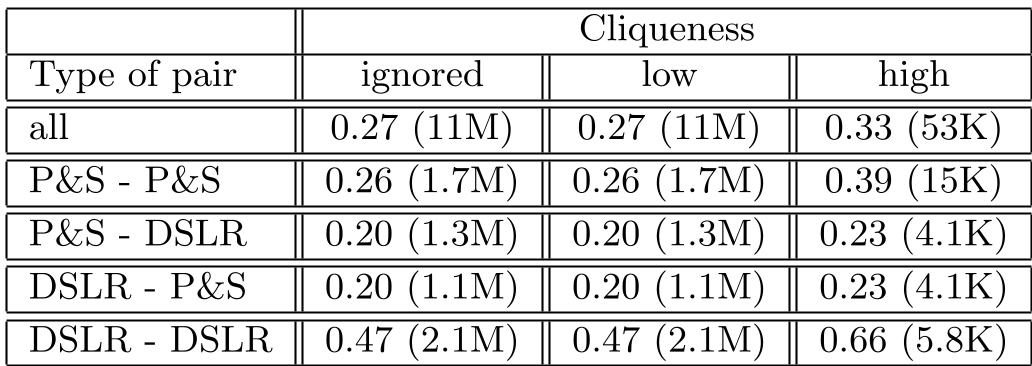
- DSLR Users: High brand loyalty (60%) and high congruence (47% baseline). They are influenced by their peers and stick to their "ecosystem."
- P&S Users: Low loyalty (33%). Their brand choice is often driven by whoever is in the same country (geography) rather than social ties.
2. The Impact of Cliqueness
As cliqueness increases, brand congruence skyrockets. For DSLR users in a tight friendship circle, the probability of using the same brand reaches a staggering 66%.
3. Dynamics of Change
When a user buys a new camera, are their friends likely to follow suit? The data says yes. Friends in high-cliqueness groups were nearly 10% more likely to change their camera model in the same timeframe compared to random users, often switching to the same brand.
Critical Analysis & Conclusion
Takeaway
Social networks are not just for communication; they are massive engines for brand contagion. For high-end, "expert" products, the social graph is the single most important factor for targeting marketing efforts. A brand that captures a "clique" of experts essentially secures a self-reinforcing fortress of loyalty.
Limitations
- Temporal Lag: The friendship graph represents a snapshot in 2008, while some brand data goes back to 2006. We cannot be 100% sure the friendship existed before the purchase.
- Hidden Variables: Does "influence" cause the congruence, or do people with the same cameras simply seek each other out (homophily)? The paper suggests influence but cannot entirely rule out selective association.
Future Outlook
This methodology paves the way for "Viral Marketing" strategies. By identifying high-clique "expert" nodes, brands can trigger cascading purchases across entire social clusters.