
CampusTracker: Decoding the "When" and "Where" of Mobile Micro-Labor
CampusTracker:assessing mobile workers' momentary willingness to work on paid crowdsourcing tasks
CampusTracker is a mobile crowdsourcing framework that evaluates workers' momentary willingness to perform paid tasks based on their situational context. Using the Experience Sampling Method (ESM), the study reveals how location, time of day, and task complexity (e.g., polls vs. transcription) significantly influence worker receptivity and task preference.
TL;DR
Mobile crowdsourcing often assumes workers are ready to work whenever they are "active," but reality is more complex. CampusTracker is a research framework that probes the situational willingness of mobile workers. The study finds that context—where you are and what you are doing—dictates not just if you will work, but what kind of tasks you are willing to tackle.
The Problem: The "Always-On" Fallacy
In the world of online crowdsourcing (like Amazon Mechanical Turk), workers self-select their hours. In mobile crowdsourcing, tasks are often pushed to users. However, prior work has largely ignored the "cognitive availability" of these users. Sending a transcription task to someone running for a bus is a recipe for failure. The core challenge is: how do we match the right task to the right moment?
Methodology: Probing the Moment
The researchers built CampusTracker, a cross-platform app designed to capture the "Ecological Momentary Assessment" (EMA) of workers. The system functions as a notification gateway:
- Randomized Probing: Notifications are sent at 60-90 minute intervals.
- Context Capture: Upon clicking "Yes," the app records the user’s GPS and probes them on task duration, type preference, and social context.
- Task Priming: Users were asked to imagine a fair hourly wage, ensuring their responses reflected professional intent rather than just casual volunteerism.
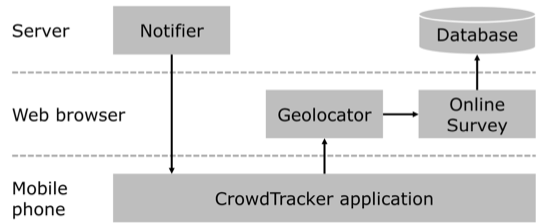 Figure 1: The CampusTracker architecture showing the flow from notification to data collection.
Key Insights: Complexity Matters
The results highlight a sharp divide between "low-effort" and "high-effort" tasks:
- Polls are King: Simple voting and radio-button tasks were acceptable in almost any context.
- The Transcription Barrier: Tasks requiring audio transcription or copywriting were heavily rejected, regardless of the worker's location.
- Input Friction: Preferred input methods like radio buttons and checkboxes dominated. Users were highly reluctant to use cameras or write long text while on the go.
 Figure 2: Analysis of willingness to work on longer tasks vs. the hour of the day.
Spatial Dynamics and Social Context
The study mapped willingness across a university campus. Interestingly:
- Offices and Labs: High willingness to work, but very low willingness to involve peers (social context).
- Cafeterias/Shared Spaces: Higher potential for "collaborative crowdsourcing" or tasks requiring peer input.
- The "Toilet" Rule: Participants explicitly noted that certain contexts (like privacy-sensitive areas) make specific data entry methods (like camera usage) prohibitive.
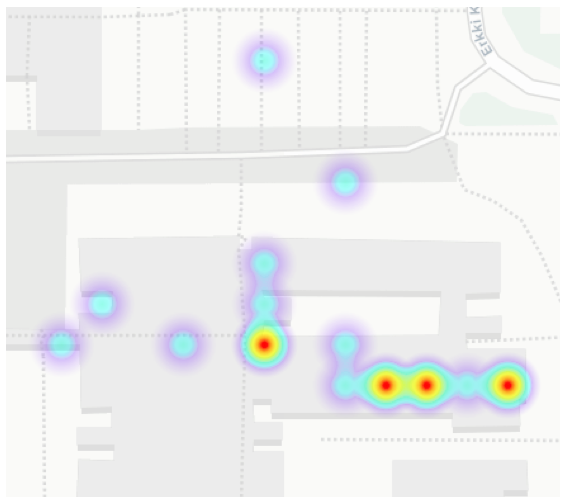 Figure 3: Heatmap of campus locations where users were most receptive to work.
Conclusion and Future Outlook
CampusTracker proves that a "one-size-fits-all" notification strategy is inefficient. The takeaway for the industry is clear: Context is the new currency.
Future Work: The authors suggest moving toward µEMA (Micro-EMA), where tasks are embedded directly within the notification itself to minimize friction. By building rich user profiles that learn when a person is "idle" (e.g., waiting for a bus vs. focused at a desk), mobile crowdsourcing can achieve SOTA efficiency without burning out the workforce.
Limitations
The study was small-scale (5 participants), meaning results are qualitative rather than statistically universal. However, it serves as a vital proof-of-concept for context-aware labor allocation.